Facts
The appellant claimed that on 28 August 2017 he was travelling from Mathura to New Delhi on a valid journey ticket. While travelling in a crowded general compartment, he allegedly fell from the moving train near Okhla Bridge after returning from the toilet and being unable to pass through the gallery. He sustained crush injuries resulting in the amputation of both legs.
Source reference: p.2, para. 3The Railway Claims Tribunal dismissed his claim, relying on discrepancies concerning the time of boarding, the absence of details of the train, the nature of the injuries, and a subsequent AIIMS medical notation recording “RTA”.
Source reference: p.2, para. 4; p.3, para. 9The appellant challenged that decision under Section 23 of the Railway Claims Tribunal Act, 1987.
Source reference: p.1, para. 1The High Court noted that the journey ticket bearing No. 10378787 had been produced and verified by the Railway authorities, while the respondent did not appear at the hearing or lead contrary evidence.
Source reference: p.3, paras. 5–7Issues
1. Whether the appellant established that he was a bona fide passenger for the relevant journey, despite the discrepancy concerning the precise time of boarding.
Source reference: p.3, para. 72. Whether the appellant’s injuries resulted from an “untoward incident” under Section 123(c)(2) of the Railways Act, 1989, so as to attract compensation under Section 124-A.
Source reference: p.3, para. 8; p.4, paras. 9–113. Whether the Tribunal was justified in rejecting the claim on the basis of the nature of the injuries, the absence of injuries to other parts of the body, the medical notation “RTA”, and the inability to identify the exact train or sequence of events.
Source reference: p.4, paras. 9–12Law Applied
The Court exercised appellate jurisdiction under Section 23 of the Railway Claims Tribunal Act, 1987.
Source reference: p.1, para. 1Under Sections 123(c)(2) and 124-A of the Railways Act, 1989, an accidental fall from a passenger train constitutes an “untoward incident” attracting the Railways’ statutory and strict liability, subject to the exceptions in the proviso to Section 124-A.
Source reference: p.3, para. 8; p.4, para. 11Relying on Union of India v. Rina Devi, (2019) 3 SCC 572, and Lata v. Union of India, 2026 SCC OnLine SC 1350, the Court held that the claimant discharges the initial burden by establishing foundational facts and attending circumstances; thereafter, the burden shifts to the Railways.
Source reference: p.3, para. 7The compensation provisions are beneficial in nature and must receive a liberal, purposive and pragmatic interpretation.
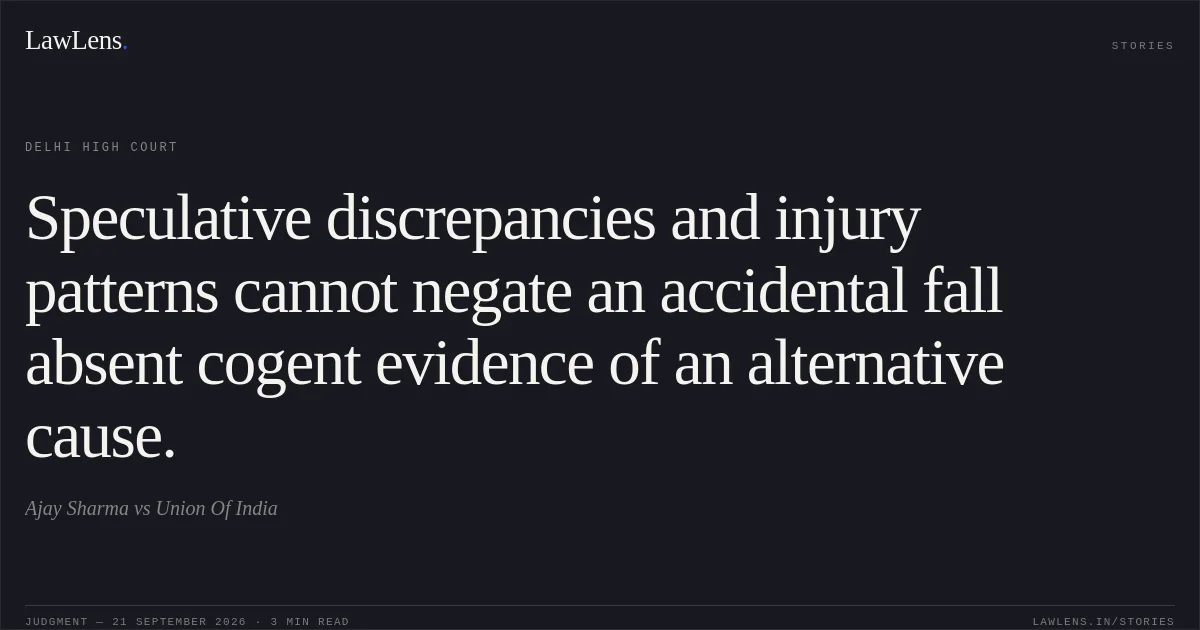
Source reference: no citationThe Court also relied on Basant Kumar Singh & Anr. v. Union of India, 2026 SCC OnLine Del 666, for the principle that hyper-technical or speculative inferences based on the location of the body, the nature of injuries, or the precise mechanics of a fall cannot defeat a claim absent cogent evidence of an alternative cause.
Source reference: p.4, para. 11; p.4–5, para. 12Reasoning
The verified journey ticket established the appellant’s bona fide passenger status, and the discrepancy regarding the exact boarding time was insufficient, by itself, to displace that conclusion.
Source reference: p.3, para. 7The contemporaneous DD entries and the first medical record at Apollo Hospital supported the appellant’s account of having fallen from a train near Okhla Railway Station.
Source reference: p.3, para. 5The later AIIMS notation of “RTA”, particularly when read against the earlier medical and railway records, did not affirmatively establish that the injuries resulted from a road accident or any other cause.
Source reference: p.4, para. 10Similarly, the nature and distribution of the injuries could create doubt but could not conclusively establish an alternative manner of occurrence.
Source reference: no citationThe Tribunal improperly required the appellant to prove the precise sequence and mechanics of the fall, despite the absence of contrary evidence from the Railways and the beneficial, strict-liability framework of Section 124-A.
Source reference: p.4, paras. 10–12The discrepancies relied upon by the Tribunal therefore did not constitute cogent evidence sufficient to displace the contemporaneous material supporting an accidental fall from the train.
Source reference: p.5, para. 13Holding
The High Court held that the appellant was a bona fide passenger and that the material on record supported his case that his injuries arose from an accidental fall from a moving train, constituting an “untoward incident” under Section 123(c)(2) of the Railways Act, 1989.
The Tribunal’s judgment dated 5 February 2020 was set aside.
Source reference: p.5, para. 14The matter was remanded to the Tribunal to assess the compensation payable in accordance with law and to direct disbursement by the concerned authorities within two months of receiving the order.
Source reference: p.5, para. 14The matter was directed to be listed before the Tribunal on 15 October 2026.
Source reference: p.5, para. 14The appeal was accordingly allowed and disposed of.
Source reference: p.6, para. 15Acts & Sections Cited
2 provisions across 2 statutes referred to in this judgment. Each provision opens on LawLens.
Railway Claims Tribunal Act, 19871
Railways Act, 19891
Original Court PDF
Ajay SharmavsUnion Of India
Click to open original judgment
Original judgment, available to read, download and summarize on LawLens.in