Facts
The Petitioner paid stamp duty of ₹29,75,000 on an Agreement for Assignment dated 19 April 2018, registered as Document No. 5929/2018, concerning property rights in an MIDC plot and factory
Source reference: para. 4, 6The transaction was not completed; the parties executed and registered a Cancellation Deed on 18 October 2018.
Source reference: para. 2–3, 6, 16The Petitioner later acquired the same property through a Bank auction under a separate Sale Deed and paid stamp duty on that deed as well.
Source reference: para. 2–3, 6, 16The Petitioner applied for refund within six months of the first instrument.
Source reference: para. 7, 9–10The application was rejected on the ground that the document fell under Article 60, rather than Article 25, of Schedule I to the Maharashtra Stamp Act.
Source reference: para. 7, 9–10The Petitioner challenged that rejection by writ petition.
Source reference: para. 1Issues
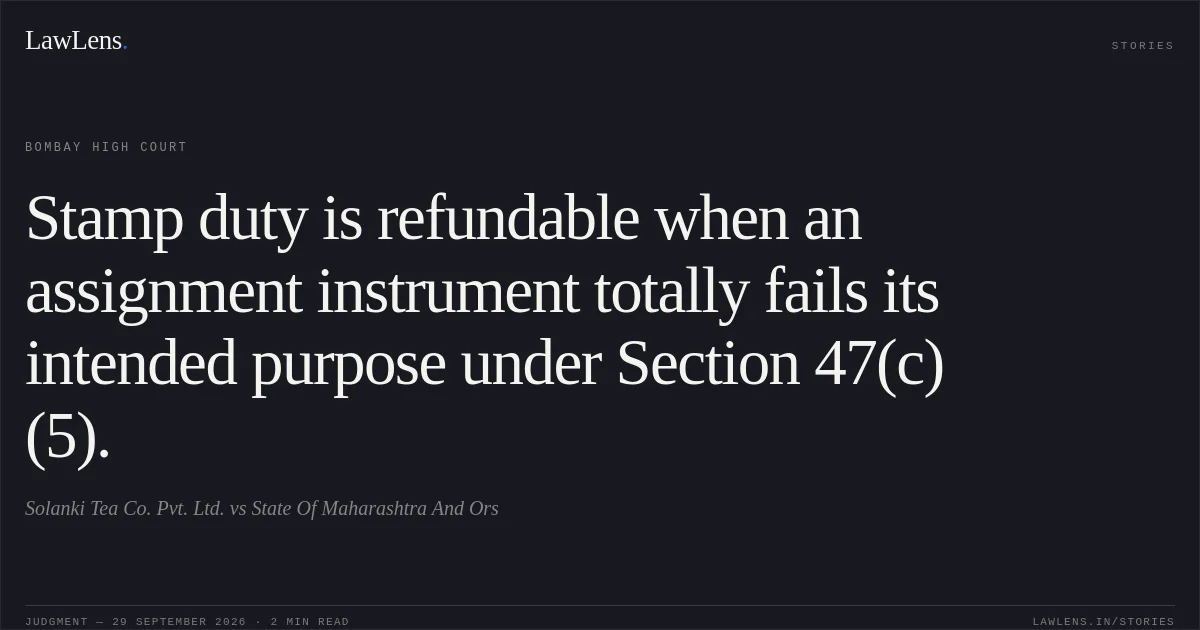
Whether stamp duty paid on an Agreement for Assignment falling under Article 60 could be refunded under Sections 47(c)(5) and 48(1) of the Maharashtra Stamp Act when the instrument’s intended purpose had totally failed
Source reference: para. 10–13, 18–21Whether the Petitioner’s refund application was made within the limitation period prescribed by Section 48(1)
Source reference: para. 20Law Applied
Section 47(c)(5) of the Maharashtra Stamp Act permits relief where an instrument, because of a specified event, “totally fails of the intended purpose”; the inquiry concerns the instrument’s utility for the purpose for which it was executed, not merely its label or the Schedule I article under which it was stamped.
Source reference: para. 11–15Section 48(1) prescribes the period for applications seeking relief under Section 47; the Court held that the applicable period in this case was one year, and distinguished the special proviso concerning registered agreements to sell stamped under Article 25.
Source reference: para. 19–21Relying on Sanman Trade Impex v. State of Maharashtra, AIR 2005 Bom 94, the Court applied the principle that Section 47(c)(5) may cover different kinds of instruments where the intended transaction has become ineffective, subject to the statutory requirements and the absence of a false or fraudulent refund claim.
Source reference: para. 14–18, 25–26Reasoning
The Court accepted that the Agreement for Assignment was governed by Article 60 and could not be reclassified as an Article 25 agreement merely because the stamp duty rates were equivalent; however, that did not exclude relief under the separate test in Section 47(c)(5).
Source reference: para. 13, 21The Petitioner did not acquire the property under the first instrument: it was cancelled by registered deed, and the same property was subsequently acquired through the Bank’s auction under a separate Sale Deed.
Source reference: para. 16, 23–24, 29This sequence showed that the first instrument had totally failed to achieve its intended purpose.
Source reference: para. 16, 23–24, 29The application, made within one year of the instrument, was timely, and the amount claimed did not create a statutory bar to refund.
Source reference: para. 20, 22, 28The Court therefore found the rejection unsustainable insofar as it rested solely on the document’s classification under Article 60.
Source reference: para. 30–31Holding
The Court held that the Petitioner qualified for relief under Section 47(c)(5), read with Section 48(1), of the Maharashtra Stamp Act.
It allowed the writ petition, quashed the rejection order dated 11 September 2019, and directed the Respondents to refund ₹29,75,000, subject to any lawful deduction, within six weeks of uploading the judgment.
Source reference: para. 33Acts & Sections Cited
2 provisions across 1 statute referred to in this judgment. Each provision opens on LawLens.
Maharashtra Stamp Act2
Original Court PDF
Solanki Tea Co. Pvt. Ltd.vsState Of Maharashtra And Ors
Click to open original judgment
Original judgment, available to read, download and summarize on LawLens.in