Facts
The petitioner allotted 188,450 shares on 30 March 2007 and 197,000 shares on 5 March 2008, each at an issue price of ₹100 per share
Source reference: p.1, para. 2In June 2016, it applied under Section 31 of the Indian Stamp Act, 1899, for determination of the stamp duty payable
Source reference: p.2, para. 3On 10 January 2017, the stamping authority directed payment of stamp duty totalling ₹38,545 and imposed penalties of ₹1,00,000 for each allotment.
Source reference: p.2, para. 3The appellate authority upheld the penalties, and the petitioner challenged that decision, submitting that there had been no mala fide evasion and that it would accept a penalty of up to twice the stamp duty.
Source reference: pp. 2–3, paras. 4–7Issues
Whether the penalty imposed for delayed payment of stamp duty was a reasonable and judicious exercise of discretion under Section 40(1)(b) of the Indian Stamp Act, 1899
Source reference: p.3, paras. 8–10Whether, in the circumstances, the penalty should be reduced to twice the amount of the requisite stamp duty
Source reference: p.3, paras. 7, 9–10Law Applied
Section 40(1)(b) of the Indian Stamp Act, 1899 permits the Collector to impose a penalty of up to ten times the proper duty, but that discretion must be exercised judiciously and reasonably, without arbitrariness or oppression
Source reference: p.3, para. 9A penalty is intended to deter, not to punish retributively, and its amount should be proportionate to the nature and gravity of the default; fraud, deceit, or intentional deprivation of State revenue may be relevant aggravating circumstances
Source reference: p.3, para. 9The Court relied on Trustees of H.C. Dhanda Trust v. State of Madhya Pradesh & Ors., Civil Appeal Nos. 3195–3196 of 2020, for the deterrent purpose of a penalty
Source reference: p.3, para. 9Reasoning
Although the petitioner’s applications were belated, it had itself approached the authority under Section 31 to determine the duty payable.
Source reference: p.4, para. 10No notice had been issued by the stamping authority before those applications, and the record did not disclose an intention to deceive or evade payment
Source reference: p.4, para. 10In the absence of mala fides or other aggravating circumstances, the Court found that the penalty should reflect a proportionate exercise of statutory discretion, consistent with the petitioner’s limited request for a penalty of up to twice the duty
Source reference: pp. 3–4, paras. 9–11Holding
The Court modified the impugned order and directed the petitioner to pay ₹38,545 in stamp duty and ₹77,090 as penalty—twice the duty—within four weeks
The petition was disposed of on those terms, and the pending applications were also disposed of
Source reference: p.4, para. 12Acts & Sections Cited
2 provisions across 1 statute referred to in this judgment. Each provision opens on LawLens.
Indian Stamp Act, 18992
Original Court PDF
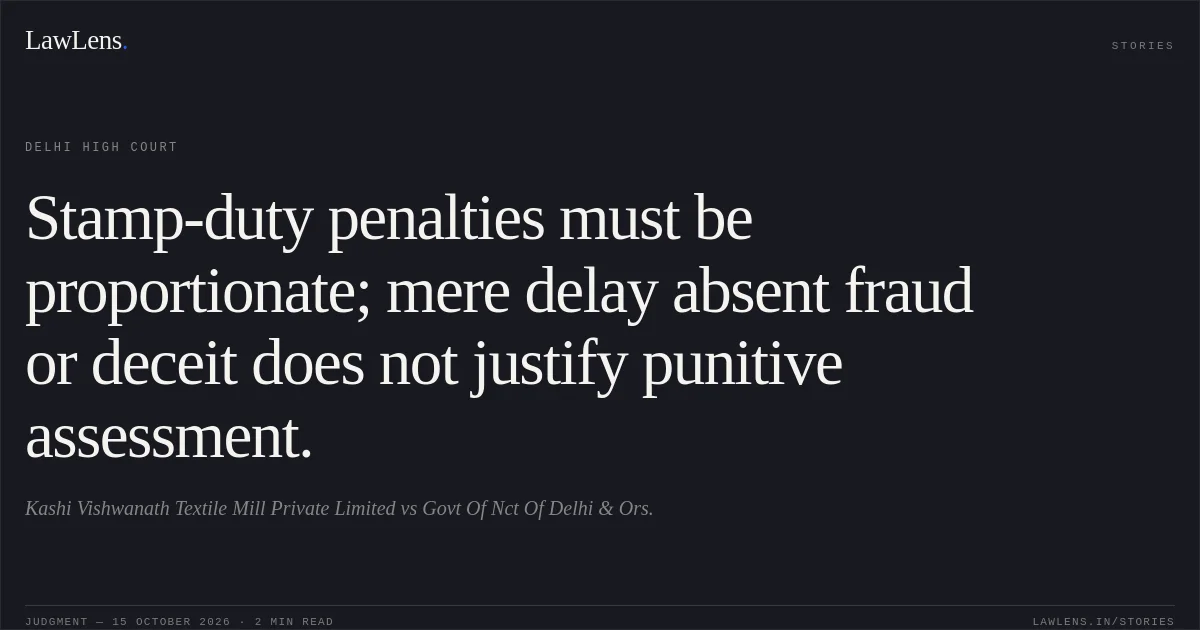
Kashi Vishwanath Textile Mill Private LimitedvsGovt Of Nct Of Delhi & Ors.
Click to open original judgment
Original judgment, available to read, download and summarize on LawLens.in