Facts
The Petitioners, serving as Constables/Head Constables in the CISF, appeared for a Limited Departmental Competitive Examination on March 29, 2023, for recruitment to the post of Assistant Sub Inspector (Executive)
Source reference: p. 1-2The Petitioners failed to qualify for further recruitment rounds and subsequently challenged the results, alleging that five questions in the ‘General Intelligence & Reasoning’ section were contradictory or incorrect
Source reference: p. 2-3They sought a re-evaluation and the awarding of full marks for the impugned questions
Source reference: p. 1During the proceedings, the Respondents clarified the logic of the questions, asserting they were "craftily framed" rather than erroneous, supported by an explanation from an outsourced agency
Source reference: p. 3-4Issues
1. Whether the disputed questions in the competitive examination were patently wrong or contradictory, necessitating judicial interference and re-evaluation of marks
Source reference: p. 1, 42. Whether the court should substitute its own interpretation for that of subject matter experts in the context of competitive examination answer keys
Source reference: p. 4-5Law Applied
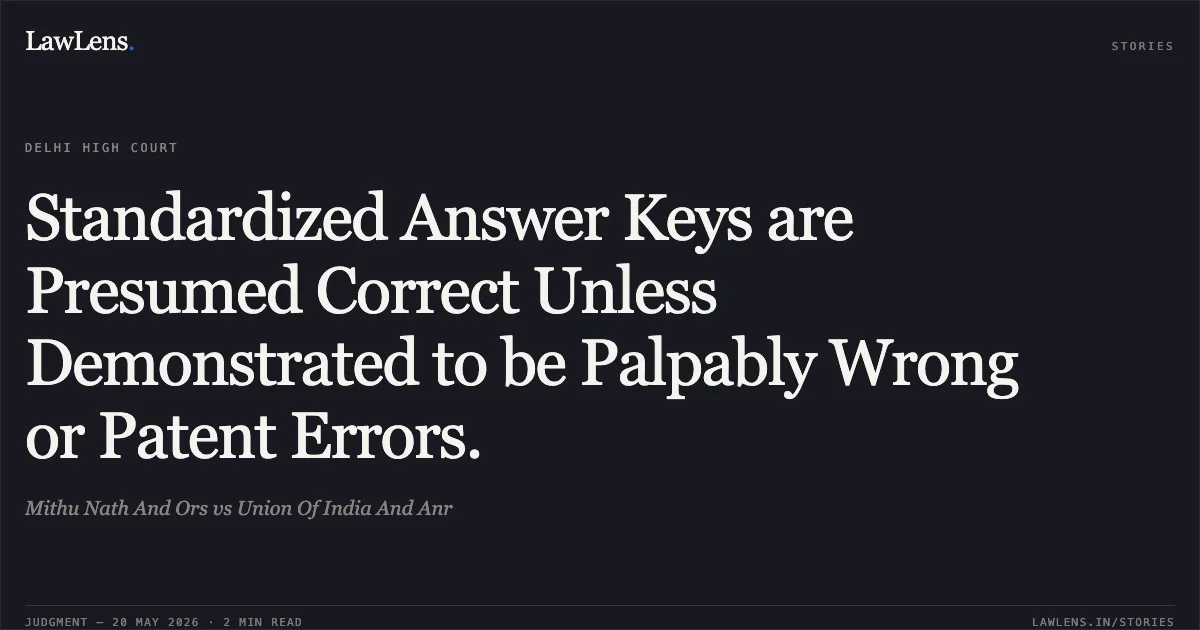
The court primarily applied the principle of judicial restraint regarding academic and competitive examinations as established in Kanpur University v. Samir Gupta (1983) 4 SCC 309, which dictates that an answer key is presumed correct unless demonstrated to be palpably or patently wrong on its face
Source reference: p. 4The court further observed that the framing of questions and assessment of logic are matters within the specialized domain of experts, and mere candidate confusion does not warrant judicial interference
Source reference: p. 5Reasoning
The court initially noted that the conditions in the reasoning questions appeared contradictory on a "first blush"
Source reference: p. 4However, upon a closer review of the logic provided by the Respondents, the court found that the questions were designed to test relative positioning (i.e., the direction of 'left' was relative to the person sitting in the scenario rather than the examinee)
Source reference: p. 4The court reasoned that the Respondents' proposed sequence was the only plausible logic that satisfied all conditions, meaning the answer key was not "patently wrong"
Source reference: p. 4The Bench emphasized that because the answer key was applied universally and the interpretation of the scenario was a matter for expert determination, the court should not intervene simply because some candidates found the narration confusing
Source reference: p. 5Holding
The court answered the issues in the negative and dismissed the petition
It held that the Petitioners failed to establish any "palpable error" in the questions or the answer key
Source reference: p. 5The court affirmed that the opinion of experts prevails in such matters and refused to order a re-evaluation or grant consequential reliefs. All pending applications were disposed of accordingly
Source reference: p. 5Original Court PDF
Mithu Nath And OrsvsUnion Of India And Anr
Click to open original judgment
Original judgment, available to read, download and summarize on LawLens.in