Facts
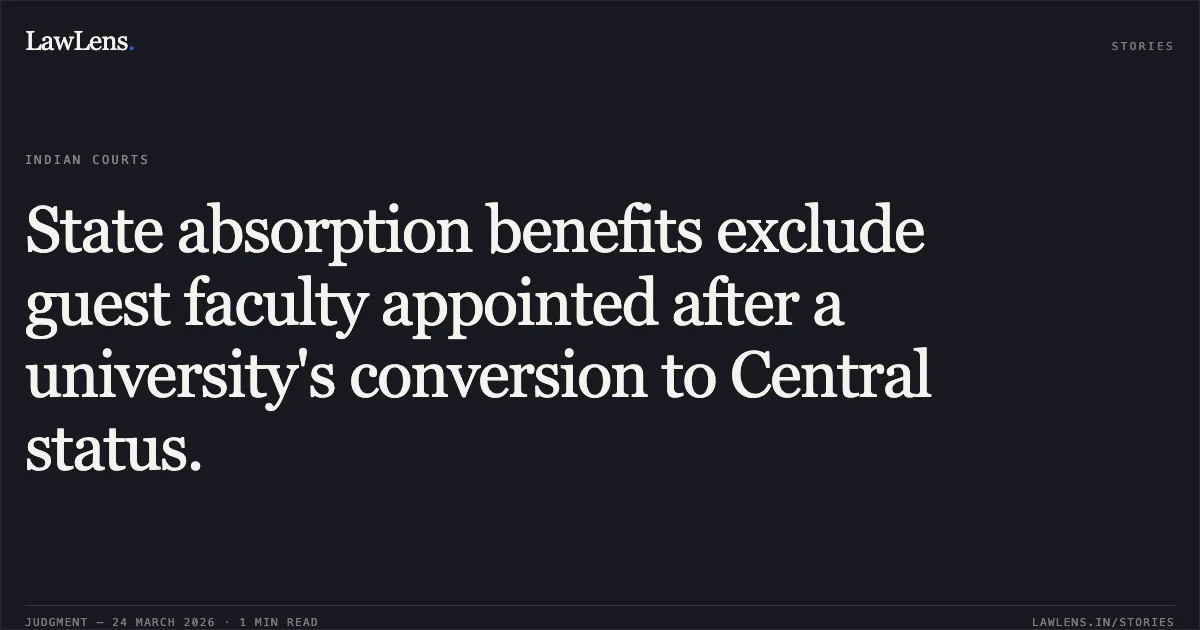
H.N.B. Garhwal University, originally established under the U.P. State Universities Act, 1973, was converted into a Central University on 15.01.2009
Source reference: para. 2Following this conversion, the State Government formulated a policy to adjust guest faculty members who had been serving in the erstwhile State University into other Government Degree Colleges or the Hill Campus of Sri Dev Suman Uttarakhand University
Source reference: para. 2The petitioners, serving as guest faculty at H.N.B. Garhwal Central University, sought inclusion in the adjustment list attached to the Government Order dated 01.06.2022
Source reference: para. 1, 3Their representations were rejected by the Director, Higher Education, on 31.08.2022, on the grounds that they were appointed after the university achieved Central status
Source reference: para. 1, 5The petitioners challenged these rejection orders, asserting they were appointed prior to 15.01.2009, and alleging that the State had adopted a "pick and choose" policy by absorbing other similarly situated post-conversion appointees
Source reference: para. 7, 9Issues
1. Whether the petitioners are entitled to adjustment in State-run colleges under the State Government’s policy for guest faculty of the erstwhile H.N.B. Garhwal State University
Source reference: para. 5, 72. Whether the determination of the petitioners' appointment dates constitutes a question of fact that can be adjudicated within the extraordinary writ jurisdiction of the High Court
Source reference: para. 83. Whether the State Government is liable to adjust employees appointed by a Central University into State Government services
Source reference: para. 7Law Applied
The court applied the principle that the State Government's liability to absorb or adjust temporary staff is limited to those who were employees of the State University prior to its conversion to a Central University
Source reference: para. 6, 7It held that individuals appointed after the conversion (15.01.2009) are employees of a Central University, and their employment liability cannot be fastened upon the State Government
Source reference: para. 7Furthermore, the court reiterated the procedural rule that "pure questions of fact"—specifically regarding dates of appointment—cannot be appropriately decided in a writ petition under Article 226 in the absence of substantiating evidence on record
Source reference: para. 8, 14Reasoning
The Court observed that the eligibility for adjustment under the State’s policy was strictly contingent upon the guest faculty being appointed before the 15.01.2009 cutoff
Source reference: para. 6, 11The Director of Higher Education found that the petitioners were appointed post-conversion, making them Central University employees
Source reference: para. 5, 14While the petitioners contended they were appointed earlier, the Court found "no evidence on record" to substantiate this claim
Source reference: para. 7, 14Regarding the petitioners' argument of discrimination (Article 14), they cited instances like Dr. Rakesh Singh and Mr. Hemendra Mohan Bhatt, alleging they were absorbed despite post-conversion appointments
Source reference: para. 9, 12However, the State Counsel disputed this, providing records that those individuals were appointed as part-time teachers before the conversion
Source reference: para. 10The Court declined to adjudicate on the eligibility of third parties not present before the Court, noting the lack of material to test the veracity of such contentions
Source reference: para. 13, 15Holding
The Court held that in the absence of material evidence proving appointment prior to 15.01.2009, it could not conclude that the petitioners were entitled to absorption in State-run colleges
The Court disposed of the writ petitions but granted the petitioners liberty to file fresh representations before the Director, Higher Education, specifically to challenge the inclusion of allegedly ineligible persons in the absorption list
Source reference: para. 16If such representations are made within two weeks, the Director must decide the matter in accordance with the law, after hearing concerned parties, within three months
Source reference: para. 16, 17Original Court PDF
LALITAvsSTATE OF UTTARAKHAND
Click to open original judgment
Original judgment, available to read, download and summarize on LawLens.in