Facts
The petitioner’s wife, Monimala Debbarma, aged approximately 72 years, was attacked and killed by a wild elephant inside the petitioner’s residence at Mungiakami, Khowai District, on 3 April 2026 at about 2:30 a.m.
Source reference: p.2, para. 3Following the incident, the Forest Department paid ₹1 lakh and the Sub-Divisional Magistrate disbursed ₹4 lakh from the SDRF Fund, totalling ₹5 lakh.
Source reference: p.2, para. 3The petitioner sought ₹10 lakh as compensation, a pucca house, employment for a family member, a shop, and relocation of elephants from the area.
Source reference: p.2, para. 2He also submitted representations to the authorities on 4 May 2026, alleging that his grievances had not been addressed.
Source reference: p.3, para. 3The State contended that ₹5 lakh had already been paid and that the remaining ₹5 lakh would be disbursed subject to availability of funds; it also stated that action had been initiated on the petitioner’s representation.
Source reference: p.4, para. 5Issues
Whether the petitioner was entitled to payment of the remaining ₹5 lakh claimed as compensation for the death caused by a wild-elephant attack.
Source reference: p.3, para. 4; p.4, para. 5Whether the respondents’ failure to dispose of the petitioner’s representation warranted a direction from the High Court.
Source reference: p.4, para. 6Whether the petitioner was entitled to the additional reliefs of a pucca house, compassionate employment, a shop, and relocation of elephants.
Source reference: p.2, para. 2Law Applied
The Court relied on the principles of justice, equity and good conscience in exercising its writ jurisdiction.
Source reference: p.4, para. 6It also considered the compensation guideline relied upon by the petitioner, stated to arise from the Supreme Court proceedings in In Re: Corbett, T.N. Godavarman Thirumulpad v. Union of India & Ors., W.P. (C) No. 202 of 1995, under which ₹10 lakh was claimed for death caused by a wild-animal attack.
Source reference: p.3, para. 4The Court did not finally adjudicate the legal applicability or enforceability of that guideline; instead, it acted upon the State’s position that the authorities had decided to pay ₹10 lakh and had already disbursed ₹5 lakh.
Source reference: p.4, para. 6Reasoning
The Court found that the petitioner had approached the authorities through representations and notices, but that the grievances had not been formally disposed of, causing prejudice to him.
Source reference: p.4, para. 6Although the petitioner relied on the Supreme Court guideline to claim ₹10 lakh, the Court expressly refrained from entering into the merits of that claim.
Source reference: p.4, para. 6It relied instead on the State’s admission that the total compensation payable had been fixed at ₹10 lakh, of which ₹5 lakh had already been paid and ₹5 lakh remained due.
Source reference: p.4, para. 6Consequently, the Court issued a time-bound direction for payment of the balance amount.
Source reference: p.4, para. 6Holding
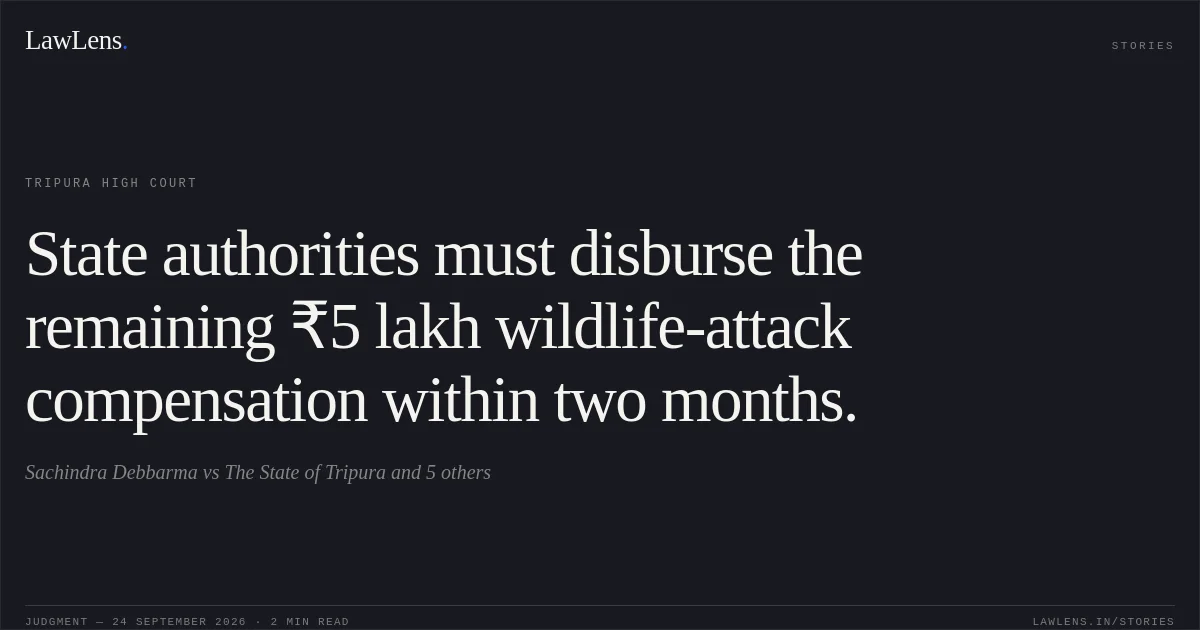
The Court directed the respondents to pay the remaining ₹5 lakh to the petitioner within two months from the date of receipt of a copy of the order.
The writ petition was accordingly disposed of, and all pending applications, if any, were also disposed of.
Source reference: p.4, para. 7The Court did not grant or expressly adjudicate the petitioner’s additional claims for a pucca house, compassionate employment, a shop, or relocation of elephants.
Source reference: p.4, para. 6Original Court PDF
Sachindra DebbarmavsThe State of Tripura and 5 others
Click to open original judgment
Original judgment, available to read, download and summarize on LawLens.in