Facts
The respondent, Premnarayan Sharma, was regularized as a 'Khalasi' in 1996. After a protracted legal battle (W.P. No. 24537/2003 and W.A. No. 558/2012), the High Court directed his reinstatement with consequential benefits.
Source reference: F.2Despite these orders, the State issued an order dated 21.04.2014, adjusting him to the post of 'Peon' in a different establishment, claiming 'Khalasi' was not a regular cadre post.
Source reference: F.3, F.4Sharma challenged this in W.P. No. 11730/2019. During those proceedings, the learned Single Judge held the Engineer-in-Chief (appellant in the Contempt Appeal) guilty of civil contempt for non-compliance with undertakings and sentenced him to fifteen days' imprisonment on 17.03.2025 and 18.03.2025.
Source reference: F.7Subsequently, on 29.10.2025, the Single Judge allowed the writ petition, quashed the 2014 order, and imposed costs of Rs. 1,00,000/- on the State.
Source reference: F.9Issues
1. Whether the Writ Appeal survives for adjudication if the State Government has already implemented the directions of the Single Bench following a Cabinet decision.
Source reference: C-12. Whether the orders holding the appellant guilty of civil contempt and sentencing him to imprisonment were legally sustainable without following mandatory procedures.
Source reference: C-2Law Applied
The Court applied the principles of the Contempt of Courts Act, 1971, emphasizing that contempt jurisdiction is quasi-criminal in nature.
Source reference: C-2It relied on the doctrine of Natural Justice, which requires the framing of specific charges, issuance of formal notice, and providing an adequate opportunity of hearing before a sentence of imprisonment can be passed.
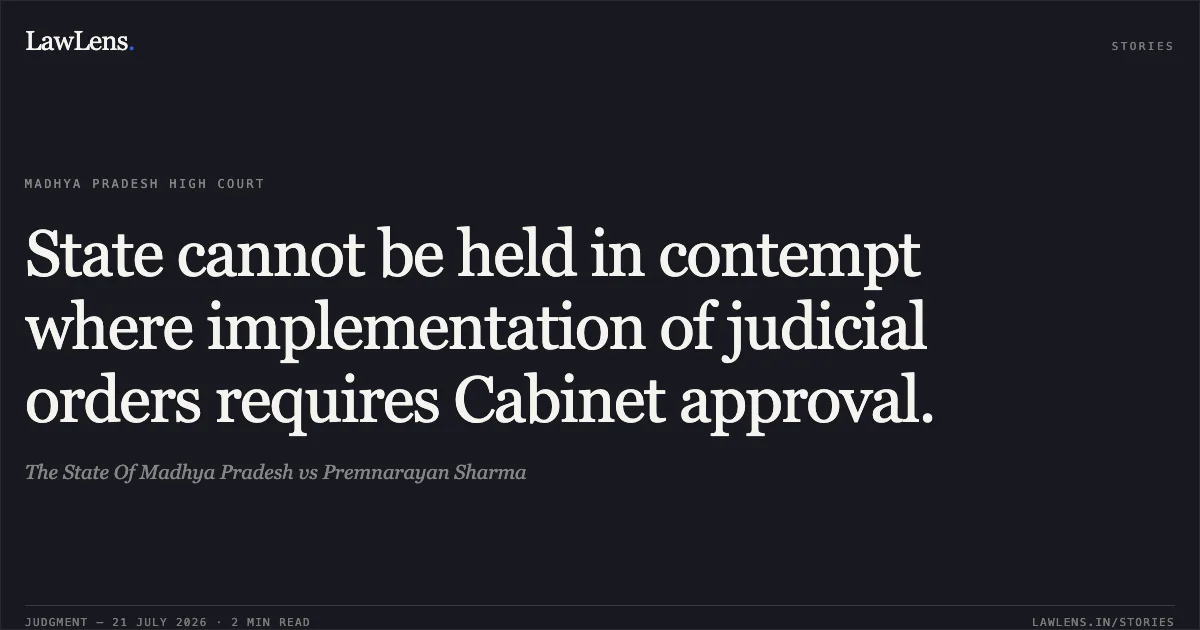
Source reference: C-2The court acknowledged the administrative principle that an officer cannot be held liable for wilful disobedience if the power to implement the judicial order rests with a superior body—in this case, the Cabinet of the State Government.
Source reference: C-2Reasoning
In the Writ Appeal, the Court observed that the State Government, pursuant to a Cabinet decision, had already implemented the Single Bench’s order and granted all consequential benefits and costs to the respondent. Consequently, the dispute on merits became infructuous.
Source reference: C-1Regarding the Contempt Appeal, the Division Bench found that the learned Single Judge committed a procedural error. The appellant (Engineer-in-Chief) lacked the individual competence to implement the order as it required a Cabinet-level decision.
Source reference: C-2Crucially, the Court noted that the Single Judge failed to adhere to the mandatory quasi-criminal procedure under the Contempt of Courts Act, as no charges were framed and no sufficient opportunity for defense was provided before the summary sentencing. This violation of natural justice rendered the contempt orders (17.03.2025 and 18.03.2025) legally unsustainable.
Source reference: C-2Holding
The Court dismissed the Writ Appeal (W.A. No. 102/2026) as the underlying grievance was resolved by the State’s compliance.
Regarding the Contempt Appeal (C.A. No. 13/2025), the Court allowed the appeal and set aside the orders dated 17.03.2025 and 18.03.2025, holding that the appellant was wrongly convicted without due process. The contempt proceedings stand disposed of.
Source reference: C-2, C-3Acts & Sections Cited
1 provisions across 1 statute referred to in this judgment. Each provision opens on LawLens.
Contempt of Courts Act, 19711
Original Court PDF
The State Of Madhya PradeshvsPremnarayan Sharma
Click to open original judgment
Original judgment, available to read, download and summarize on LawLens.in