Facts
The Petitioner, a registered small-scale industrial unit owned by a Kashmiri Pandit migrant, was originally allotted Industrial Shed No. 5 in Srinagar in 1978.
Source reference: para. 02Due to the mass migration in 1989-90, the Petitioner moved to Jammu, and the unit was subsequently damaged by fire in 1991.
Source reference: para. 03-05In 1996, the State re-allotted the Petitioner's original shed to Respondent No. 6.
Source reference: para. 06Following a court order in 2000 directing the State to provide a similar shed, the Respondents offered two sheds at Rangret but demanded a premium and significantly higher rent compared to the original allotment.
Source reference: para. 07-08After several rounds of litigation and contempt petitions, the Respondents issued an order on 06.04.2004 cancelling the allotment at Rangret, citing the Petitioner's failure to pay the premium and execute a lease deed.
Source reference: para. 12The Petitioner challenged this cancellation, seeking the return of the original shed or fair alternate allotment.
Source reference: para. 13Issues
1. Whether the State’s action of cancelling the Petitioner’s original allotment and subsequently imposing fresh commercial terms on a forced migrant was legally and equitably sustainable.
Source reference: para. 21-222. Whether the Respondents violated the principles of natural justice by ignoring the extenuating circumstances of the Petitioner's migration when cancelling the allotment.
Source reference: para. 23Law Applied
The court applied the constitutional principles of equity and fairness under Article 14, emphasizing the State's fiduciary duty to protect the property of displaced persons.
Source reference: para. 21It further relied on the Principles of Natural Justice, asserting that administrative actions must account for the "force of circumstances" that prevent a party from fulfilling standard procedural formalities.
Source reference: para. 23The court underscored the doctrine of "adjusting equities," which requires the judiciary to balance historical injustices with the passage of time and changed circumstances.
Source reference: para. 22Reasoning
The Court observed that the State, instead of acting as a "protector" of the property of a migrant forced to flee for safety, acted as a "predator" by exploiting the Petitioner's absence to re-allot the original site to a third party.
Source reference: para. 21-22The Court reasoned that the Respondents' offer of alternate sheds was a "mirage" because it treated a victim of forced migration as a new commercial allottee by demanding premiums and higher rents that were not part of the original 1978 lease.
Source reference: para. 09, 21Furthermore, the Court found the cancellation of the Rangret sheds to be a violation of natural justice; it was unrealistic and inequitable for the State to expect a migrant to restore industrial activity in a turmoil-hit region where their personal safety was not guaranteed.
Source reference: para. 23The Court concluded that the Petitioner was subjected to unfair and inequitable treatment, necessitating judicial intervention to restore justice while acknowledging the current occupancy of the original shed by Respondent No. 6.
Source reference: para. 22-24Holding
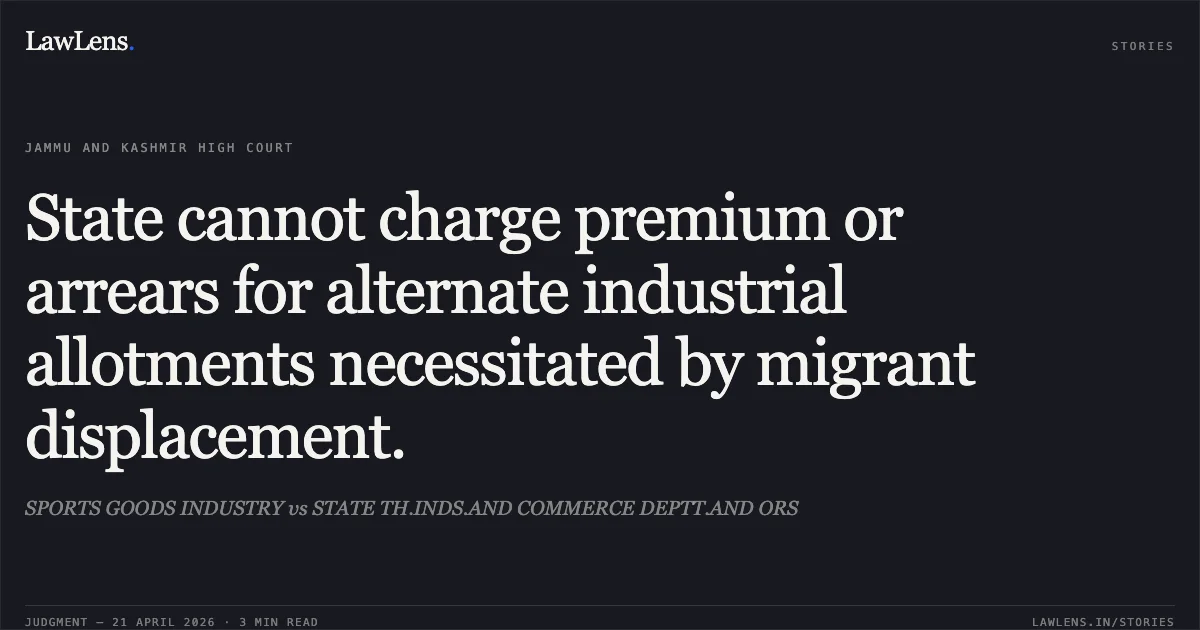
The High Court disposed of the writ petition by directing the official Respondents to fulfill the allotment of the two sheds at the Industrial Estate, Rangret (or similar vacant sheds) in favor of the Petitioner.
The Court specifically ordered that: (i) no premium shall be charged for the allotment; (ii) the rent shall be at the prevalent rate; and (iii) no arrears shall be insisted upon, with rent becoming payable only prospectively from the date the Petitioner takes actual possession.
Source reference: para. 24The Court held that the State must bear the responsibility for the Petitioner's displacement and cannot profit from the misery of a migrant.
Source reference: para. 21-22Original Court PDF
SPORTS GOODS INDUSTRYvsSTATE TH.INDS.AND COMMERCE DEPTT.AND ORS
Click to open original judgment
Original judgment, available to read, download and summarize on LawLens.in