Facts
The applicant, an Associate Professor of Nursing at Alamdar Memorial College of Nursing and Medical Technology (a constituent college of IUST), challenged her retirement at age 60
Source reference: para. 02Originally an employee of SKIMS, she was appointed to IUST in 2016 following Advertisement Notice No. 07 of 2015
Source reference: para. 03She sought a Writ of Mandamus to continue service until age 62 or 65, arguing that University Grants Commission (UGC) Regulations and IUST Statutes prescribed higher retirement ages for teaching faculty
Source reference: para. 04-05The respondents contended that the Nursing College is a constituent unit governed by the Indian Nursing Council (INC) and Jammu & Kashmir Civil Service Regulations (J&K CSR), rather than UGC-mandated university teaching departments
Source reference: para. 06-08They further noted that the applicant was recruited based on INC qualifications (M.Sc. Nursing), not the mandatory Ph.D. required by UGC for Associate Professors
Source reference: para. 29Issues
1. Whether the retirement age of 65 years prescribed by UGC Regulations and University Statutes is automatically applicable to faculty of a constituent Nursing College without express state adoption.
Source reference: para. 352. Whether an employee recruited under the eligibility criteria of a specific regulatory body (INC) can claim retirement benefits prescribed by a different regulatory body (UGC).
Source reference: para. 43Law Applied
The Tribunal applied the principle that fixing the age of retirement is a policy matter within the exclusive domain of the State or Union Territory under Article 309 of the Constitution
Source reference: para. 37, 40It relied on Dr. J. Vijayan v. State of Kerala (2022), which held that UGC Regulations do not override a state’s authority to legislate employment policies like retirement age
Source reference: para. 37It further cited P.J. Dharamaraj v. Church of South India (2022), establishing that state-affiliated institutions are not bound by UGC amendments regarding superannuation without formal state adoption
Source reference: para. 27Additionally, the Tribunal considered SRO 164 of 2014, which mandates retirement at age 60 for J&K Government servants
Source reference: para. 13, 41the Indian Nursing Council (INC) Syllabus, which defines the qualifications for nursing faculty
Source reference: para. 29, 43Reasoning
The Tribunal reasoned that the applicant’s appointment was fundamentally governed by INC norms rather than UGC Regulations.
Source reference: para. 29, 43While UGC Regulations 2010 and 2018 require a mandatory Ph.D. for appointment as an Associate Professor, the applicant was appointed based on an M.Sc. Nursing qualification, which aligns with INC standards
Source reference: para. 29, 43Consequently, the applicant could not "cherry-pick" regulatory benefits by seeking appointment under INC norms but retirement under UGC norms
Source reference: para. 43Regarding the University Statutes, the Tribunal noted that Section 5.18, which suggests a retirement age of 65, is subject to the assent of the Chancellor, which the applicant failed to prove
Source reference: para. 44Furthermore, the Tribunal emphasized that the J&K Government had not consciously adopted the UGC’s retirement age enhancement; thus, SRO 164 of 2014, fixing the age at 60, remained the binding authority
Source reference: para. 41, 44Holding
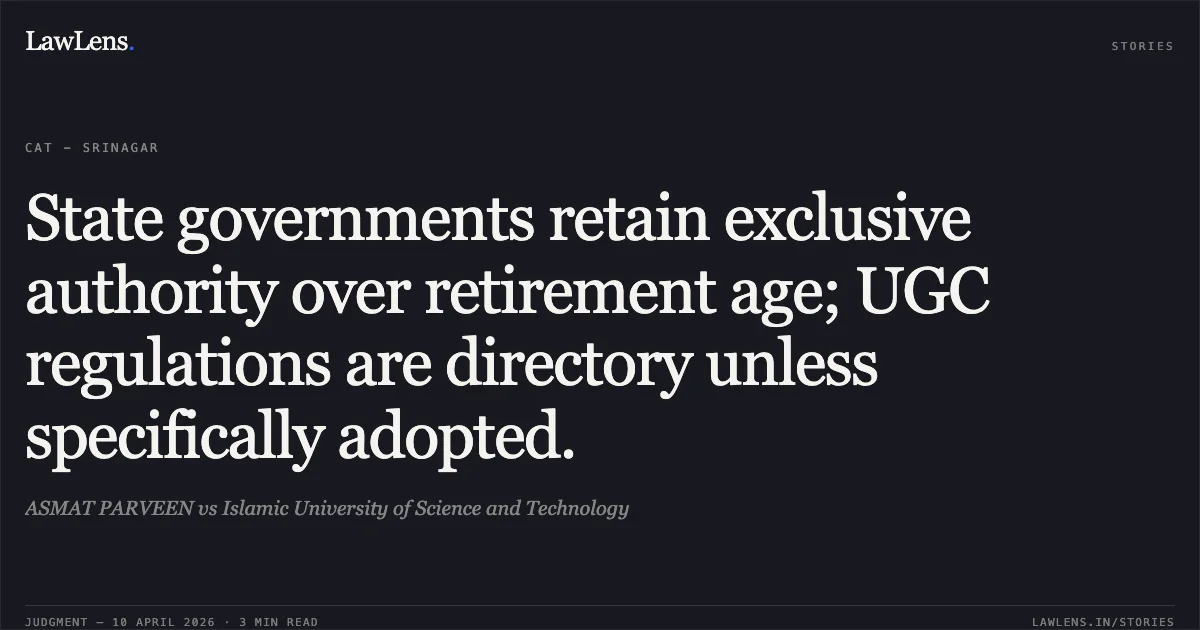
The Tribunal dismissed the Transfer Application (T.A. 161/2024), holding that the applicant has no legal right to serve beyond the age of 60
It ruled that in the absence of a formal adoption of UGC superannuation norms by the UT of Jammu and Kashmir, and given the applicant’s recruitment under INC criteria, the state-prescribed retirement age of 60 years applies
Source reference: para. 44All interim orders were vacated
Source reference: para. 45Acts & Sections Cited
2 provisions across 1 statute referred to in this judgment. Each provision opens on LawLens.
Original Court PDF
ASMAT PARVEENvsIslamic University of Science and Technology
Click to open original judgment
Original judgment, available to read, download and summarize on LawLens.in