01Facts
The Petitioners, telecom infrastructure providers operating over 10,000 mobile sites in Maharashtra, were billed at Industrial tariff until 2009.
¶ 2–3 · pp. 3–4By circular dated 26 June 2009, Respondent No. 3 directed that Commercial tariff apply to mobile operators and telephone exchanges.
¶ 3 · p. 4That circular was challenged in Writ Petition No. 6702 of 2009 (Tata Teleservices), where the Court stayed it on 17 August 2009.
¶ 3 · p. 4While that petition was pending, Respondent No. 3 issued a circular dated 20 April 2010 restoring Industrial tariff for mobile towers with effect from 20 March 2010, conditional on furnishing an undertaking on Rs. 100 stamp paper to abide by the outcome of WP 6702/2009 and to pay any differential if that petition was dismissed.
¶ 4 · p. 4The Petitioners allege that Commercial tariff continued to be charged until August–September 2010, resulting in excess payments of about Rs. 60 crores to Respondent No. 1.
¶ 5 · pp. 4–5 · ¶ 11 · pp. 8–9Despite letters, including letters dated 14 March 2013, refund was not made.
¶ 11 · pp. 9–10The Respondents' affidavit in reply dated 4 December 2013 raised an alternative-remedy objection under the Electricity Act, 2003 and contended that the Petitioners are not "industry".
¶ 6 · pp. 5–6On 4 August 2014 the Petition was admitted, with all contentions, including maintainability, kept open and liberty granted to pursue alternative remedies.
¶ 8 · pp. 6–702Issues
i.1. Whether the writ petition is maintainable despite the availability of statutory remedies under the Electricity Act, 2003 before the IGRC, CGRF, and Electricity Ombudsman.
¶ 6, 7, 9 · pp. 5–7ii.2. Whether Respondents Nos. 1 to 3 could lawfully continue to levy Commercial tariff on the Petitioners' mobile towers between 20 March 2010 and August/September 2010, despite the Circular dated 20 April 2010.
¶ 10 · p. 8iii.3. Whether the Petitioners' non-manufacturing status and the contention that they are not "industry" defeat their entitlement to Industrial tariff.
¶ 6, 13 · pp. 5–6, 10–11iv.4. Whether the Petitioners are entitled to refund of the excess amount with interest.
¶ 14–15 · p. 1103Law Applied
The Court applied Article 226 of the Constitution, holding that exhaustion of an efficacious statutory remedy is a rule of discretion, not an inflexible bar to writ jurisdiction, and that a litigant should not be relegated to an alternative forum where the petition has remained pending for a long time, relying on Durga Enterprises (P) Ltd. v. Principal Secretary, Govt. of U.P., (2004) 13 SCC 665.
¶ 9 · p. 7The Court noted the statutory forums under the Electricity Act, 2003 raised by the Respondents, and the coordinate bench decision in BSNL v. MSEDCL, WP No. 7884 of 2010 (order dated 16 April 2024), which rejected an identical objection.
¶ 6 · p. 5 · ¶ 7 · p. 6The principle that an unambiguous executive circular binds the issuing authority, which must act consistently with its own lawful directions.
¶ 10 · p. 8 · ¶ 13 · pp. 10–11Article 14 of the Constitution, under which retention of amounts collected contrary to such a direction is arbitrary and results in unjust enrichment.
¶ 13 · p. 11The Respondents' failure to deny material pleadings is treated as an admission for the purposes of the case.
¶ 12 · p. 10The Court's power to grant mandamus and direct interest under Article 226 of the Constitution.
¶ 14–15 · p. 1104Reasoning
The Court declined to dismiss the petition on maintainability grounds because it had been pending for about thirteen years, was admitted in 2014 with liberty expressly kept open, and the Petitioners would be prejudiced by relegation to a new forum.
¶ 9 · p. 7 · ¶ 8 · pp. 6–7On merits, the Court held that the 20 April 2010 Circular was clear and unambiguous: it restored Industrial tariff from 20 March 2010, subject only to the undertaking. The reservation of a right to recover the differential was conditional on the outcome of WP 6702/2009 and did not authorise interim Commercial tariff. The Respondents did not deny the pleaded facts of wrongful levy and refusal to refund, nor identify any later direction suspending the Circular. The Court held that the Petitioners' classification as non-manufacturers was irrelevant, because the claim rested entirely on the Circular and not on classification. Accordingly, the continued collection of Commercial tariff contrary to the Circular, and retention of the surplus, were held arbitrary and violative of Article 14.
¶ 10 · p. 8 · ¶ 12 · p. 10 · ¶ 13 · pp. 10–1105Holding
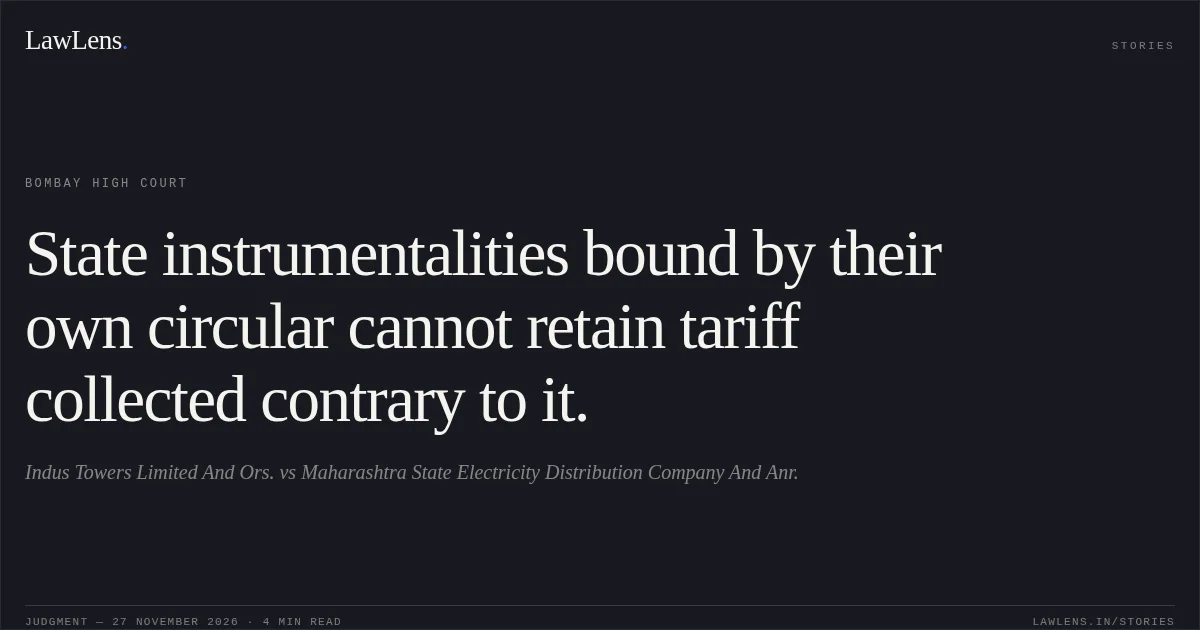
The writ petition is maintainable notwithstanding the alternative statutory remedy, because the Petition had remained pending for over a decade with liberty granted and the alternative-remedy rule is discretionary. The Respondents could not charge Commercial tariff contrary to the 20 April 2010 Circular, and retention of the excess sum was arbitrary.
¶ 9 · p. 7 · ¶ 10, 13 · p. 8, 11The Rule was made absolute. The Court directed Respondents Nos. 1 to 3 to issue directions to their divisions to compute and refund the differential recovered between 20 March 2010 and August/September 2010 within 60 days, subject to the Petitioners furnishing the undertaking within two weeks if not already done. Any amount not refunded within 60 days shall carry 9% per annum interest from the date of judgment until realisation, recoverable from Respondent No. 1. No order as to costs.
¶ 14–16 · pp. 11–12 · ¶ 15 · pp. 11–12 · ¶ 17 · p. 12Original Court PDF
Indus Towers Limited And Ors.vsMaharashtra State Electricity Distribution Company And Anr.
Click to open original judgment
Original judgment, available to read, download and summarize on LawLens.in