Facts
The State of Uttarakhand enacted "The Uttarakhand Water Tax on Electricity Generation Act, 2012," which levied a tax on "users" drawing water from any source within the state for electricity generation
Source reference: p.5-6Various hydroelectric power companies challenged the Act’s constitutional validity, arguing the state lacked legislative competence
Source reference: p.10-14A Division Bench of the High Court delivered a split verdict on 25.10.2023: one judge upheld the Act as a tax on water use, while the other struck it down as a tax on electricity generation
Source reference: p.4The matter was referred to a third judge, Justice Alok Kumar Verma, to resolve the deadlock
Source reference: p.4Issues
1. Whether the true nature (pith and substance) of the tax is a levy on the "drawal of water" or an incompetent tax on the "generation of electricity"
Source reference: p.22 / para. 302. Whether Section 17 of the Act constitutes "excessive delegation" by granting the State Government unfettered power to fix tax rates without legislative guidelines
Source reference: p.25 / para. 43-453. Whether the State is barred by the doctrine of "Promissory Estoppel" from levying the tax due to prior Implementation Agreements promising tax-free status
Source reference: p.36 / para. 67-68Law Applied
The Court applied the Doctrine of Pith and Substance to determine the true character of the legislation beyond its nomenclature
Source reference: p.23It relied on Article 246 read with Seventh Schedule Lists of the Constitution, noting that taxation is a distinct legislative field and cannot be derived from general entries
Source reference: p.28, 35The Court followed Union of India v. H.S. Dhillon regarding the requirements of Entry 49 List II (Tax on lands/buildings)
Source reference: p.33State of West Bengal v. Kesoram Industries Ltd., which establishes that power to tax cannot be inferred from a general entry as an ancillary power
Source reference: p.35Regarding delegation, it applied the principle that "essential legislative functions," including fixing tax rates without a ceiling or policy, cannot be delegated
Source reference: p.26M/s Hero Motocorp Ltd. v. Union of India: there is no promissory estoppel against the legislature in the exercise of its legislative functions
Source reference: p.37-38Reasoning
The Court examined the Act’s charging provisions (Sections 2, 12, and 17) and concluded that since the tax is triggered only upon the use of water for electricity generation, and not mere drawal, the "taxable event" is effectively the generation of electricity
Source reference: p.24It rejected the State's argument to trace the power to Entry 49 (Land) or Entry 50 (Mineral Rights) of List II, noting that water was not treated as "land units" and the precedent treating water as a "mineral" was limited to specific statutory contexts not applicable here
Source reference: p.33-34Under Section 17, the legislature provided no minimum/maximum rates or policy guidelines, amounting to an unconstitutional "naked delegation" of power to the Executive
Source reference: p.26The Court rejected the appellants' plea of promissory estoppel, reasoning that executive agreements cannot bind the Sovereign Legislature's power to tax
Source reference: p.37-38Holding
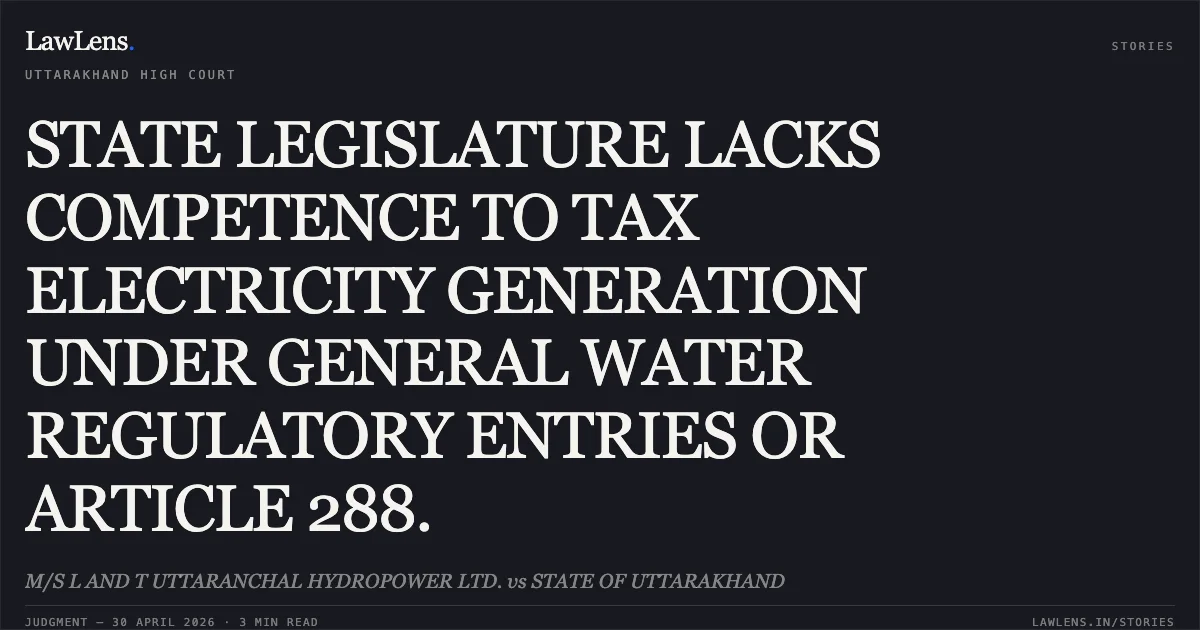
The Court concurred with the view of Justice Ravindra Maithani, holding that the "Uttarakhand Water Tax on Electricity Generation Act, 2012" is ultra vires the Constitution
It held that the State Legislature lacks competence to tax electricity generation (a field not in List II) and that the Act suffers from excessive delegation
Source reference: p.27, 36The Court answered Issue 1 and 2 in favor of the appellants, while answering Issue 3 (Promissory Estoppel) in favor of the State, concluding that while the tax is unconstitutional for lack of power, it would not have been barred by estoppel alone
Source reference: p.37-38Acts & Sections Cited
20 provisions across 1 statute referred to in this judgment. Each provision opens on LawLens.
Uttarakhand water tax and electricity Generation Act
Original Court PDF
M/S L AND T UTTARANCHAL HYDROPOWER LTD.vsSTATE OF UTTARAKHAND
Click to open original judgment
Original judgment, available to read, download and summarize on LawLens.in