Facts
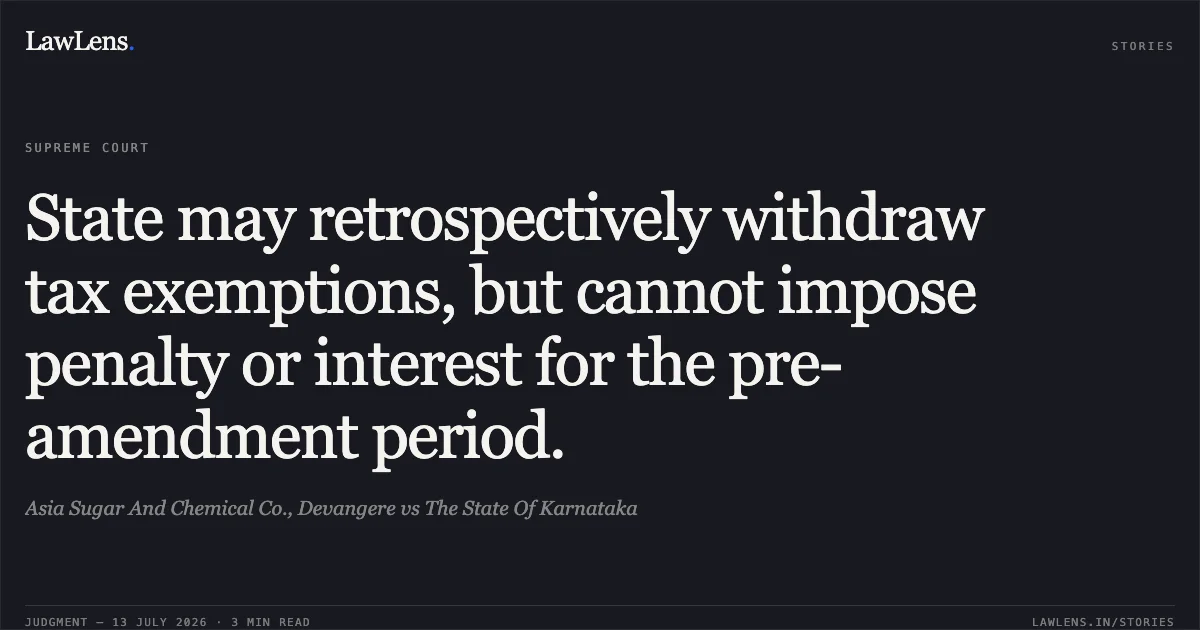
The appellants, dealers in imported sugar, treated their sales as exempt from tax under the Karnataka Sales Tax (KST) Act, 1957, based on Entry 31-B/51 of the Fifth Schedule, which exempted "sugar" without territorial restriction.
Source reference: p. 3-5The assessing authorities initially granted these exemptions in original assessments.
Source reference: p. 6, 8However, the Karnataka Act No. 5 of 2001 amended the entry with retrospective effect, confining the exemption to sugar "produced or manufactured in India".
Source reference: p. 7Consequently, reassessment notices were issued to recover tax on past transactions where dealers had not collected tax from customers.
Source reference: p. 8The Single Judge of the High Court struck down the retrospectivity as an unreasonable burden; however, the Division Bench reversed this, upholding the amendment in full.
Source reference: p. 9Issues
1. Whether imported sugar was covered by the exemption entry relating to "sugar" in the Fifth Schedule prior to the 2001 Amendment?
Source reference: p. 13 / para. 402. Whether Karnataka Act No. 5 of 2001, inserting the words "produced or manufactured in India" with retrospective effect, is constitutionally valid?
Source reference: p. 14 / para. 403. Whether the retrospective withdrawal of exemption could be enforced with interest and penalty against dealers who had already completed assessments without collecting tax?
Source reference: p. 14 / para. 40Law Applied
The Court applied the principle of strict construction of taxing statutes, holding that there is no room for intendment and words cannot be added to a clear statutory entry (Mathuram Agrawal v. State of M.P.).
Source reference: p. 15It affirmed the legislative competence to enact retrospective fiscal laws under Entry 54, List II (Rai Ramkrishna v. State of Bihar) and the power to validate laws by removing the legal basis of a judgment (Shri Prithvi Cotton Mills Ltd. v. Broach Borough Municipality).
Source reference: p. 15-16Retrospective levies must not be oppressive or punitive regarding past transactions where the assessee followed the then-prevailing law (Empire Industries Ltd. v. Union of India; D. Cawasji & Co. v. State of Mysore).
Source reference: p. 17-18Reasoning
The Court first determined that the pre-2001 entry for "sugar" did not distinguish between domestic and imported varieties; referencing the Additional Duties of Excise Act was merely to identify the commodity, not its origin.
Source reference: p. 19-21While the 2001 Amendment was within legislative competence and not merely "clarificatory," its retrospective application required nuance.
Source reference: p. 22-24The Court reasoned that since the dealers acted on the Department’s own interpretation and did not collect tax, imposing penalties for "default" was legally untenable as there was no contumacious conduct at the time.
Source reference: p. 27Interest, which is typically compensatory, would become punitive if levied from the date of the original transaction for a liability created years later by legal fiction.
Source reference: p. 27Thus, while the principal tax could be recovered, the "incidents" of penalty and interest for the pre-amendment period were deemed unreasonable.
Source reference: p. 28Holding
The Supreme Court upheld the constitutional validity of the 2001 Amendment and the State's power to recover the principal tax.
The Court set aside the imposition of any penalty for transactions prior to the 2001 Act and directed that interest should only run from the date of a fresh lawful demand pursuant to reassessment, not from the original transaction date.
Source reference: p. 31The Court further ordered the reassessment of inter-State sales to be conducted strictly per Section 8(2) of the Central Sales Tax Act, 1956.
Source reference: p. 32Acts & Sections Cited
3 provisions across 2 statutes referred to in this judgment. Each provision opens on LawLens.
KARNATAKA PROHIBITION OF SMOKING AND PROTECTION OF HEALTH OF NON-SMOKERS ACT, 20011
Original Court PDF
Asia Sugar And Chemical Co., DevangerevsThe State Of Karnataka
Click to open original judgment
Original judgment, available to read, download and summarize on LawLens.in