Facts
The petitioner, a Supervisor in the Women and Child Development Department, challenged the Chhattisgarh Rajya Mahila Ayog’s recommendation dated 27 March 2021.
Source reference: para. 1The recommendation directed the State Government to initiate a departmental enquiry against her under the Civil Services (Conduct) Rules, recommended her suspension, and further stated that she could be terminated if the allegations were proved.
Source reference: para. 1Respondent No. 4, claiming to be the wife of Kaushal Prasad Sahu, alleged before the Ayog that Kaushal Prasad Sahu had married the petitioner during the subsistence of his marriage with Respondent No. 4.
Source reference: paras. 3, 9Her complaint arose against the background of pending domestic-violence proceedings against her husband and his family.
Source reference: paras. 3, 9The Ayog initially requested the Superintendent of Police to enquire into the matter, but no enquiry report was placed before it.
Source reference: para. 3After issuing notices and requiring the petitioner and Kaushal Prasad Sahu to appear, the Ayog made the impugned recommendation without granting the petitioner adequate opportunity to file a reply.
Source reference: paras. 3–5The petitioner contended that the Ayog lacked jurisdiction to recommend disciplinary action and had acted in breach of natural justice.
Source reference: paras. 4–5Issues
1. Whether the Chhattisgarh Rajya Mahila Ayog, exercising powers under Section 10 of the Chhattisgarh/Madhya Pradesh Rajya Mahila Ayog Adhiniyam, 1995, could specifically recommend departmental enquiry, suspension, or termination of a government employee.
Source reference: paras. 11, 14, 16–182. Whether the impugned recommendation was invalid for having been issued without adequate material and without affording the petitioner a proper opportunity of hearing.
Source reference: paras. 4–5, 16Law Applied
Section 10 of the Rajya Mahila Ayog Adhiniyam, 1995 empowers the Commission to investigate matters concerning safeguards for women, receive complaints relating to atrocities and deprivation of women’s rights, take up such matters with the appropriate authorities for remedial action, and make reports or recommendations to the State Government.
Source reference: para. 11The civil-court powers conferred by Section 10(3) are limited to specified procedural matters, such as summoning persons, requiring documents, receiving affidavits, and requisitioning public records; they do not confer adjudicatory jurisdiction.
Source reference: para. 18In Bhupendra Kumar Sahu v. State of Chhattisgarh, WPCR No. 269 of 2021, decided on 6 August 2021, and Bhabani Prasad Jena v. Convenor-Secretary, Orissa State Commission for Women, (2010) 8 SCC 633, the courts held that a State Women’s Commission is investigative and recommendatory, not adjudicatory, and cannot determine parties’ rights or issue binding orders.
Source reference: paras. 15, 18The Commission may recommend that competent authorities take appropriate remedial action, but it cannot itself direct or specifically recommend disciplinary measures such as suspension or termination under service rules.
Source reference: paras. 13–14, 17Reasoning
The Court held that the Ayog’s statutory role was confined to receiving and examining the complaint, investigating issues concerning women’s rights, and referring the matter to the competent authorities for appropriate remedial action.
Source reference: paras. 11–14By recommending initiation of a departmental enquiry for alleged violation of the Civil Services (Conduct) Rules, suspension of the petitioner, and her possible termination, the Ayog entered the domain of the departmental authorities and exceeded the jurisdiction conferred by Section 10.
Source reference: paras. 16–17The Court further noted that the recommendation was made despite the absence of an enquiry report from the police and without adequate consideration of the pending proceedings concerning the alleged marital dispute.
Source reference: paras. 3, 5Applying the principles that the Commission is not an adjudicatory body and cannot determine service-related consequences, the Court found the recommendation to be per se illegal and without jurisdiction.
Source reference: paras. 18, 20Holding
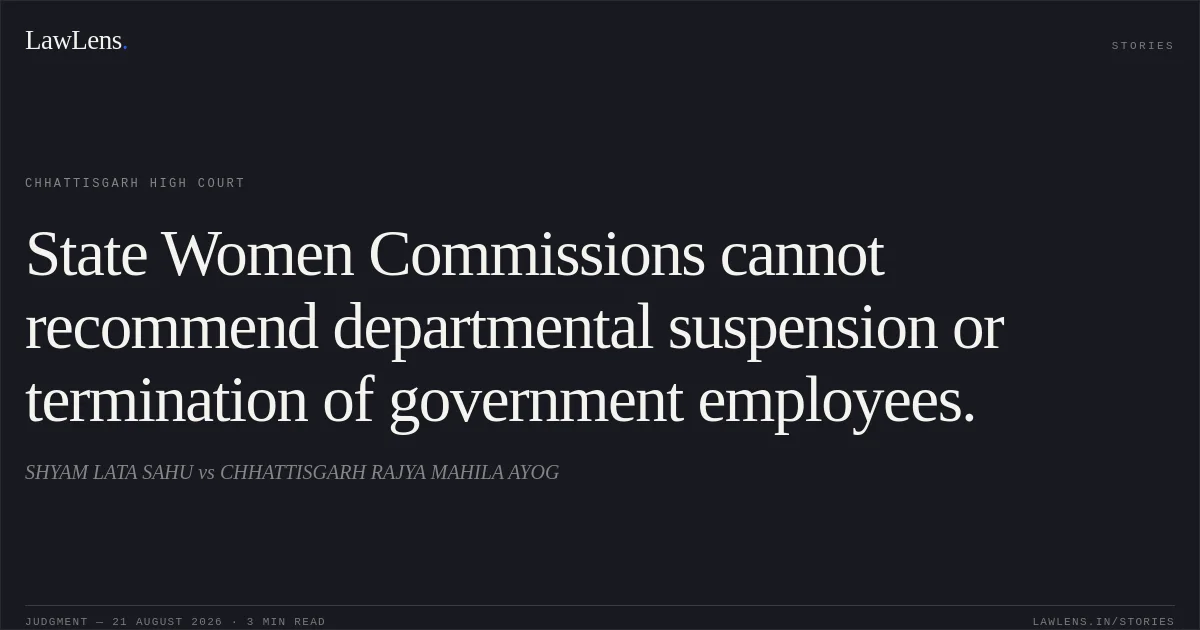
The High Court allowed the writ petition and quashed the Ayog’s recommendation dated 27 March 2021, holding that the Commission lacked authority to recommend departmental enquiry, suspension, or termination of the petitioner.
The competent Women and Child Development/Social Welfare authorities were left at liberty to initiate appropriate proceedings against the petitioner, if otherwise permissible, but only in accordance with law and after providing her due opportunity of hearing.
Source reference: para. 21Acts & Sections Cited
1 provisions across 1 statute referred to in this judgment. Each provision opens on LawLens.
Protection of Women from Domestic Violence Act, 20051
Original Court PDF
SHYAM LATA SAHUvsCHHATTISGARH RAJYA MAHILA AYOG
Click to open original judgment
Original judgment, available to read, download and summarize on LawLens.in