Facts
The applicant, an OBC candidate, challenged Recruitment Advertisement No. 02/21 issued by the Delhi Subordinate Services Selection Board (DSSSB) for Post Code 36/21 (TGT Natural Science - Female)
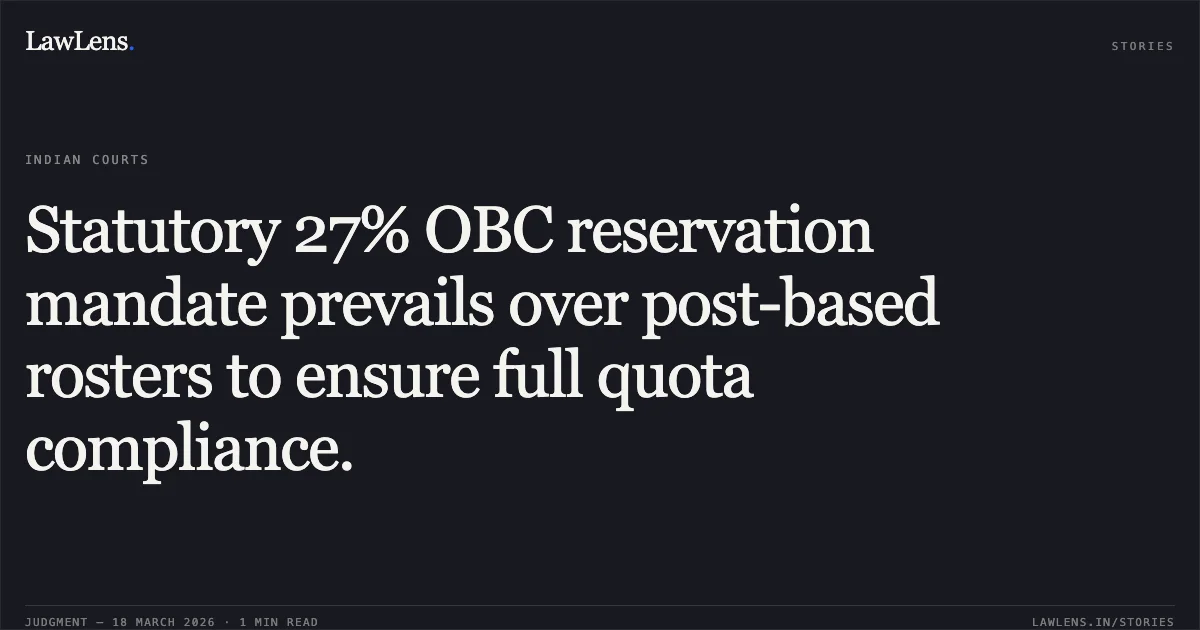
Source reference: p. 2The applicant contended that out of 824 total advertised vacancies, only 96 were reserved for the OBC category, whereas a 27% reservation policy should have resulted in approximately 222 vacancies
Source reference: p. 2-3The respondents defended the allocation, stating that posts were filled based on a "post-based roster" in accordance with applicable policy
Source reference: p. 3The applicant sought a direction for the respondents to implement the full 27% quota and consider her candidature against the revised vacancy count
Source reference: p. 2Issues
1. Whether the respondents violated the mandated 27% OBC reservation policy by earmarking only 96 vacancies out of 824 for Post Code 36/21
Source reference: p. 22. Whether the application of a post-based roster can supersede the constitutional and statutory mandate of percentage-based reservation in a recruitment advertisement
Source reference: p. 3-4Law Applied
The Tribunal relied on the constitutional mandate governing reservations and the Office Memorandum (OM) dated 19.01.2007, which prescribes that reservation percentages (15% SC, 7.5% ST, and 27% OBC) must be applied to the sanctioned strength and vacancy quotas
Source reference: p. 4It further followed the judicial precedents set in Prateek Singhal Ors. v. Govt. of NCT of Delhi Ors. (O.A. No. 741/2023), which addressed similar discrepancies in reservation counts
Source reference: p. 2, 4Gaurav Sharma, which applied similar principles to the EWS category
Source reference: p. 3Reasoning
The Tribunal observed that the issues in the present case were "strikingly similar" to those in Prateek Singhal
Source reference: p. 3It rejected the respondents' argument that the post-based roster alone governs reservation, noting that such an interpretation in isolation would defeat the object and purpose of the reservation policy
Source reference: p. 3-4The Tribunal emphasized that the roster must be implemented based on the actual vacancy position to remain in consonance with constitutional mandates
Source reference: p. 4By referencing the 2007 OM, the Tribunal illustrated that reservation must be calculated as a specific percentage of the recruitment quota (e.g., 27% of direct recruitment posts)
Source reference: p. 4Following the logic in Prateek Singhal, the Tribunal reasoned that any shortfall in the reserved category must be rectified to satisfy the legal requirement
Source reference: p. 4-5Holding
The Tribunal disposed of the Original Application in terms of the ratio laid down in Prateek Singhal
It held that the reservation policy must be fully implemented.
Source reference: no citationFollowing the cited precedent, the Tribunal suggested that if additional posts are required to meet the 27% OBC quota, they should be offered by creating supernumerary posts to ensure that the rights of currently selected candidates or those on the waiting list are not adversely affected
Source reference: p. 4-5No costs were awarded
Source reference: p. 5Original Court PDF
Shruti DhimanvsGNCTD
Click to open original judgment
Original judgment, available to read, download and summarize on LawLens.in