01Facts
The appellants challenged an order dated 20 July 2023 passed by the Registrar of Trade Unions, West Bengal, concerning the registration/continuance of appellant no. 2–Trade Union.
¶ 1The Registrar’s order allegedly relied, inter alia, on information furnished by respondent no. 3 without supplying a copy thereof to the appellants, and concluded that the Union had failed to satisfy the minimum membership requirement under Section 9A of the Trade Unions Act, 1926.
¶ 2–4The appellants contended that the membership assessment improperly clubbed employees of different Peerless establishments located in Kolkata, Hyderabad, Durgapur, Mukutmanipur and Port Blair, although the relevant settlements concerned only the Kolkata unit.
¶ 2–4They also alleged that the Registrar acted contrary to an earlier order dated 3 April 2023 in WPA No. 29125 of 2022, which had directed consideration of the Union’s Form H returns, and that the impugned order travelled beyond the show-cause notice.
¶ 5–9The learned Single Judge declined to adjudicate the writ petition on merits and granted liberty to the appellants to pursue the statutory appeal under Section 11 of the 1926 Act.
¶ 1The State and respondent no. 3 relied on several alleged statutory infractions, including non-filing of annual returns for eight consecutive years from 2014 to 2021, filing of nine returns together in October 2022, discrepancies in the returns, and failure to produce registers and records.
¶ 10–2002Issues
i.1. Whether the learned Single Judge was justified in declining to entertain the writ petition and relegating the appellants to the statutory appellate remedy under Section 11 of the Trade Unions Act, 1926.
¶ 28–30ii.2. Whether the alleged non-supply of information relied upon by the Registrar constituted such a violation of natural justice as to justify writ-court interference despite the alternative statutory remedy.
¶ 2, 13–18, 30–31iii.3. Whether the Registrar’s order was contrary to the earlier judicial direction to consider the appellants’ returns or travelled beyond the grounds stated in the show-cause notice.
¶ 5–9, 23–2703Law Applied
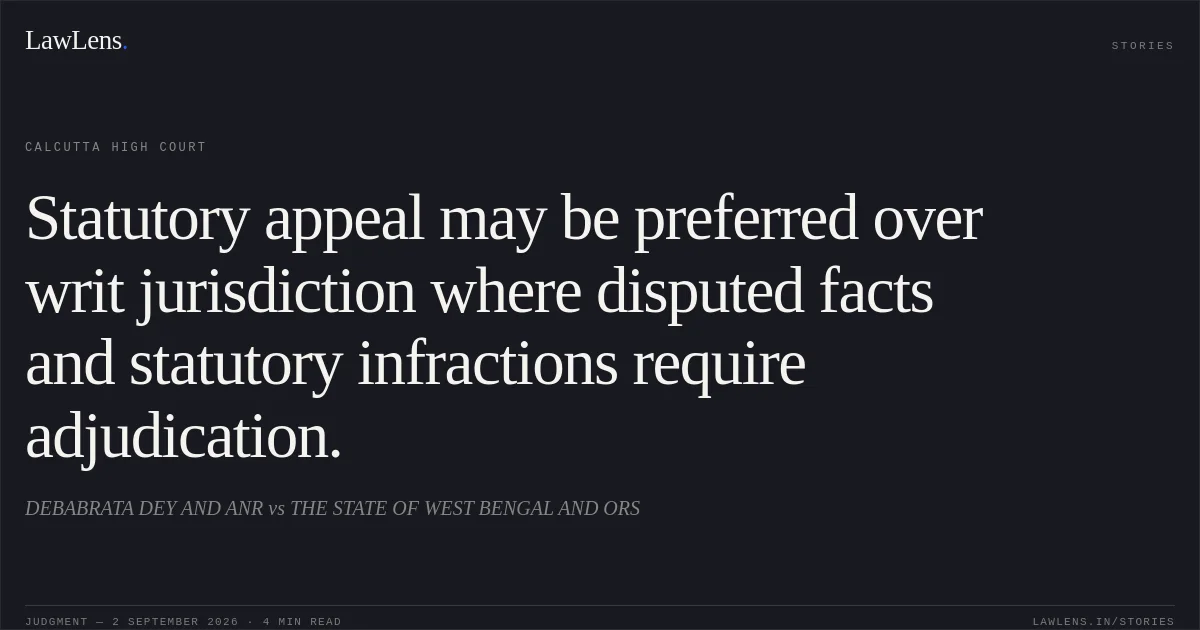
Section 11 of the Trade Unions Act, 1926 provides a statutory appellate remedy against orders of the Registrar of Trade Unions; where the impugned order involves disputed questions of fact and law, the statutory appeal is ordinarily the appropriate and more efficacious remedy.
¶ 29–31Although the existence of an alternative remedy does not constitute an absolute bar to jurisdiction under Article 226 of the Constitution, writ interference may be warranted in recognised exceptional circumstances such as breach of natural justice, lack of jurisdiction or an order that is a nullity.
¶ 17–18A prior judicial direction to consider documents or returns does not require the authority to accept or validate them if they are found to be legally defective.
¶ 23The appellate authority under Section 11 has a wider fact-finding and legal adjudicatory scope than a writ court, including the ability to examine whether relied-upon information ought to have been furnished to the affected party.
¶ 31Provisions in the judgment · 2
Trade Unions Act, 1926 Section 9ASection 11
04Reasoning
The Court held that the Registrar’s order was not founded solely on the allegedly undisclosed information concerning the respondent no. 3’s establishment.
¶ 26–27It also relied on multiple alleged statutory violations, including delayed or non-submission of annual returns for eight successive years and discrepancies in the returns.
¶ 26–27Consequently, the earlier direction to consider the appellants’ returns had been complied with in substance; that direction did not compel the Registrar to accept the returns as legally valid.
¶ 23The Court further declined to determine the merits of the membership calculation, the applicability of Section 9A, the alleged breach of natural justice, or the scope of the show-cause notice, since those matters involved disputed facts and legal questions better suited for determination in the statutory appeal.
¶ 28–31The alleged non-supply of information, even if material, could therefore be raised before the appellate authority and did not, in the circumstances, compel exercise of writ jurisdiction.
¶ 3105Holding
The Court dismissed FMA No. 1656 of 2025 on contest and affirmed the learned Single Judge’s order dated 14 August 2025 in WPA No. 16813 of 2025, holding that relegation of the appellants to an appeal under Section 11 of the Trade Unions Act, 1926 was justified.
¶ 30, 34The Court expressed no opinion on the merits of the Registrar’s order.
¶ 32The appellants were granted liberty to file the statutory appeal within thirty days from the date of judgment; if filed within that period, it was directed to be decided in accordance with law after affording hearing to all concerned and independently of the observations in the judgment or the orders under challenge.
¶ 35CAN 1 of 2026 was disposed of consequentially, with no order as to costs.
¶ 36–37Original Court PDF
DEBABRATA DEY AND ANRvsTHE STATE OF WEST BENGAL AND ORS
Click to open original judgment
Original judgment, available to read, download and summarize on LawLens.in