01Facts
The appellant, an employee of the British India Corporation Limited (the "Corporation"), was penalised with compulsory retirement by the Chairman cum Managing Director (C.M.D.).
¶ 2In the first round of litigation, the Writ Court found a defect in the first penalty order, namely non-observance of natural justice at the second show cause notice stage, and directed fresh action.
¶ 8, 13The Board of Directors passed a resolution on 08.12.2025 directing a fresh enquiry and reinstatement of the appellant pending a fresh second show cause notice.
¶ 8, 13, 14The record does not clearly show whether reinstatement was implemented.
¶ 14The C.M.D. issued the second show cause notice, the appellant replied, and the C.M.D. passed the impugned penalty order.
¶ 16The judgment dates this order variously as 10.06.2026 and 08.06.2026.
¶ 2, 28The appellant contended that the next higher authority, the Functional Director, was bypassed.
¶ 8The single judge dismissed the writ petition solely because a statutory departmental appeal lay to the Court of Directors/Board of Directors (C.O.D./B.O.D.) under Rule 32 of the Employees' Conduct (Discipline and Appeal) Rules, 1986 (the "Rules").
¶ 2, 302Issues
i.1. Whether the writ petition was rightly dismissed on the ground of an alternative statutory appellate remedy, or whether a recognised exception to the alternative-remedy rule applied.
¶ 9, 15ii.2. Whether the C.M.D., rather than the specified Disciplinary Authority or the next higher authority (Functional Director), could validly pass the penalty order.
¶ 4, 5, 17, 18iii.3. Whether a statutory appeal lies against the C.M.D.'s penalty order to the C.O.D./B.O.D. under Rule 32 read with the Schedule and Note (b).
¶ 7, 19–25, 27iv.4. Whether the C.M.D.'s role as the appellate-body member would vitiate the appeal on the ground of bias.
¶ 7, 12, 26v.5. Whether the appellant is entitled to reinstatement and wages for the period after the Board resolution of 08.12.2025.
¶ 8, 14, 2803Law Applied
Rule 32(i)–(ii) of the Employees' Conduct (Discipline and Appeal) Rules, 1986 grants an employee a right of appeal against penalty orders to "the authority specified in the schedule," within one month, with the appellate authority empowered to confirm, enhance, reduce, set aside, or remit.
¶ 18The Schedule specifies the appointing, disciplinary, appellate, and reviewing authorities for each category of employee. For Supervisors and above (Category 1), the Appellate Authority is the Functional Director and the Reviewing Authority is the C.M.D., while for Category 2 the C.M.D. is the Disciplinary Authority and the C.O.D./B.O.D. is the Appellate Authority.
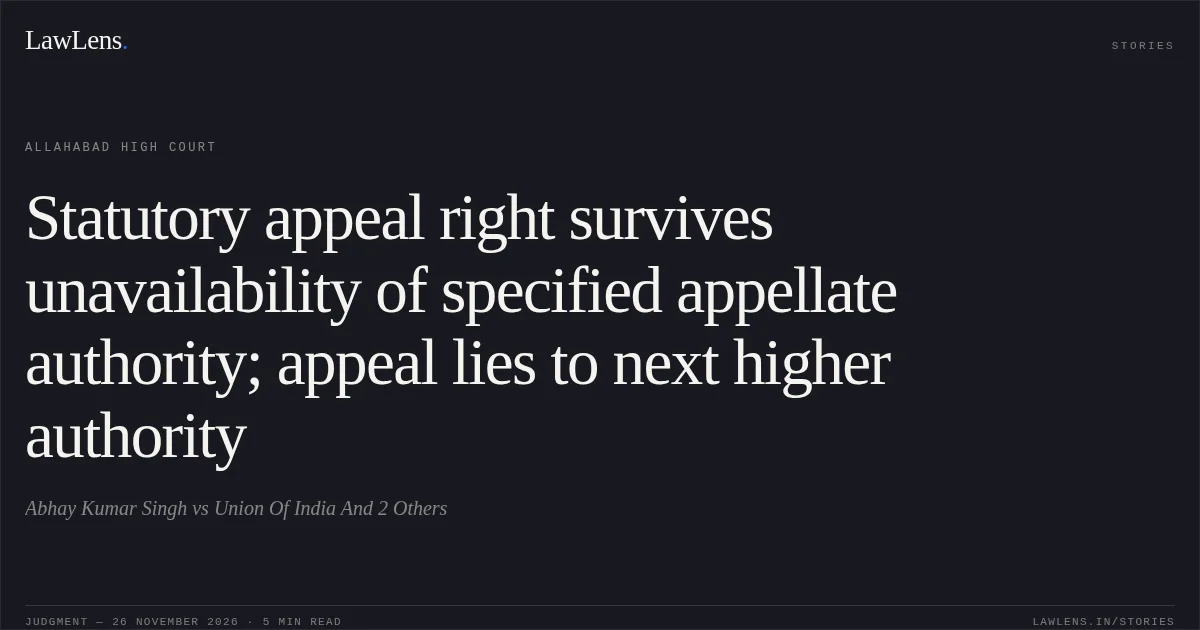
¶ 19Note (b) provides that "in case the appropriate Appellate Authority is not available for any reason, the appeal will lie with the next higher Authority."
¶ 19, 22In Surjit Ghosh v. Chairman & M.D., United Commercial Bank (1995) 2 SCC 474, the Supreme Court held that a higher authority may validly pass a penalty order, but the order is unsustainable if it deprives the employee of a statutory right of appeal.
¶ 6, 20, 21In Whirlpool Corporation v. Registrar of Trade Marks (1998) 8 SCC 1, the Court recognised limited exceptions to the rule requiring exhaustion of alternative remedies.
¶ 9, 15In Electronics Corporation of India v. G. Muralidhar (2001) 10 SCC 43, the Court held that no appeal lies to the Board against a C.M.D.'s order absent a general statutory provision conferring such power.
¶ 7, 27In Amar Nath Chowdhury v. Braithwaite & Co. Ltd. (2002) 2 SCC 290, an appellate decision was vitiated by bias where the C.M.D. participated in hearing an appeal against his own order.
¶ 7, 13, 2604Reasoning
The Court held that a statutory appeal was available, so the writ petition was not maintainable under the alternative-remedy rule and the Whirlpool exceptions did not apply.
¶ 15The Court rejected the argument that the C.M.D. lacked authority to pass the order. Under Surjit Ghosh, a higher authority may impose a penalty, and the only defect would be loss of the appellate right.
¶ 17, 21Relying on Note (b), the Court reasoned that "for any reason" encompasses the situation where the Functional Director, as the specified appellate authority, is unavailable because the C.M.D., who is higher in rank, passed the order.
¶ 22, 27Reading the Schedule as a whole, the appeal therefore lies to the C.O.D./B.O.D., which is an authority specified elsewhere in the Schedule.
¶ 23The Court rejected the narrower reading that only authorities specified for the appellant's own category may act as appellate authority. Such a reading would render penalties passed by the General Manager unappealable if both the Functional Director and C.M.D. were unavailable, defeating the principle that a statutory appeal right cannot be lost due to non-availability of authorities.
¶ 24, 25Electronics Corporation was distinguished because there no provision conferred Board jurisdiction over C.M.D. orders, whereas Note (b) expressly does so here.
¶ 27On bias, the Court held the issue premature, since the C.M.D.'s conduct in any appeal had not yet arisen, and Amar Nath Chowdhury turned on the C.M.D. sitting in appeal against his own order.
¶ 12, 26On natural justice, the Court found the second show cause notice was issued and replied to, so the challenge failed.
¶ 16On reinstatement, the 08.12.2025 Board resolution entitled the appellant to reinstatement from that date, and wages for the interregnum until the second penalty order were payable.
¶ 2805Holding
The Court held that the single judge was right that the statutory appeal remedy was efficacious and that no exception to the alternative-remedy rule applied.
¶ 15The Court held that the C.M.D. validly passed the penalty order under Note (b) because the Functional Director was unavailable, and that the appeal lies to the C.O.D./B.O.D.
¶ 22–24, 23, 27The bias issue was left open for the appellate stage.
¶ 26The Special Appeal was partly allowed. Directions: (i) the appellant is to be reinstated from 08.12.2025 and paid wages for the period, computed and paid within two months if not already paid; (ii) the appellant may file a statutory appeal within four weeks, to be decided by a speaking and reasoned order within two months thereafter; (iii) the appellant may raise all grounds before the appellate authority, including denial of fair hearing, without prejudice to the Court's observations. No order as to costs.
¶ 28, 29, 30, 31Original Court PDF
Abhay Kumar SinghvsUnion Of India And 2 Others
Click to open original judgment
Original judgment, available to read, download and summarize on LawLens.in