01Facts
The Commission conducted the UPTET 2026 and declared final results on 26 August 2026 along with the final answer key/Master Set.
¶ 16Questions 36 and 37 of the Master Set were disputed. The provisional answer key had shown only one correct response for each question.
¶ 16The four writ petitioners (respondents in the appeal) had marked a response other than the one shown as correct, though they had marked one of the two responses the Commission later accepted as correct.
¶ 15, 16The petitioners did not file objections to the provisional key, as they believed it was correct.
¶ 10After the final result, the Commission, on its own appraisal of objections received, found that two responses were correct for each question and awarded full marks to candidates who had marked either correct response.
¶ 5The petitioners filed a writ petition after the final result. The learned single judge held that Smt. Shimla Singh governed, directed that Questions 36 and 37 be excluded or dealt with consistently with precedent, extended the benefit to all similarly situated candidates, and directed recomputation of scores.
¶ 2The Commission appealed.
¶ 3–602Issues
i.1. Whether the writ petitions were barred by laches or non-maintainable because the petitioners did not file objections to the provisional answer key.
¶ 3, 8, 15, 16ii.2. Whether, where two answer responses to a multiple-choice question are correct, the Court may order exclusion of the question or award equal marks to all candidates, including those who did not mark either correct response.
¶ 11, 14, 19, 2103Law Applied
A challenge to an answer key lies only where the error is glaring, the candidate bears the onus of proving incorrectness, and where a question admits two correct answers, the Court may order exclusion of the question (Ran Vijay Singh v. State of U.P., (2018) 2 SCC 357; UPSSSC v. Ashok Yadav, as quoted).
¶ 16, 17Courts must be strict about laches and may reject a challenge where the prescribed objection procedure was not followed.
¶ 16, 17A faulty question should not be treated as part of the paper for candidates who attempted it, and credit cannot be given to those who did not attempt it (Guru Nanak Dev University v. Saumil Garg, (2005) 13 SCC 749).
¶ 5, 18The Division Bench decision in Akhilesh Kumar Yadav (2025) is not an absolute rule and must be tested on individual facts.
¶ 12, 21The single judge decision in Sunil Kumar Singh, (2017) 2 UPLBEC 1048 has no precedential value because the Supreme Court set it aside, though on a different point.
¶ 13, 2104Reasoning
The petitioners first learned of the defect only when the final key was published with the result on 26 August 2026, when no objection was available. Their writ petitions were therefore timely, and the Ashok Yadav caveat on procedural non-compliance did not apply.
¶ 15, 16Because two responses were in fact correct, judicial interference under Article 226 was permissible, and relief could take the form of exclusion or equal marks.
¶ 19Guru Nanak Dev University was found applicable to candidates who attempted the disputed questions, so they could receive credit for the correct response. Benefit was not extended to candidates who did not attempt either question.
¶ 18, 21, 22(iii)The final result had already been declared and only four petitioners had challenged it. The Court therefore protected the results already declared and limited relief to candidates not yet declared successful.
¶ 2205Holding
The writ petitions were not barred by laches, and the merits challenge failed in its substantive form, since the disputed questions admitted two correct answers and the Court could grant relief in the form of equal marks.
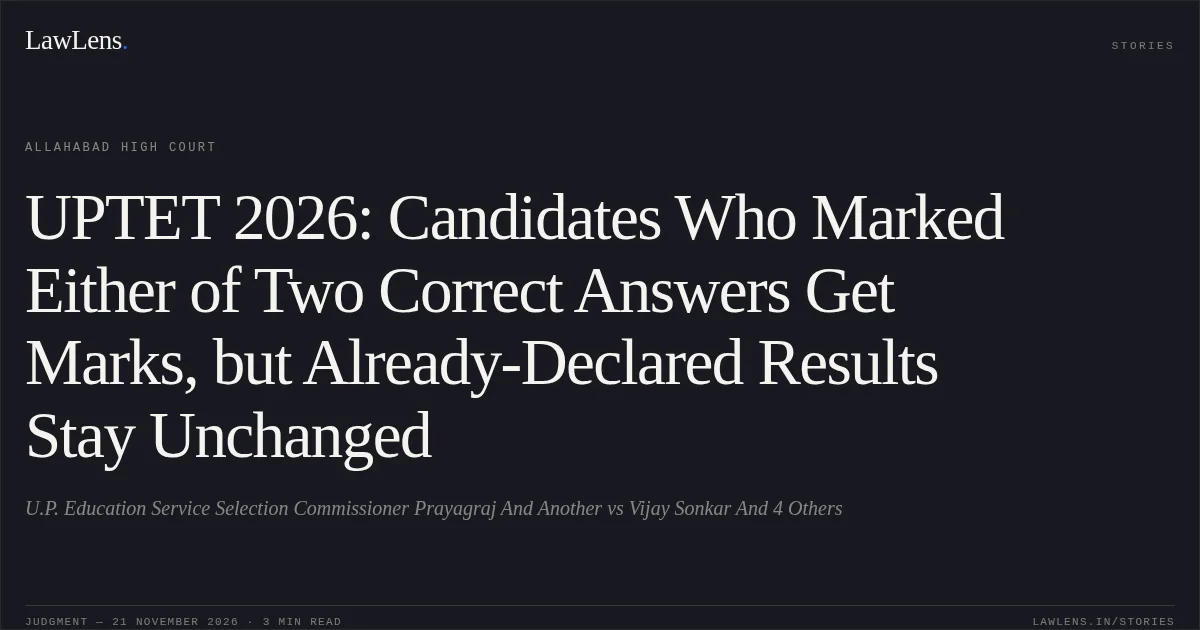
¶ 15, 19, 22The Special Appeal was partly allowed and the single judge's directions were modified. The Court ordered that: (i) results of candidates already declared successful on 26 August 2026 remain unaffected; (ii) for candidates not yet declared successful, the Commission shall award one mark each to those who marked either correct response to Questions 36 and 37; (iii) candidates who did not attempt either question shall receive no additional marks; and (iv) a supplementary result shall be prepared within one month, with liberty to seek further time.
¶ 22, 23, 24Original Court PDF
U.P. Education Service Selection Commissioner Prayagraj And AnothervsVijay Sonkar And 4 Others
Click to open original judgment
Original judgment, available to read, download and summarize on LawLens.in