Facts
The applicant, a Gramin Dak Sevak (GDS) Postman and Divisional Secretary of the GDS Employees Union, challenged a punishment order dated 18.10.2022 and an appellate order dated 16.12.2022.
Source reference: para 1, 2The applicant had applied for leave from 13.06.2022 to 22.06.2022, which was initially sanctioned but subsequently cancelled on 14.06.2022 after he participated in a protest/dharna against alleged corruption in the division.
Source reference: para 2.2, 5.6Despite directives to join duty and warnings that the protest was unauthorized, the applicant continued the dharna until 29.06.2022.
Source reference: para 5, 20Consequently, disciplinary proceedings were initiated under Rule 10 of the GDS (Conduct and Engagement) Rules, 2020.
Source reference: para 2.3, 5.1A minor penalty of withholding the annual increase in Time Related Continuity Allowance (TRCA) for three years without cumulative effect was imposed.
Source reference: para 2.3, 5.1The applicant’s statutory appeal was rejected by the Superintendent of Post Offices.
Source reference: para 2.4, 5.1Issues
1. Whether the punishment imposed by the disciplinary authority and upheld by the appellate authority warrants judicial interference by the Tribunal.
Source reference: para 12(i)2. Whether the disciplinary proceedings suffered from procedural illegality or a violation of the principles of natural justice, particularly regarding the absence of a formal inquiry.
Source reference: para 12(ii)3. Whether the applicant was required to exhaust alternative remedies, such as a Review Petition, before approaching the Tribunal.
Source reference: para 12(iii)Law Applied
Gramin Dak Sevak (Conduct and Engagement) Rules, 2020, specifically Rule 10 (procedure for imposing penalties), Rule 10(E) (discretion of the Disciplinary Authority regarding inquiries for minor penalties), and Rules 20, 21, and 23 regarding conduct and demonstrations.
Source reference: para 5.1, 5.7, 10Postal Directorate O.M. dated 02.02.2021, which prohibits mixing GDS issues with departmental union agitations.
Source reference: para 13.1, 20The Tribunal applied the principles from B.C. Chaturvedi v. Union of India regarding the scope of judicial review.
Source reference: para 16Union of India v. P. Gunasekaran, which restrict the court from re-appreciating evidence unless the findings are perverse.
Source reference: para 16S.S. Rathore v. State of Madhya Pradesh regarding the exhaustion of statutory remedies and the accrual of the cause of action.
Source reference: para 22Reasoning
The Tribunal observed that the scope of judicial review is limited to examining procedural propriety and the presence of evidence rather than the quantum of punishment.
Source reference: para 13, 16.3It found that the applicant was specifically informed that permission for the dharna was denied and his leave was cancelled, yet he willfully remained absent.
Source reference: para 17, 20The Tribunal held that under Rule 10(E) of the GDS Rules, a formal inquiry is not mandatory for minor penalties, and since the applicant was given an opportunity to submit a defense statement, the principles of natural justice were satisfied.
Source reference: para 10, 14The Tribunal rejected the applicant's claim of mala fides, noting that bald allegations without cogent evidence are insufficient for interference.
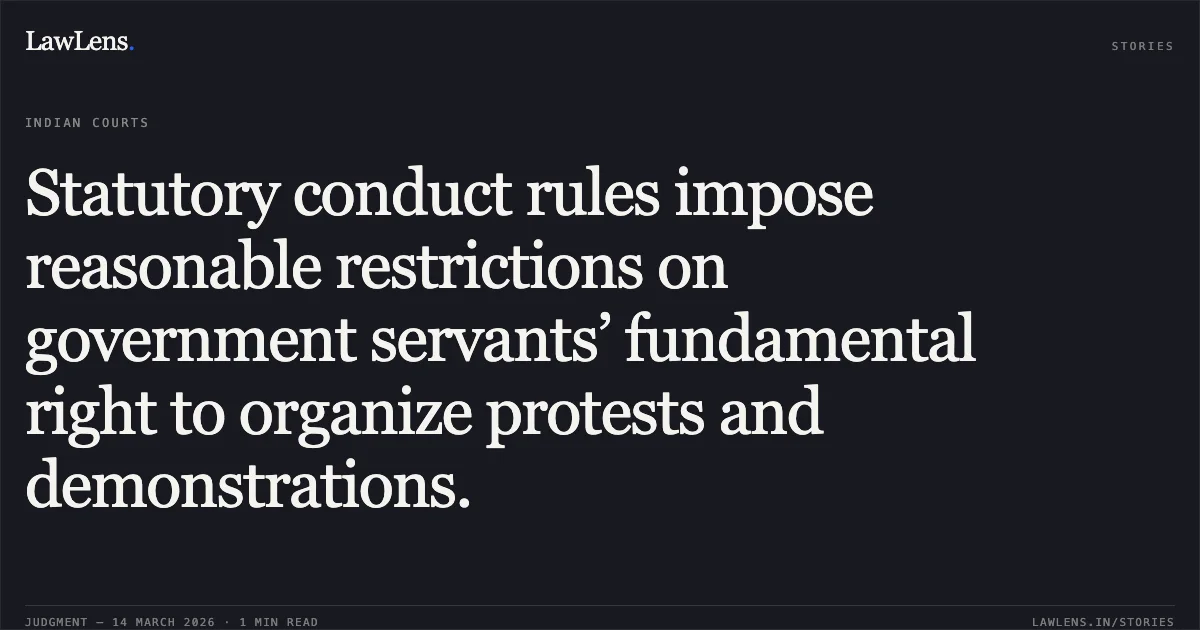
Source reference: para 18, 23The Tribunal clarified that while Article 19 guarantees the right to protest, government servants are subject to reasonable restrictions under statutory conduct rules to maintain administrative efficiency.
Source reference: para 19, 24Holding
The Tribunal dismissed the Original Application, holding that there was no procedural irregularity or lack of jurisdiction in the impugned orders.
The court held that the applicant’s participation in an unauthorized joint protest while absent without leave constituted a valid ground for the minor penalty imposed.
Source reference: para 20, 24The court further clarified that the precedent in B.R. Singh v. Union of India was distinguishable as the present case concerned individual disciplinary misconduct under service rules rather than the general right to form associations.
Source reference: para 25No costs were awarded.
Source reference: para 29Original Court PDF
AKBAR SINGH PUNDIRvsPOST UTTRAKHAND CIRCLE
Click to open original judgment
Original judgment, available to read, download and summarize on LawLens.in