Facts
The petitioner, an employee in the Bihar Police service, filed a writ petition seeking to quash a letter dated 12.09.2025, which declared him ineligible for the third Modified Assured Career Progression (M.A.C.P.).
Source reference: para. 2(a)He further sought directions for the respondents to grant him the third M.A.C.P. effective from 04.08.2018, and to correct the effective date of his second M.A.C.P. to 01.01.2009.
Source reference: para. 2(b)-(c)During the proceedings, the State raised a preliminary objection regarding the maintainability of the writ, pointing to an alternative statutory remedy for grievance redressal.
Source reference: para. 3Issues
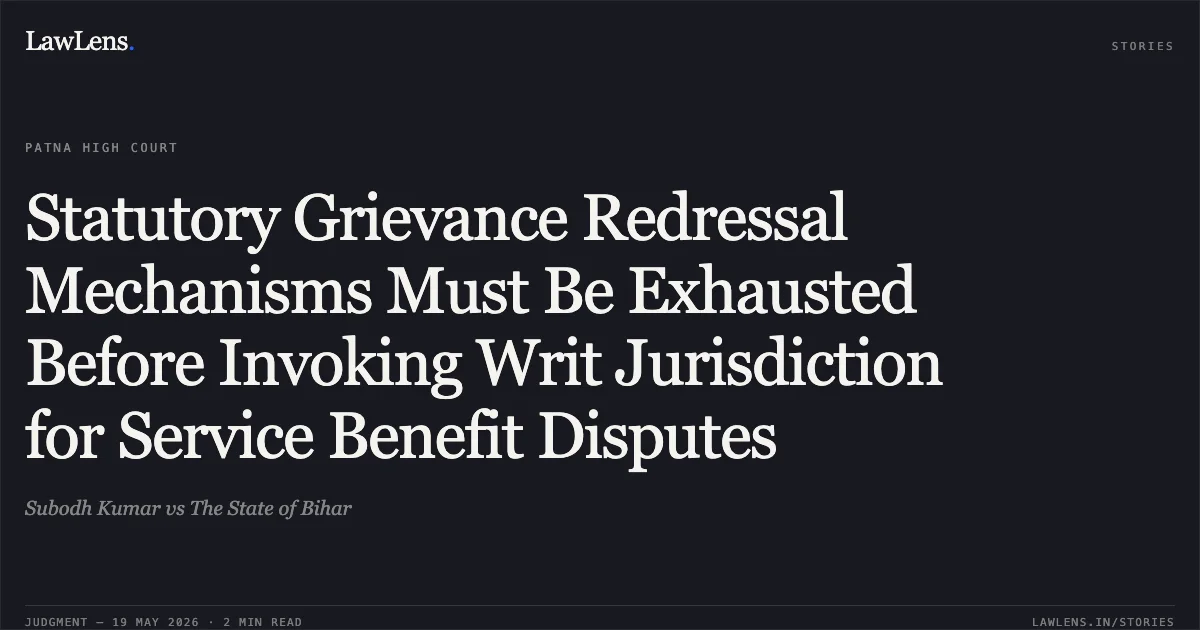
1. Whether the petitioner must exhaust the alternative remedy provided under the Bihar Government Servant Grievance Redressal Rules, 2019, before seeking relief under writ jurisdiction.
Source reference: para. 3-4Law Applied
Rule 2(c) of the Bihar Government Servant Grievance Redressal Rules, 2019 defines a "complaint" to include disputes regarding salary, increments, promotion, A.C.P., and M.A.C.P.
Source reference: para. 4Rule 3 prescribes the mandatory procedure for filing such complaints through an online mode for both serving and retired government personnel.
Source reference: para. 4.1The principles of administrative law generally require the exhaustion of alternative statutory remedies before a High Court exercises its discretionary power under Article 226 of the Constitution of India.
Source reference: no citationReasoning
The Court examined the nature of the petitioner's grievances—namely the denial of the third M.A.C.P. and the correction of the date for the second M.A.C.P.—and found that these matters fall squarely within the definition of a "complaint" under Rule 2(c) of the Rules of 2019.
Source reference: para. 4The Court noted that the State has established a specific specialized mechanism to deal with service-related benefits to reduce the burden on the judiciary. Consequently, the Court determined that rather than adjudicating the merits of the M.A.C.P. claim at this stage, the petitioner should be directed to follow the procedure for registering a complaint as outlined in Rule 3.
Source reference: para. 5Holding
The Court disposed of the writ petition without interfering with the impugned order at this stage.
It directed the petitioner to avail himself of the alternative remedy by filing a complaint under the Rules of 2019 before the concerned authority within 30 days. The concerned authority was further directed to decide the matter within the time frame specified by the 2019 Rules.
Source reference: para. 5-6Original Court PDF
Subodh KumarvsThe State of Bihar
Click to open original judgment
Original judgment, available to read, download and summarize on LawLens.in