Facts
The Petitioner joined the Respondent company in 1986. He resigned on May 15, 1996.
Source reference: para. 4Subsequently, he sought re-employment and was appointed as an Assistant Manager on September 20, 1996, on the express condition that it would be a "fresh appointment" and past service would not be counted.
Source reference: para. 5-6Under the General Insurance (Employees’) Pension Scheme, 1995, the Petitioner, being over 35 at the time of fresh appointment, exercised a written option on November 20, 1996, to "forego his right to pension," choosing the Provident Fund (PF) route instead.
Source reference: para. 6, 8He superannuated on January 31, 2019.
Source reference: para. 9In April 2019, an amendment to the Scheme reopened a pension option for employees who had joined service before June 28, 1995.
Source reference: para. 10The Petitioner’s request to join under this amendment was rejected by the Respondents on the grounds that his relevant appointment date was in 1996 (post-notified date) and he had previously opted out.
Source reference: para. 11Issues
1. Whether the Petitioner’s appointment in September 1996 constitutes a "fresh appointment" effectively severing his past service for pensionary benefits?
Source reference: para. 40(i) & (ii)2. Whether the option exercised by the Petitioner in 1996 to opt out of the Pension Scheme was final and binding?
Source reference: para. 40(iv)3. Whether the 2019 Amendment is discriminatory under Articles 14 and 16 by restricting the reopened pension option to those who joined before June 28, 1995?
Source reference: para. 40(v)Law Applied
The court applied the General Insurance (Employees’) Pension Scheme, 1995, specifically Paragraph 3(4) regarding post-notified date entrants and Paragraph 4, which allows employees aged 35+ to forego pension rights via a final option.
Source reference: para. 16-17, 49Regarding constitutional validity, the court relied on the "intelligible differentia" test under Article 14.
Source reference: para. 66It distinguished D.S. Nakara v. Union of India and All Manipur Pensioners Association v. State of Manipur, which prohibit arbitrary cut-off dates for a homogeneous class of pensioners, by contrasting them with Krishena Kumar v. Union of India, which establishes that PF optees and pension optees do not form a homogeneous class.
Source reference: para. 28, 66, 72Reasoning
The court reasoned that the Petitioner’s 1996 resignation terminated his first spell of service; thus, his status is determined solely by his fresh appointment in September 1996.
Source reference: para. 43-44Although Paragraph 3(4) of the Scheme covers post-1995 entrants, it is subject to the Paragraph 4 option mechanism. The Petitioner consciously signed a final, irrevocable declaration opting out of the pension scheme.
Source reference: para. 50-51Regarding the 2019 Amendment, the court found no "hostile discrimination." The classification between "pre-notified date" employees (who joined before the scheme existed) and "post-notified date" employees (who joined when the scheme was active and opted out) is a rational one.
Source reference: para. 68-70The 2019 Amendment was a "special window" for a transitional class, not a general pension revision; therefore, Article 14 does not compel the State to allow those who previously declined the scheme to revoke their choice years later.
Source reference: para. 70-74Holding
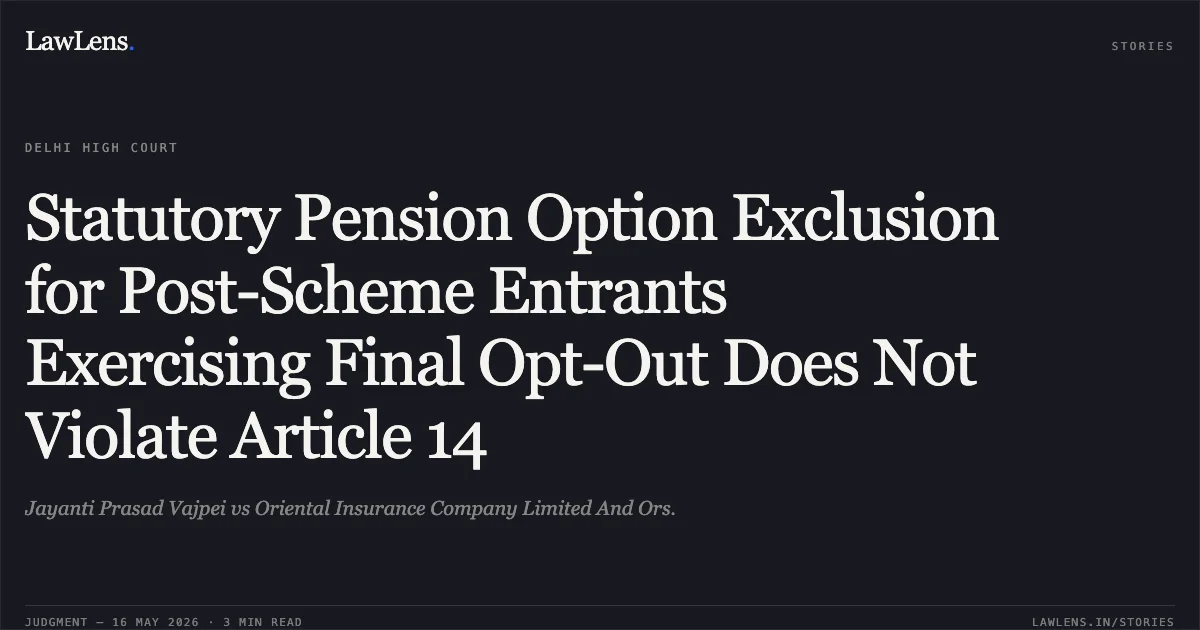
The court held that the Petitioner’s 1996 appointment was a fresh start that did not satisfy the "pre-June 1995" criteria of the 2019 Amendment; specifically, the Petitioner’s 1996 decision to forego pension was final and binding.
The court concluded that the 2019 Amendment’s cut-off date is constitutionally valid as it targets a specific historical class of employees who joined before the Pension Scheme was originally notified. The court dismissed the writ petition and relief was denied.
Source reference: para. 82.5, 83Acts & Sections Cited
9 provisions across 5 statutes referred to in this judgment. Linked provisions open on LawLens.
General Insurance Business (Nationalisation) Act, 19721
General Insurance (Employees’) Pension Scheme, 19955
General Insurance (Employees’) Pension (Amendment) Scheme, 19971
General Insurance (Employees’) Pension (Amendment) Scheme, 20101
General Insurance (Employees’) Pension (Amendment) Scheme, 20191
Original Court PDF
Jayanti Prasad VajpeivsOriental Insurance Company Limited And Ors.
Click to open original judgment
Original judgment, available to read, download and summarize on LawLens.in