Facts
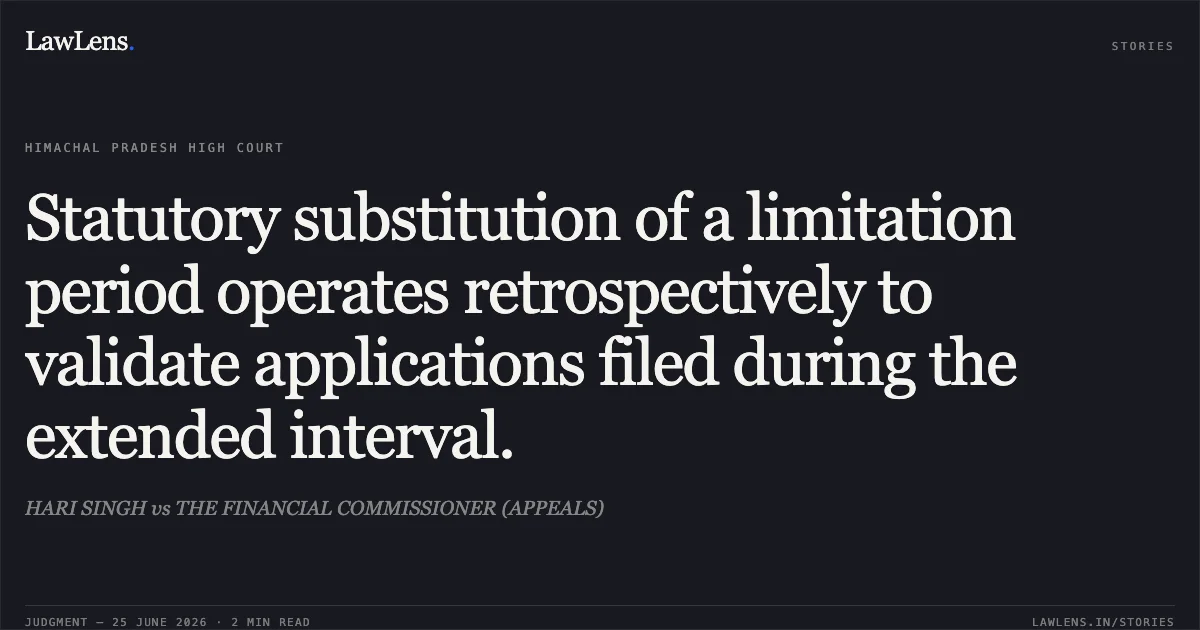
The appellants (tenants) challenged the concurrent findings of the revenue authorities and a learned Single Judge regarding the resumption of land by landowners under Section 104 of the Himachal Pradesh Tenancy and Land Reforms Act, 1972.
Source reference: para. 1-3The landowners (three brothers) filed an application for resumption on 03.12.1975, which was initially signed by only one brother (Hem Raj).
Source reference: para. 5The appellants contended that the application was time-barred because the original one-month window expired on 03.11.1975, and that the application was improperly constituted due to the missing signatures.
Source reference: para. 6In the first round of litigation, these specific objections were not raised by the tenants in their reply.
Source reference: para. 7-8Following a remand by the Financial Commissioner in 1987, the tenants raised these technical objections for the first time.
Source reference: para. 8Issues
1. Whether an application for resumption of land filed on 03.12.1975 was barred by limitation despite a subsequent notification extending the deadline to 31.12.1975.
Source reference: para. 6, 142. Whether the application was legally maintainable when signed by only one of three joint landowners at the time of filing.
Source reference: para. 5, 22Law Applied
Section 104 of the Himachal Pradesh Tenancy and Land Reforms Act, 1972, which grants landowners the right to resume land for personal cultivation.
Source reference: para. 12Rule 21 of the HP Tenancy and Land Reforms Rules, noting that the substitution of a limitation period by notification (dated 15.12.1975) operates retrospectively from the date the original rules came into force.
Source reference: para. 13-15The "mischief rule" from Heydon's case and M/s National Insurance Co. Ltd. v. Baljit Kaur to advance the legislative remedy.
Source reference: para. 17The principle from Collector of Central Excise v. Wood Crafts Products Ltd. and CIT v. Vatika Township that clarificatory or curative amendments are generally retrospective.
Source reference: para. 19-21Principles from Karan Singh v. Rachpal Singh and All India Reporter Ltd. v. Ram Chandra Dhondo Datar to hold that signing a plaint is a matter of procedure that can be rectified.
Source reference: para. 9Reasoning
The court reasoned that since Rule 21(2) was "substituted" rather than merely amended, the extended deadline of 31.12.1975 related back to the inception of the Rules (03.10.1975), thereby validating the application filed on 03.12.1975.
Source reference: para. 14-16The court held that the extension was beneficiary for landowners and intended to make the law workable.
Source reference: para. 18On the issue of signatures, the court found that the tenants were estopped from raising this plea in the second round of litigation, as they failed to object during the first round reaching the Financial Commissioner in 1987.
Source reference: para. 23-24The court observed that Rule 21 allows an "authorized person" to file the form; given the applicants were brothers, one was implicitly authorized to act for the others, and subsequent signatures validated the act.
Source reference: para. 9, 26Holding
The High Court dismissed the appeals, holding that the application was filed within the validly extended limitation period and was properly constituted.
The court affirmed that procedural rules are "handmaids of justice" and cannot be used to defeat substantive rights when clarified by retrospective substitution.
Source reference: para. 16, 18The orders of the revenue authorities and the Single Judge allowing the landowners to resume 17-4-14 bighas of land were upheld.
Source reference: para. 28, 34Acts & Sections Cited
1 provisions across 1 statute referred to in this judgment. Each provision opens on LawLens.
Insolvency and Bankruptcy Code, 2016.1
Original Court PDF
HARI SINGHvsTHE FINANCIAL COMMISSIONER (APPEALS)
Click to open original judgment
Original judgment, available to read, download and summarize on LawLens.in