01Facts
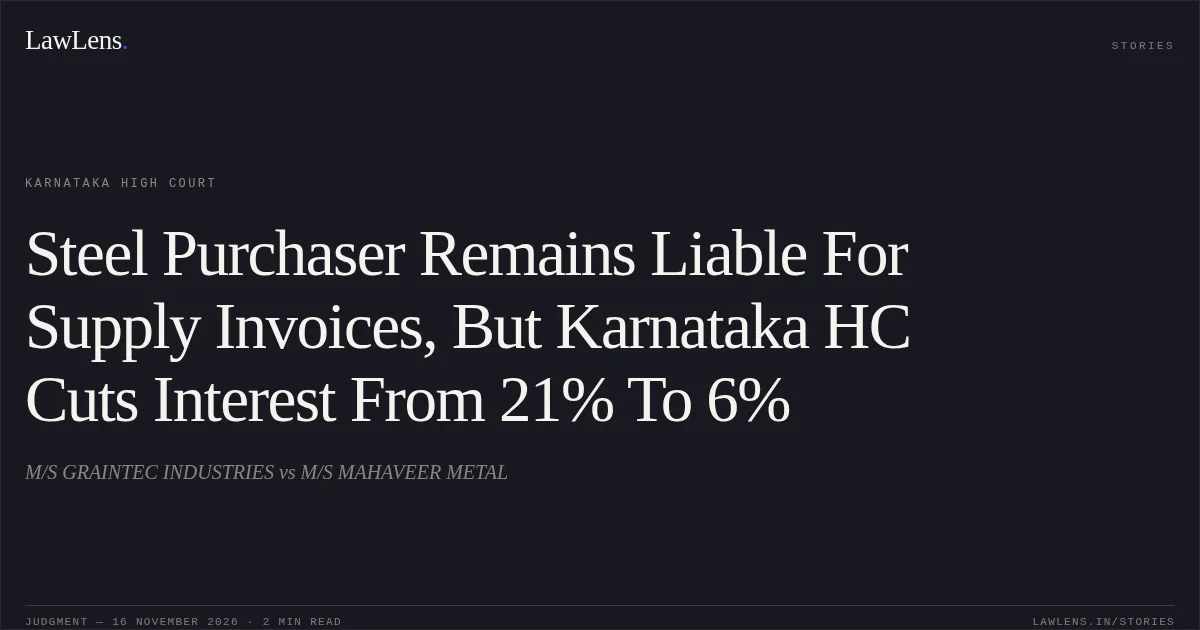
The plaintiff sued to recover the price of iron and steel supplied on credit under ten invoices, claiming a total of ₹27,93,205, including interest.
pp. 3–6The defendant admitted some purchases but alleged that payments for certain invoices had been made by RTGS, disputed supply under the remaining invoices, and contended that cheques had been given as security.
pp. 3–6The Commercial Court decreed the suit with costs and awarded interest at 21% per annum.
pp. 3–6In the appeal, the defendant challenged both the finding of liability and the interest rate.
pp. 6–7, 9–10The High Court left the finding on liability undisturbed but considered the interest award separately.
pp. 6–7, 9–1002Issues
i.1. Whether the defendant established grounds to disturb the finding that it was liable for the goods supplied.
p. 7ii.2. Whether the award of interest at 21% per annum was justified, or required modification.
pp. 7, 9–1003Law Applied
Under Section 34 of the Code of Civil Procedure, the court has discretion to determine a reasonable rate of interest; an agreed contractual rate is relevant but does not remove the court’s obligation to assess whether the award is reasonable.
p. 9In I.K. Merchants (P) Ltd. v. State of Rajasthan, 2025 SCC OnLine SC 692, the Supreme Court stated that interest should fairly compensate the claimant, reflect the loss of use of money, and should not be punitive or unduly burdensome; the rate and period must be assessed on the circumstances of the case rather than applied mechanically.
p. 9A pleaded defence, without evidence supporting it, does not displace unchallenged oral and documentary evidence.
pp. 8–9Provisions in the judgment · 1 · Linked ones open on LawLens
Commercial Courts Act, 2015 Section 13
04Reasoning
The defendant did not cross-examine the plaintiff’s witness, enter the witness box, or produce evidence of the alleged RTGS payments or non-supply.
pp. 8–9The Commercial Court was therefore entitled to rely on the plaintiff’s unchallenged testimony and documents, and the High Court found no basis to disturb the principal liability.
pp. 8–9However, the invoice stipulation for interest did not justify a 21% rate throughout the period after suit without a separate assessment of reasonableness.
p. 9The High Court considered that rate excessive and held that the defendant’s failure to contest the evidence did not absolve the court of its duty to assess the interest award.
p. 905Holding
The appeal was partly allowed.
pp. 10–11The finding of liability for the goods supplied was affirmed, but the decree was modified to award interest at 6% per annum on the amount determined, from the date of institution of the suit until realisation.
pp. 10–11The amount already deposited was ordered to be released to the plaintiff, and the parties were directed to bear their own costs.
pp. 10–11Original Court PDF
M/S GRAINTEC INDUSTRIESvsM/S MAHAVEER METAL
Click to open original judgment
Original judgment, available to read, download and summarize on LawLens.in