01Facts
The suit property was allotted by the BDA to the plaintiff's father, who later gifted it to the plaintiff (Smt. Geetha) by registered gift deed dated 25.02.2006.
¶ 5(i), 21The plaintiff mortgaged the property to BDA Housing Co-operative Society for a loan of ₹4,00,000, of which ₹2,00,000 was repaid.
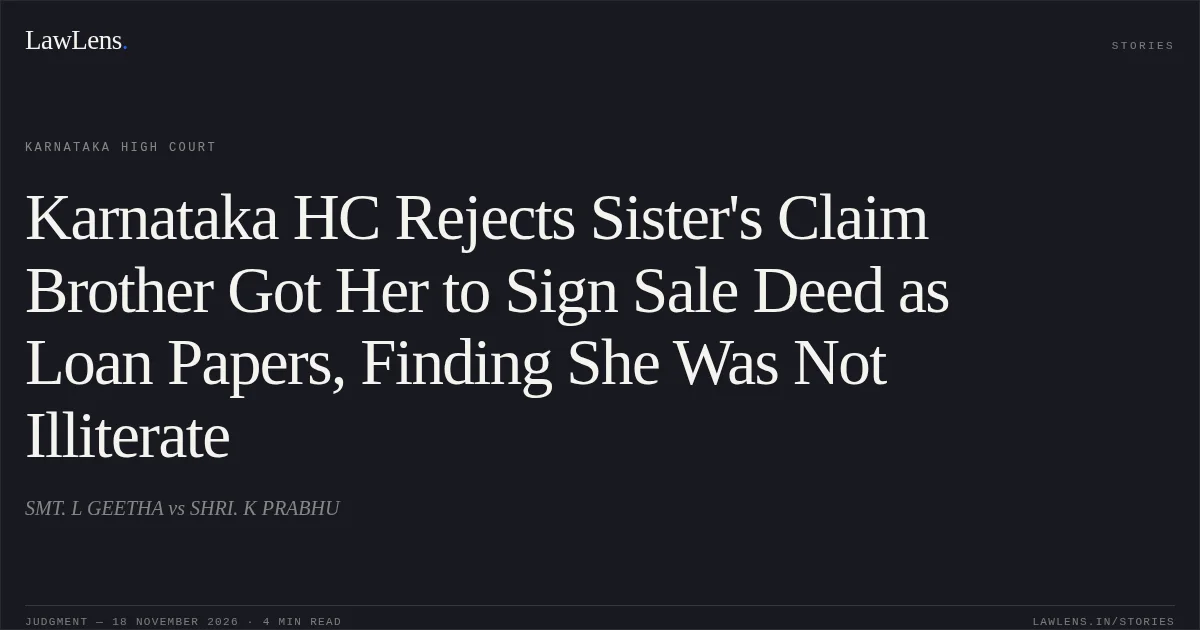
¶ 5(ii), 21The plaintiff alleged that her brother, defendant No. 1 (K. Prabhu), a bank employee, induced her to clear the Society loan through a bank loan at lower interest, and that she signed papers she believed were loan documents.
¶ 5(ii), 12A registered sale deed dated 01.10.2007 in favour of defendant No. 1 recited a consideration of ₹8,00,000.
¶ 5(iii), 33Defendant No. 1 pleaded a sale agreement dated 23.08.2007 (Ex. D31) with ₹2,00,000 paid in cash, and a bank housing loan of ₹6,00,000 from defendant No. 2 (Vijaya Bank).
¶ 6(ii)–(iii), 34Of that loan, ₹2,74,254 was paid to the BDA Society and ₹3,25,746 was credited to the plaintiff's account, which she partly withdrew.
¶ 6(ii)–(iii), 34A lease of the second floor at ₹4,000 per month was executed on 11.10.2007.
¶ 6(vi), 35The plaintiff stopped paying rent in February 2011. A legal notice dated 04.03.2013 (also referred to as 07.03.2013) terminated the tenancy, and the plaintiff replied on 22.03.2013.
¶ 6(vi)–(viii), 10, 41The plaintiff filed OS No. 8450/2012 seeking a declaration that the sale deed was fraudulent and void. The trial court dismissed it on 15.10.2019 (RFA 650/2020).
¶ 4, 9Defendant No. 1 then filed OS No. 1913/2020 for ejectment and arrears of rent, which was decreed on 04.09.2024 (RFA 2683/2024).
¶ 10Both appeals were heard together.
¶ 10–1102Issues
i.1. Whether the plaintiff proved that defendant No. 1 misrepresented the character of the document and procured the sale deed dated 01.10.2007 by fraud, rendering it void.
¶ 20(i), 23, 28–39ii.2. Whether the trial court was justified in dismissing OS No. 8450/2012.
¶ 20(ii), 39iii.3. Whether the trial court was justified in decreeing OS No. 1913/2020 for ejectment.
¶ 20(iii), 40–4203Law Applied
The court relied on the distinction between fraud as to the character of a document, which renders it void, and fraud as to its contents, which renders it voidable, as laid down in Ningawwa v. Byrappa.
¶ 24The court relied on Dularia Devi v. Janardan Singh on the same distinction between character and contents of a document.
¶ 25The court applied the plea of non est factum as explained in Ramathal v. K. Rajamani (2024), under which the signatory must belong to a class unable to understand the document through illiteracy or similar disability, must have made a fundamental mistake as to its nature, and the document must be radically different from what was intended.
¶ 26The court referred to Subhas Chandra Das Mushib v. Ganga Prasad Das Mushib on undue influence under Section 16 of the Indian Contract Act, which requires a dominant position in the relationship and an unfair advantage.
¶ 27Whether a registered sale deed is valid as against the executant is governed by these principles, and a lessor's right to recover possession after valid termination of tenancy is governed by the title established in the sale deed.
¶ 42Provisions in the judgment · 3 · Linked ones open on LawLens
Code of Civil Procedure, 1908 Section 96
Limitation Act, 1963 Section 95
Indian Contract Act, 1872 Section 16
04Reasoning
The court held that the plaintiff was not illiterate in the relevant sense. She had identified and admitted the documents in cross-examination, and defendant No. 1 stated she had studied to the eighth standard.
¶ 29Because she had earlier attended the Sub-Registrar's office for the gift deed and the BDA mortgage, she was aware of registration procedure.
¶ 30The court relied on conduct consistent with a completed sale: the sale agreement (Ex. D31) was attested.
¶ 31The plaintiff admitted receiving the ₹2,74,254 DD and obtained the loan discharge certificate, which was registered after the sale deed.
¶ 32The sub-registrar's endorsement recorded her admission of execution.
¶ 33She withdrew sums credited from the bank DD, which formed part of the consideration.
¶ 34The lease deed dated 11.10.2007 was executed by her, and the stamp paper was purchased on 09.10.2007, which undercut her claim that she signed a mortgage or loan document on 01.10.2007.
¶ 35Her failure to pay property tax after 2007 further supported the finding that she parted with ownership.
¶ 37The court also found a credible motive for sale, namely repaying the BDA loan and funding her daughter's marriage.
¶ 38Taken together, these findings led the court to conclude that the plaintiff knowingly executed the sale deed and that the fraud alleged was not established.
¶ 39The dismissal of OS No. 8450/2012 therefore established that defendant No. 1 holds title, and the plaintiff's continued occupation was under the lease of 11.10.2007. The court held that the ejectment decree was correct, noting that the claim for damages was limited to three years before the suit.
¶ 42The judgment does not expressly address certain appellant contentions, including the discrepancy between ₹8,00,000 and ₹16,00,000 in DW-1's evidence, the variance in the agreement and notice dates (23.05.2007/23.08.2007; 04.03.2013/07.03.2013), and the variance in signatures. The findings on these points are implicit at most.
¶ 12, 14, 1805Holding
1. Issue 1 is answered in the negative: the plaintiff did not prove that defendant No. 1 misrepresented the character of the sale deed or procured it by fraud, and the sale deed dated 01.10.2007 is valid and binding.
¶ 392. Issue 2 is answered in the affirmative: the trial court was justified in dismissing OS No. 8450/2012.
¶ 39, 433. Issue 3 is answered in the affirmative: defendant No. 1 is the owner, the lease dated 11.10.2007 subsisted and was validly terminated, and the ejectment decree in OS No. 1913/2020 was rightly passed.
¶ 42Both RFA No. 650/2020 and RFA No. 2683/2024 are dismissed, and the trial court judgments and decrees are affirmed.
¶ 43Original Court PDF
SMT. L GEETHAvsSHRI. K PRABHU
Click to open original judgment
Original judgment, available to read, download and summarize on LawLens.in