Facts
The petitioner was appointed as an Anganwadi Worker on 23 March 2017 and was serving at Anganwadi Centre No. 9D, Kolaras, District Shivpuri.
Source reference: pp. 1–3, paras. 2–5The Project Officer terminated her services by order dated 24 March 2018. The order referred to alleged unauthorised absence, deputing her sister to perform her duties, residing at her matrimonial home in Gwalior, failure to provide services and benefits under various welfare schemes, and deficiencies in monitoring and reporting.
Source reference: pp. 1–3, paras. 2–5The petitioner contended that the termination order was stigmatic and was passed without a charge-sheet, proper hearing, or regular departmental enquiry.
Source reference: pp. 1–3, paras. 2–5Her appeal was rejected on 30 November 2018.
Source reference: p. 2, para. 2The State defended the action on the basis of the appointment condition permitting termination without notice.
Source reference: p. 2, para. 3Issues
Whether the termination order dated 24 March 2018, containing allegations of misconduct and dereliction of duty, was stigmatic in nature.
Source reference: pp. 3–4, para. 5; p. 5, paras. 6–9Whether the petitioner’s services could be terminated without a regular departmental enquiry and an effective opportunity of hearing merely because the appointment condition permitted termination without notice.
Source reference: pp. 2–3, paras. 3–4; pp. 8–9, paras. 12–14Whether the termination order and the appellate order were liable to be quashed, with consequential reinstatement and other relief.
Source reference: pp. 9–10, para. 15Law Applied
The Court applied Article 226 of the Constitution and the principles of natural justice governing stigmatic termination.
Source reference: pp. 4–7, paras. 6–10A termination order founded on allegations of misconduct, dereliction of duty, or conduct adversely affecting an employee’s character or future prospects is stigmatic and cannot ordinarily be passed without framing charges, granting a meaningful opportunity of defence, and conducting a regular departmental enquiry.
Source reference: pp. 4–7, paras. 6–10Relying on Khem Chand v. Union of India, AIR 1958 SC 300, the Court held that reasonable opportunity includes notice of the allegations, an opportunity to deny the charges and cross-examine witnesses, and an opportunity to make a representation against the proposed punishment.
Source reference: pp. 4–5, para. 7The Court also relied on Rahul Tripathi v. Rajeev Gandhi Shiksha Mission, 2001 (3) MPLJ 616; Jitendra v. State of M.P., 2008 (4) MPLJ 670; Malkhan Singh Malviya v. State of M.P., ILR (2018) MP 660; and other coordinate Bench decisions holding that stigmatic termination without enquiry is legally unsustainable.
Source reference: pp. 5–9, paras. 7–11The State Government policy dated 10 July 2007 specifically required that an Anganwadi Worker be given an opportunity of hearing and be found guilty in an enquiry before removal from service.
Source reference: p. 8, para. 12Reasoning
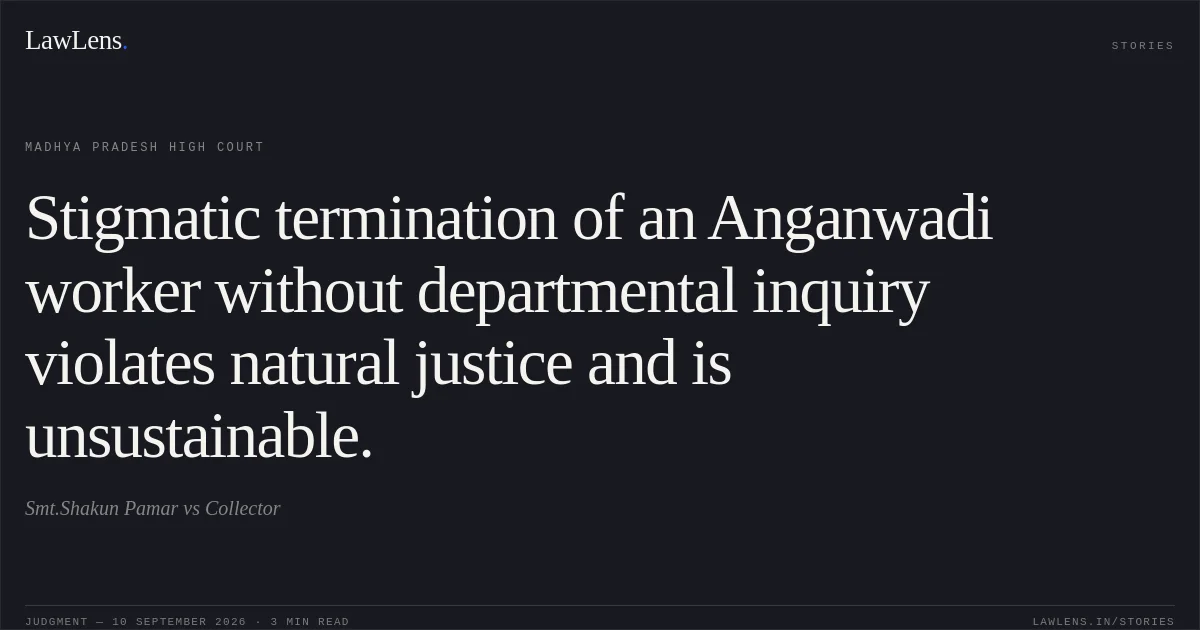
The Court examined the language of the termination order and found that it was not a simpliciter order of discontinuance; it expressly attributed several acts of misconduct and failure in the discharge of official duties to the petitioner.
Source reference: pp. 3–4, para. 5These findings carried adverse consequences for her service record and future prospects, thereby making the order stigmatic.
Source reference: pp. 3–4, para. 5Although the State relied on the appointment condition permitting termination without notice, that condition could not authorise termination founded on misconduct without compliance with natural justice.
Source reference: pp. 8–9, paras. 12–14The Court further noted that no charge-sheet had been issued and no regular departmental enquiry had been conducted, contrary both to the requirements of law and the State’s 10 July 2007 policy.
Source reference: pp. 8–9, paras. 12–14The appellate authority also failed to cure these foundational defects.
Source reference: no citationAccordingly, the termination and appellate orders could not be sustained.
Source reference: no citationHolding
The Court allowed the petition by setting aside the termination order dated 24 March 2018 and the appellate rejection order dated 30 November 2018.
The respondents were directed to reinstate the petitioner forthwith and grant all consequential benefits, except back wages, applying the principle of “no work, no pay”.
Source reference: p. 10, para. 15(ii)The State was granted liberty to initiate fresh proceedings against the petitioner in accordance with law, if necessary.
Source reference: p. 10, para. 15(iii)Original Court PDF
Smt.Shakun PamarvsCollector
Click to open original judgment
Original judgment, available to read, download and summarize on LawLens.in