Facts
The respondents established a new Branch Post Office (BO) at Thangappapuram on June 19, 2017
Source reference: p.3The applicant provided accommodation for the BO and was engaged as a Branch Postmaster (BPM) on a "stopgap" or "outsider" basis
Source reference: p.6The applicant alleged she was promised regular appointment subject to her performance
Source reference: p.3The respondents contended she was engaged without observing statutory recruitment formalities until a regular incumbent could be posted
Source reference: p.6On February 8, 2019, the applicant was disengaged after Smt. E. Gomathi, a regular GDS employee, was transferred to the Thangappapuram BO
Source reference: p.6After a previous Tribunal direction in OA/310/01181/2019, the 3rd respondent issued a speaking order on February 25, 2020, rejecting the applicant's claim for absorption on the grounds that her engagement was purely temporary
Source reference: p.5Issues
1. Whether an engagement as an "Outsider" on a stopgap basis confers a legal right to regular absorption or reinstatement as a Gramin Dak Sevak (GDS)
Source reference: p.11, para. 172. Whether an appointment made in infraction of the statutory recruitment rules can be regularized by the Tribunal
Source reference: p.13-14, para. 20-21Law Applied
The Tribunal primarily applied the Gramin Dak Sevaks (Conduct and Engagement) Rules, 2011, which mandate specific procedures—such as online notifications and merit-based selection—for regular appointments
Source reference: p.7, 14It relied on the Supreme Court precedent State of Karnataka v. Uma Devi [(2006) 4 SCC 1], which held that illegal appointments made in violation of recruitment rules cannot be regularized
Source reference: p.13-14It further cited Devika Guha v. Union of India, which established that substitutes have no legal claim to regularization
Source reference: p.10The Karnataka High Court decision in Superintendent of Post Offices & Ors v. Sandeep H.L. (W.P. No. 24557/2013), which clarified that stopgap appointees have no right to claim regular service
Source reference: p.14-17Reasoning
The Tribunal found that the applicant’s engagement was a local stopgap arrangement intended to facilitate the functioning of a newly opened office until a regular selection could be made
Source reference: p.6The court noted that the applicant had not passed any qualifying tests or completed the formalities prescribed for regular GDS appointment
Source reference: p.18Applying the doctrine in Uma Devi, the Tribunal reasoned that since the applicant's initial entry was not through a process consistent with the constitutional scheme of public employment, it constituted an illegality that cannot be regularized
Source reference: p.14The Tribunal also rejected the applicant's argument regarding her DARPAN training and provision of accommodation, noting that training was given to all current workers for operational efficiency and that she was compensated for office maintenance
Source reference: p.9The court concluded that once a regularly selected employee (E. Gomathi) joined the post, the stopgap arrangement naturally stood terminated
Source reference: p.7, 18Holding
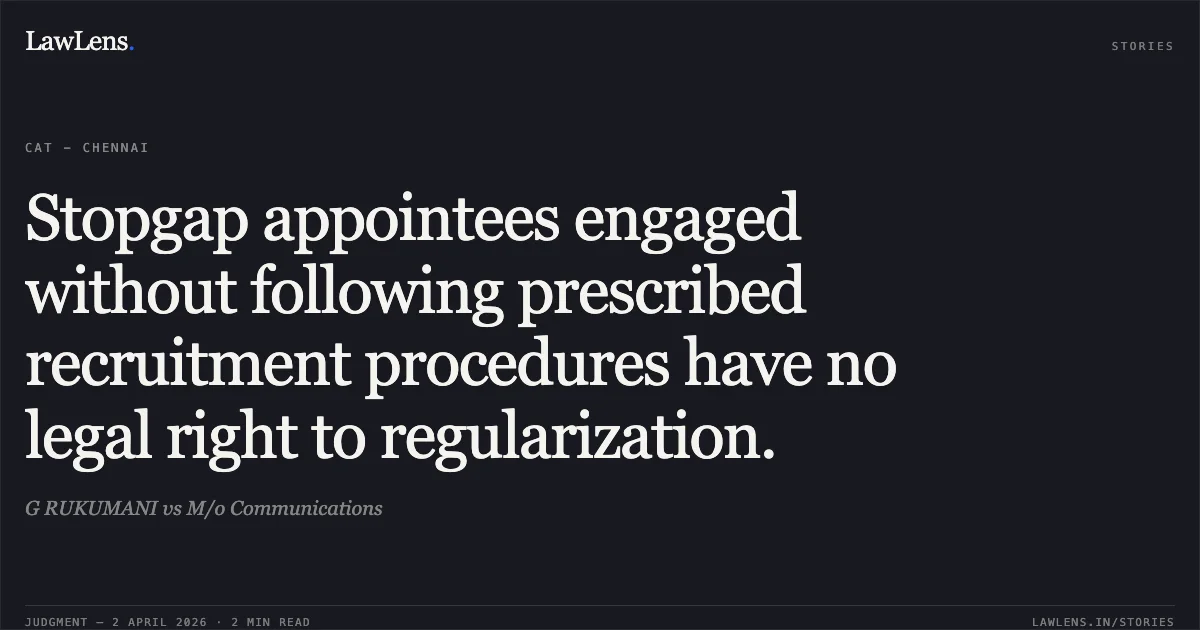
The Tribunal held that a stopgap appointee has no right to claim regular appointment or continued service under the GDS Rules
The court answered the issues in the negative, stating that the applicant's engagement was purely temporary and lacked the status of a regular appointment
Source reference: p.18The holding affirmed that the respondents' action was in accordance with departmental rules, and the Original Application was dismissed
Source reference: p.18Acts & Sections Cited
1 provisions across 1 statute referred to in this judgment. Each provision opens on LawLens.
Administrative Tribunals Act, 19851
Original Court PDF
G RUKUMANIvsM/o Communications
Click to open original judgment
Original judgment, available to read, download and summarize on LawLens.in