Facts
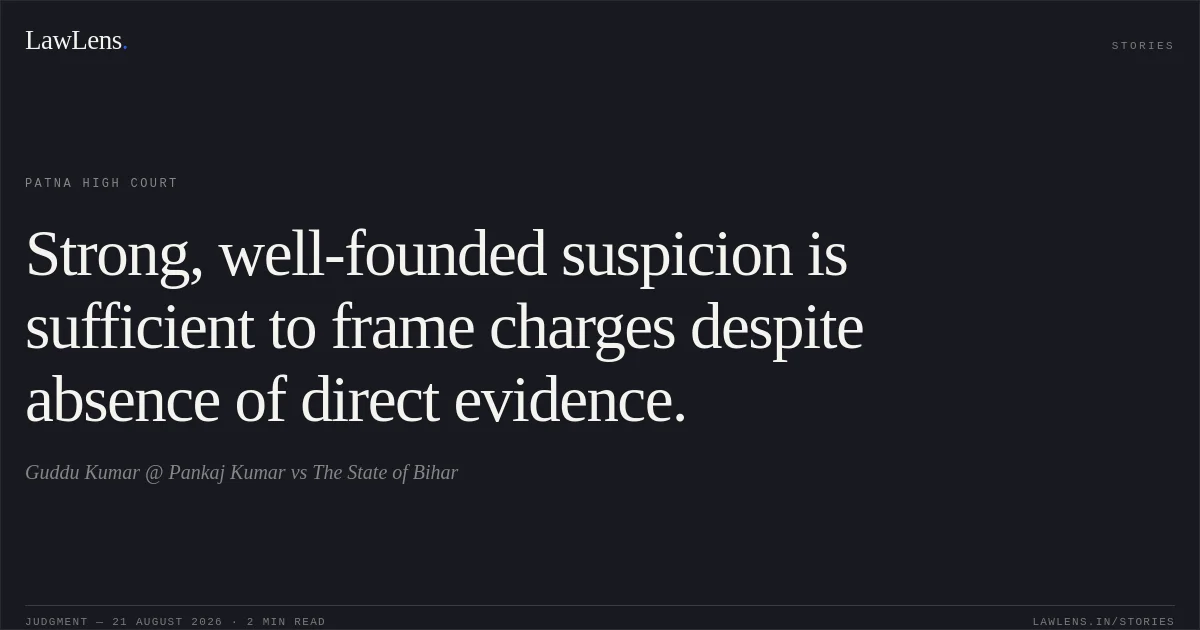
The appellant challenged the order dated 23 June 2025 passed by the Additional District & Sessions Judge-I, Jehanabad, in Special SC/ST Case No. 63 of 2024, arising from Karpi P.S. Case No. 85 of 2024.
Source reference: para. 2His application under Section 227 of the Code of Criminal Procedure, 1973, seeking discharge from prosecution, had been rejected.
Source reference: para. 2The case concerned the murder of the informant’s brother and alleged offences under Sections 302, 120-B and 34 of the Indian Penal Code, Section 27 of the Arms Act, and Sections 3(1)(r), 3(1)(s) and 3(2)(v) of the SC/ST (Prevention of Atrocities) Act.
Source reference: para. 2The FIR was initially lodged against unknown persons.
Source reference: para. 3The appellant argued that there was no eyewitness, no admissible evidence connecting him with the murder, and that he had been falsely implicated during investigation.
Source reference: para. 3The prosecution contended that investigation disclosed an altercation between the deceased and the appellant at a petrol pump, an extortion demand by the appellant, and a threat to teach the deceased a lesson shortly before the murder.
Source reference: para. 4–5The appellant had been charge-sheeted, and the trial had commenced, with two of six charge-sheeted witnesses examined by the date of judgment.
Source reference: para. 5Issues
Whether the material collected during investigation disclosed sufficient grounds or a strong suspicion against the appellant warranting framing of charges, despite the absence of direct eyewitness evidence.
Source reference: para. 5Whether the trial court erred in rejecting the appellant’s application for discharge under Section 227 of the Code of Criminal Procedure.
Source reference: para. 2, 5Law Applied
The Court applied Section 227 of the Code of Criminal Procedure, which permits discharge where, upon consideration of the record and documents submitted with the prosecution case, there is insufficient ground for proceeding against the accused; conversely, charges may be framed where the material raises a strong and well-founded suspicion of the accused’s involvement.
Source reference: para. 2The Court considered the charged offences under Sections 302, 120-B and 34 of the Indian Penal Code, Section 27 of the Arms Act, and Sections 3(1)(r), 3(1)(s) and 3(2)(v) of the SC/ST Act.
Source reference: para. 2Reasoning
The Court examined the FIR, case diary and impugned order.
Source reference: para. 5Although the FIR named no accused and there was no direct evidence of the appellant’s participation in the murder, the investigation allegedly established that the appellant had engaged in a heated altercation with the deceased at a petrol pump, demanded extortion, and threatened the deceased only a few hours before the murder.
Source reference: para. 5These circumstances constituted a strong and well-founded suspicion sufficient at the stage of framing charges.
Source reference: para. 5The Court therefore held that the absence of direct evidence was not a ground for discharge where the surrounding material justified proceeding with the prosecution.
Source reference: para. 5The pendency of the trial, during which two witnesses had already been examined, also weighed against interference with the trial court’s order.
Source reference: para. 5Holding
The High Court held that the material on record was sufficient to frame charges against the appellant and that the trial court committed no illegality in rejecting his application under Section 227 CrPC.
The appeal was dismissed for lack of merit, and any pending interlocutory application was disposed of.
Source reference: para. 5–6Acts & Sections Cited
5 provisions across 4 statutes referred to in this judgment. Each provision opens on LawLens.
Indian Penal Code, 18602
Arms Act, 19591
Scheduled Castes and the Scheduled Tribes (Prevention of Atrocities) Act, 19891
Code of Criminal Procedure, 19731
Original Court PDF
Guddu Kumar @ Pankaj KumarvsThe State of Bihar
Click to open original judgment
Original judgment, available to read, download and summarize on LawLens.in