Facts
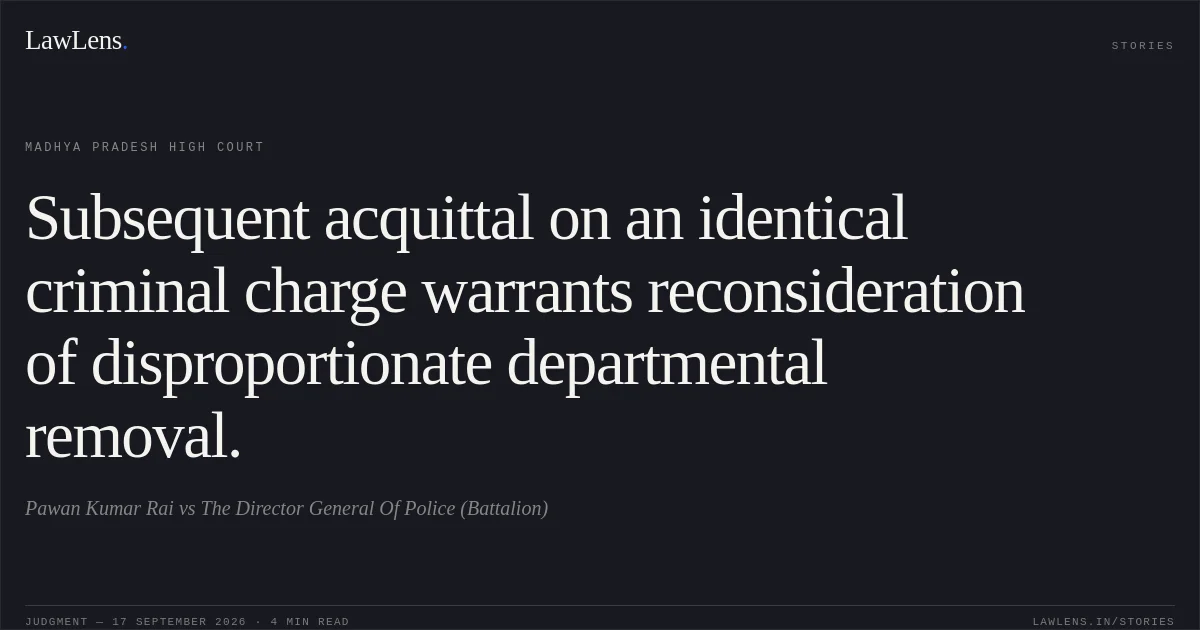
The petitioner, a Constable appointed in the 6th Battalion, Special Armed Force, Jabalpur, was charge-sheeted in December 2018 for three incidents involving alleged misbehaviour with colleagues and superior officers, including an allegation of misbehaviour and use of criminal force against a lady nurse.
Source reference: para. 2, para. 13After a departmental enquiry, the Enquiry Officer submitted a report dated 23 May 2019, and the disciplinary authority removed the petitioner from service by order dated 19 June 2019.
Source reference: para. 2, para. 12His departmental appeals were rejected on 19 July 2019 and 31 January 2020.
Source reference: para. 3One of the departmental charges substantially corresponded to the accusation in a criminal case arising from the same incident and involving substantially the same complainant and evidence.
Source reference: para. 4, para. 13The petitioner was acquitted in that criminal case by judgment dated 26 July 2021; he had also been acquitted in another criminal case by judgment dated 6 September 2019.
Source reference: para. 4, para. 13The petitioner challenged the disciplinary orders under Article 226 of the Constitution, principally contending that the criminal acquittal was relevant and that removal from service was disproportionate.
Source reference: paras. 4–7The State defended the penalty on the basis of the petitioner’s alleged habitual misconduct and adverse service record, including an earlier punishment and ten minor punishments.
Source reference: paras. 8–10Issues
Whether the subsequent acquittal in a criminal case arising from substantially the same incident, evidence and witnesses as one of the departmental charges warranted interference with the disciplinary orders.
Source reference: paras. 13–16Whether, having regard to the nature of the proved misconduct, the criminal acquittal and the petitioner’s service record, the penalty of removal from service was disproportionate.
Source reference: paras. 14–18Whether the High Court, while exercising judicial review under Article 226, could remit the matter for reconsideration of the quantum of punishment without disturbing the departmental findings on the merits.
Source reference: paras. 17–21Law Applied
The Court exercised judicial review under Article 226 of the Constitution, recognising that ordinarily it does not reappreciate evidence or act as an appellate authority over departmental findings.
Source reference: para. 10It applied Ram Lal v. State of Rajasthan, (2024) 1 SCC 175, which holds that where departmental and criminal charges are identical or substantially similar and arise from the same evidence, witnesses and circumstances, a criminal acquittal following full consideration of the prosecution evidence may justify relief if allowing the disciplinary findings to stand would be unjust, unfair or oppressive.
Source reference: para. 16The Court also applied the doctrine of proportionality in disciplinary punishment, relying on Surekha Domaji Bele v. Executive Engineer, Testing Division, MSEDCL, 2026 LiveLaw (SC) 624, under which the competent authority must consider a punishment other than the ultimate penalty after taking into account the employee’s length of service, past record, age, nature of misconduct, financial loss and other relevant circumstances.
Source reference: paras. 17–18The Court distinguished interference with the merits of the disciplinary findings from interference with the quantum of punishment.
Source reference: paras. 19–21Reasoning
The Court found that one departmental charge was substantially identical to the criminal accusation, arose from the same incident, and was supported by the same complainant and substantially the same evidence.
Source reference: para. 13, para. 16The criminal court’s acquittal therefore constituted a relevant circumstance under Ram Lal, although the Court did not itself substitute the criminal court’s conclusion for the departmental findings.
Source reference: para. 13, para. 16Even assuming that the remaining allegations of misbehaviour with colleagues and superior officers were proved, the Court held that their nature and gravity, particularly in the context of the acquittal on the substantially identical charge, did not justify the extreme penalty of removal.
Source reference: para. 14The disciplinary authority had failed to adequately examine whether the punishment was proportionate to the misconduct, and the appellate orders did not cure that defect.
Source reference: para. 15At the same time, the Court declined to adjudicate the correctness of the departmental findings or to direct automatic reinstatement, confining its intervention to reconsideration of punishment.
Source reference: paras. 17, 19, 21Holding
The petition was allowed in part.
The orders dated 19 June 2019, 19 July 2019 and 31 January 2020 were set aside only insofar as they concerned the quantum of punishment.
Source reference: para. 19The matter was remitted to the competent disciplinary authority to reconsider and impose an appropriate punishment other than the ultimate penalty of dismissal/removal, having regard to the proved charges, the petitioner’s criminal acquittal, past service record and the principle of proportionality.
Source reference: paras. 19–20The authority was directed to pass a reasoned and speaking order, preferably within three months of receiving the certified copy of the judgment.
Source reference: para. 20The departmental findings on the merits were left undisturbed, and no opinion was expressed on their correctness.
Source reference: para. 21Acts & Sections Cited
1 provisions across 1 statute referred to in this judgment. Each provision opens on LawLens.
Indian Penal Code, 18601
Original Court PDF
Pawan Kumar RaivsThe Director General Of Police (Battalion)
Click to open original judgment
Original judgment, available to read, download and summarize on LawLens.in