Facts
The petitioner was appointed as an Anganwadi Karyakarta in 2016 following the termination of respondent No. 5 in 2015 due to negligence and absence.
Source reference: p. 2Respondent No. 5 challenged her dismissal; while her first appeal was dismissed by the Additional Collector, her second appeal was allowed by the Additional Commissioner on 31.03.2018, ordering her reinstatement.
Source reference: p. 2The petitioner, who was not a party to those proceedings, challenged the reinstatement order, arguing she was selected on merit and that respondent No. 5 waived her rights by participating in the subsequent selection process.
Source reference: p. 3Respondent No. 5 contended the petitioner was merely a stop-gap arrangement and had no locus to challenge the reinstatement.
Source reference: p. 3Issues
1. Whether a subsequent appointee has the right to resist the reinstatement of a previously terminated employee whose dismissal was later set aside by a competent authority.
Source reference: p. 4, para. 9-102. Whether, on the grounds of equity and long-standing service, a subsequent appointee’s services can be protected even if the original incumbent is reinstated.
Source reference: p. 6-7, para. 13Law Applied
The Court applied the principle established in Jhunilal Yadav v. State of M.P. (2014), which holds that a person appointed to a vacancy created by a termination cannot resist the reinstatement of the original employee if that termination is quashed.
Source reference: p. 4-5The Court relied on the equitable doctrine from M.S. Mudhol (Dr.) v. S.D. Halegkar (1993), which posits that it is "inadvisable to disturb" an employee from their post after a long lapse of time (in that case 9-12 years) if they were not at fault during the selection process and equities have accrued in their favor.
Source reference: p. 5-7Reasoning
The Court first observed that, legally, the petitioner’s appointment was a consequence of respondent No. 5’s termination and was implicitly subject to the outcome of the ongoing litigation.
Source reference: p. 4Under the rule in Jhunilal Yadav, the petitioner would normally have to "make room" for the original incumbent.
Source reference: p. 5However, the Court pivoted to an equitable analysis, noting that the petitioner had been serving for over eight years and was not at fault for any procedural irregularities.
Source reference: p. 6-7The Court found that since the advertisement and appointment letter did not mention the pending litigation, and the petitioner had continued in service for a significant duration, it would be "inequitable" and "inadvisable" to terminate her at this belated stage.
Source reference: p. 7Holding
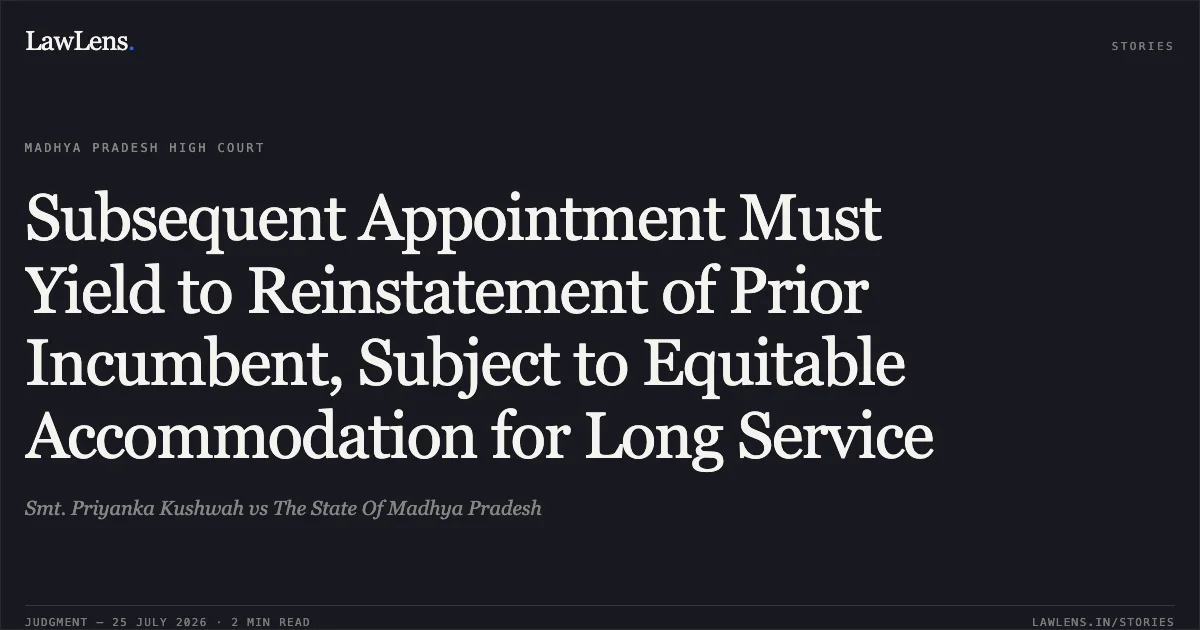
The Court allowed the petition by balancing the rights of both parties, holding that while respondent No. 5 was entitled to reinstatement due to the Commissioner’s order, the petitioner’s long service deserved protection under equity.
The Court ordered the respondents to: (i) accommodate the petitioner in an available vacant post or create a new post in a nearby center; (ii) reinstate respondent No. 5 immediately with consequential service benefits but without back wages on the "no work, no pay" principle; and (iii) complete this process within three months.
Source reference: p. 7Original Court PDF
Smt. Priyanka KushwahvsThe State Of Madhya Pradesh
Click to open original judgment
Original judgment, available to read, download and summarize on LawLens.in