Facts
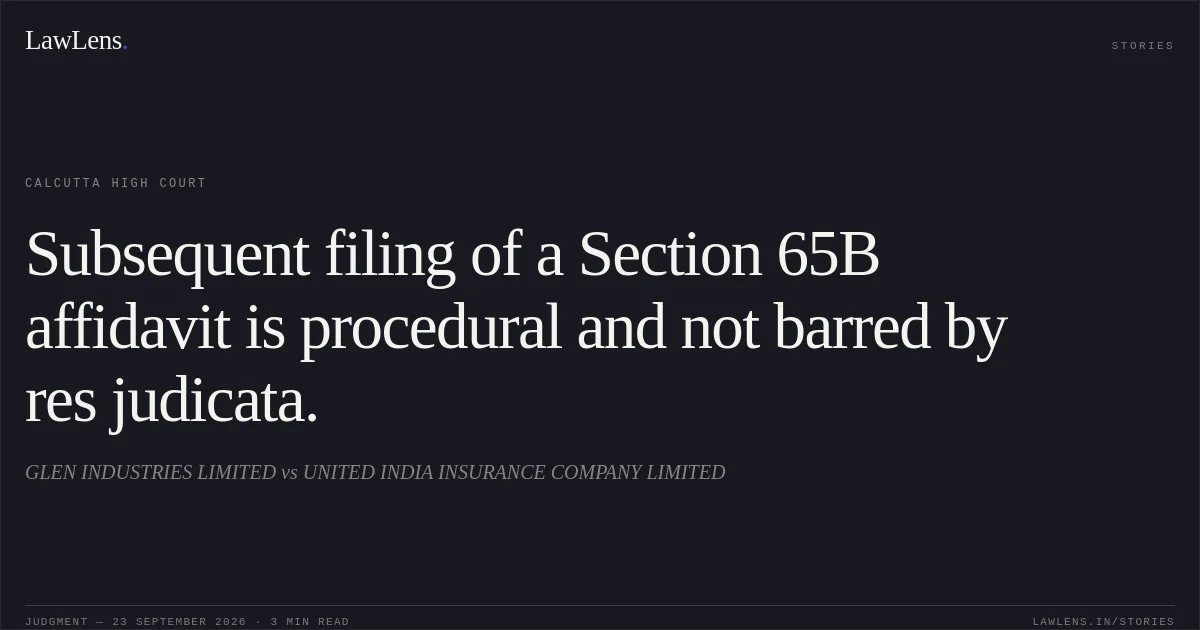
The plaintiff sought permission to file an affidavit under Section 65B of the Indian Evidence Act, 1872, corresponding to Section 63 of the Bharatiya Sakshya Adhiniyam, 2023 (“BSA”), in respect of documents identified in paragraph 5 of the application as Annexure “E”.
Source reference: para. 1; p. 1; para. 12; p. 4In an earlier application, IA No. GA-COM/5/2025, the Court had permitted the plaintiff to file a similar affidavit restricted to two documents; that affidavit had been filed and admitted in evidence during the plaintiff’s witness’s examination-in-chief.
Source reference: para. 2; p. 2The defendant opposed the application, contending that it was barred by res judicata or constructive res judicata, and arguing that permitting the affidavit could create evidentiary conflict requiring recall of witnesses.
Source reference: paras. 3–5; pp. 2–3Issues
Whether the plaintiff’s application for permission to file a further Section 65B affidavit, concerning documents other than those covered by the earlier order, was barred by res judicata or constructive res judicata?
Source reference: paras. 3, 5, 7; pp. 2–4Whether the filing of a further affidavit under Section 65B of the Evidence Act, corresponding to Section 63 of the BSA, could be permitted as a procedural act during the pending trial?
Source reference: paras. 7–10; pp. 3–4Whether any objection regarding evidentiary conflict, irregularity, or illegality arising from the filing of the affidavit should prevent its filing or instead be reserved for final hearing?
Source reference: paras. 8–10, 13; pp. 4–5Law Applied
The Court applied Section 65B of the Indian Evidence Act, 1872, corresponding to Section 63 of the BSA, governing the admissibility of electronic evidence and the supporting certificate or affidavit.
Source reference: para. 6; p. 3It considered the doctrines of res judicata and constructive res judicata, under which matters directly and substantially decided, or matters that ought to have been raised in earlier proceedings, may be barred from subsequent consideration.
Source reference: para. 6; p. 3The defendant relied on Satyadhyan Ghosal v. Deorajin Debi, AIR 1960 SC 941, concerning the principle of res judicata, and Arjun Panditrao Khotkar v. Kailash Kushanrao Gorantyal, (2020) 7 SCC 1, concerning the requirements and procedural aspects of Section 65B certification.
Source reference: para. 6; p. 3The Court held that a direction permitting the filing of a Section 65B affidavit is procedural, does not determine the parties’ substantive rights, and does not adjudicate any res between them.
Source reference: para. 7; p. 4Reasoning
The earlier order concerned only two specified documents, whereas the present application related to other documents and therefore did not seek reconsideration of an issue already finally adjudicated.
Source reference: para. 7; p. 4Since the earlier direction was procedural and the suit remained pending for final trial, it neither determined the parties’ rights nor attracted res judicata or constructive res judicata.
Source reference: para. 7; p. 4The Court further held that the filing of the affidavit was a procedural step that could not, in the circumstances, be denied.
Source reference: paras. 8–10; p. 4Any alleged conflict in evidence, defect in recording evidence, or other procedural or evidentiary objection could be recorded during trial and adjudicated at the stage of final hearing, rather than being treated as a bar to filing the affidavit.
Source reference: paras. 8–10; p. 4Accordingly, the authorities relied upon by the defendant did not apply to the facts of the case.
Source reference: para. 11; p. 5Holding
The Court rejected the defendant’s objections based on res judicata and constructive res judicata and permitted the plaintiff to file the necessary affidavit under Section 65B of the Evidence Act, corresponding to Section 63 of the BSA, limited to the documents mentioned in paragraph 5 of the application as Annexure “E”.
The affidavit was to be filed within two weeks from the date of the order.
Source reference: para. 13; p. 5The defendant was given liberty to raise any objection regarding the affidavit or the recording of evidence at the final hearing of the suit.
Source reference: para. 13; p. 5IA No. GA-COM/7/2026 was disposed of without costs.
Source reference: para. 14; p. 5Acts & Sections Cited
1 provisions across 1 statute referred to in this judgment. Each provision opens on LawLens.
Bharatiya Sakshya Adhiniyam, 20231
Original Court PDF
GLEN INDUSTRIES LIMITEDvsUNITED INDIA INSURANCE COMPANY LIMITED
Click to open original judgment
Original judgment, available to read, download and summarize on LawLens.in