Facts
The Enforcement Directorate (ED) registered ECIR Case No. 08 of 2023 against Jogendra Tiwari and 11 associated entities based on four predicate FIRs involving land fraud ("Roy Bangla" property), illegal sand mining, and liquor smuggling
Source reference: p. 5-8Investigations revealed that Tiwari was the "Beneficial Owner" of the petitioner entities, using them to layer and integrate proceeds of crime (POC) amounting to ₹13,29,92,620
Source reference: p. 8-10The ED alleged a synchronized infusion of cash into these entities' accounts in 2021 to settle liquor license fees
Source reference: p. 20The petitioners filed for discharge, arguing that several predicate FIRs had been quashed or resulted in Final Reports (closure), meaning no "proceeds of crime" could legally exist
Source reference: p. 11-13The Special Judge, PMLA, rejected these applications on 21.08.2025
Source reference: p. 5, 22The petitioners moved the High Court in revision.
Source reference: no citationIssues
1. Whether the discharge of the accused is warranted when some predicate offences have been closed or quashed, while others remain active or under protest
Source reference: p. 29, para 362. Whether the materials collected during investigation establish a *prima facie* case of money laundering sufficient to proceed to trial
Source reference: p. 29, para 36Law Applied
The Court applied Section 3 of the PMLA, 2002, which defines money laundering as a standalone offence involving any process connected with the "proceeds of crime"
Source reference: p. 32-33It relied on *Vijay Madanlal Choudhary v. Union of India*, which establishes that PMLA proceedings can only continue if a scheduled offence exists, but clarified that "proceeds of crime" includes properties derived indirectly from criminal activity
Source reference: p. 34-35The Court further applied the "reverse burden of proof" under Section 24 of the PMLA
Source reference: p. 69-70and the standard for discharge under Section 250 of the BNSS (corresponding to Section 227 CrPC), noting that at the discharge stage, the court must only look for "grave suspicion" rather than proof beyond reasonable doubt
Source reference: p. 36-41Precedents like *Pavana Dibbur v. ED* were used to affirm that a person not named in a predicate offence can still be prosecuted under PMLA
Source reference: p. 68Reasoning
The Court reasoned that while nine liquor-related FIRs were quashed, the ED’s quantification of POC (₹5,66,34,500) was derived exclusively from four active and pending predicate FIRs
Source reference: p. 70-71Specifically, although police filed Final Reports in the land fraud cases, the filing of "Protest Petitions" by complainants kept these scheduled offences legally active
Source reference: p. 71-73The Court observed that the remand of the sand mining case by the High Court rendered it a pending proceeding
Source reference: p. 71Applying the principle that a "mini-trial" is impermissible at the discharge stage, the Court found that the synchronized cash deposits and layering through shell companies created a "grave suspicion" of money laundering
Source reference: p. 53, 74The Court rejected the petitioners' defense regarding legitimate loans, holding that the truthfulness of financial entries is a triable issue to be determined during evidence, not at the stage of framing charges
Source reference: p. 54, 77Holding
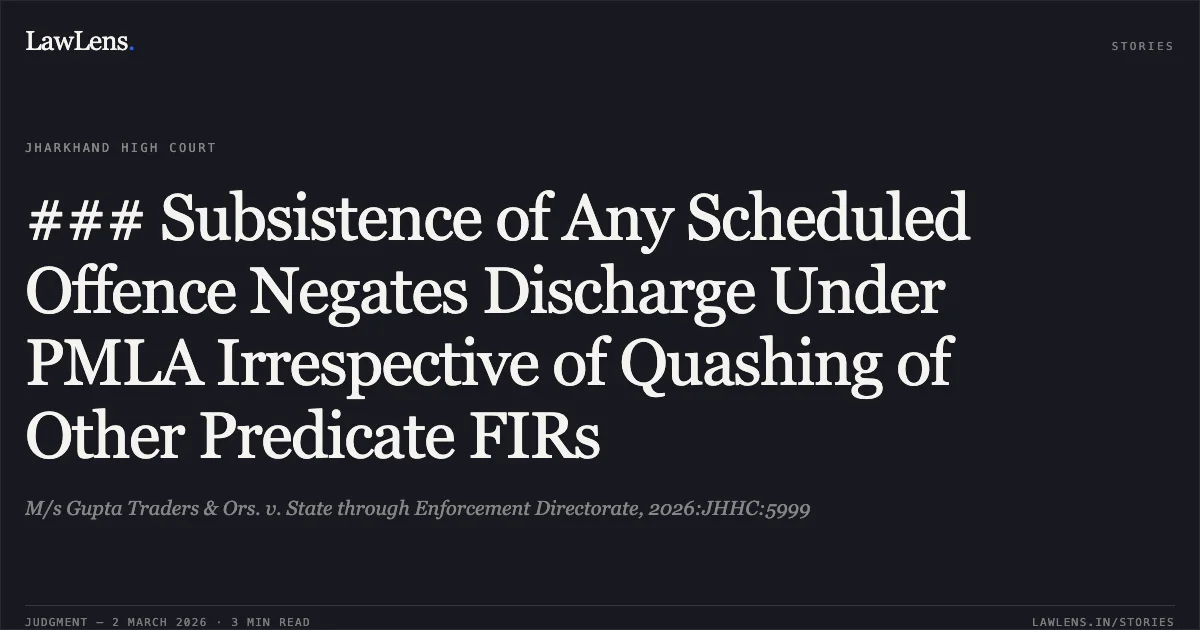
The High Court held that as long as the jurisdictional fact of a scheduled offence subsists (including cases under protest or remand), the PMLA prosecution remains valid
The Court answered both issues in the negative, finding sufficient *prima facie* material to proceed with the trial
Source reference: p. 78Consequently, the High Court dismissed the criminal revision petitions and upheld the Special Judge’s order dated 21.08.2025, refusing to interfere with the rejection of the discharge applications
Source reference: p. 82Acts & Sections Cited
33 provisions across 4 statutes referred to in this judgment. Each provision opens on LawLens.
Bharatiya Nagarik Suraksha Sanhita, 20237
Prevention of Money-Laundering Act, 20026
Indian Penal Code, 1860
Code of Criminal Procedure, 19738
Original Court PDF
M/s Gupta Traders & Ors. v. State through Enforcement Directorate, 2026:JHHC:5999
Click to open original judgment
Original judgment, available to read, download and summarize on LawLens.in