Facts
The petitioners were title-holders or long-standing occupants of residential properties in the 12 Kholi/Barahkholi locality at Hari Fatak, Ujjain. Some properties were held under registered sale deeds, while others had been allotted by the municipal authorities.
Source reference: para. 9The properties were proposed to be affected by the Hari Fatak four-lane Railway Over Bridge project, being executed through the Madhya Pradesh Road Development Corporation (MPRDC) in connection with the proposed Simhastha 2028 infrastructure works.
Source reference: paras. 3–5, pp. 3–6In an earlier writ petition, the High Court directed the authorities to issue a proper show-cause notice and provide the petitioners fifteen days to submit their replies before passing speaking orders. Pursuant thereto, notices were issued, objections were filed, and the Municipal Corporation passed orders directing the petitioners to vacate their houses within ten days.
Source reference: para. 3, p. 3The orders also contemplated interim rental assistance of ₹5,000 per month for three months and compensation calculated in accordance with the Collector Guidelines for 2026–27.
Source reference: paras. 3, 5, 10, pp. 3, 6, 9–10The petitioners challenged the eviction orders, contending that Section 305 of the Madhya Pradesh Municipal Corporation Act, 1956 could not be used to avoid compulsory acquisition under the Right to Fair Compensation and Transparency in Land Acquisition, Rehabilitation and Resettlement Act, 2013.
Source reference: paras. 4, 10, pp. 4–5, 9–10They further alleged that despite MPRDC depositing approximately ₹4.81 crore with the Collector, no valid acquisition proceedings or award had been completed before the proposed dispossession.
Source reference: paras. 4, 10, pp. 4–5, 9–10Issues
1. Whether the Municipal Corporation could invoke Section 305 of the Madhya Pradesh Municipal Corporation Act, 1956 to require the petitioners to vacate or face demolition for the Hari Fatak Railway Over Bridge project executed by MPRDC, an independent State entity?
Source reference: para. 10, p. 92. Whether the Ujjain Development Plan, 2035 and the regular line of building were binding upon the petitioners and sufficient to support the impugned orders?
Source reference: para. 10, pp. 9–103. Whether the petitioners could be dispossessed without completion of statutory acquisition proceedings and payment or tender of compensation under the 2013 Act, particularly Section 38, in light of Article 300-A of the Constitution?
Source reference: paras. 4, 10–11, pp. 4–5, 9–124. Whether the petitioners’ challenge was maintainable under Article 226, or whether they were required to pursue the statutory reference remedy under Section 64 of the 2013 Act against the determination of compensation or rehabilitation entitlements?
Source reference: paras. 6, 11–12, pp. 6–8, 11–13Law Applied
The Court applied Article 300-A of the Constitution, under which deprivation of property must be authorised by law and accompanied by reasonable compensation.
Source reference: paras. 4, 6–7, 11–13, pp. 4–8, 11–18It considered Section 305 of the Madhya Pradesh Municipal Corporation Act, 1956, concerning regulation of the regular line of building, and Section 387 of that Act, providing an arbitral remedy regarding compensation.
Source reference: paras. 4, 6–7, 11–13, pp. 4–8, 11–18The Court also applied the statutory framework of the Right to Fair Compensation and Transparency in Land Acquisition, Rehabilitation and Resettlement Act, 2013, particularly Section 38 concerning possession after payment or tender of compensation, Section 64 providing a reference remedy against measurement, compensation, apportionment and rehabilitation or resettlement entitlements, and Sections 15 and 19 concerning objections and acquisition procedure.
Source reference: paras. 4, 6–7, 11–13, pp. 4–8, 11–18Relying on Ravindra Ramchandra Waghmare v. Indore Municipal Corporation, (2017) 1 SCC 667, the Court recognised that a development plan is binding on the Corporation, local authorities and affected owners.
Source reference: paras. 5, 10, pp. 5–6, 9–11It also relied on Saira Bee v. Urban Administration and Development Department and other authorities to hold that disputes concerning compensation or rehabilitation should ordinarily be pursued under Section 64 of the 2013 Act.
Source reference: para. 11, pp. 11–12The Court distinguished challenges based on substantial procedural lapses from minor irregularities, accepting the respondents’ reliance on the doctrine of substantial compliance.
Source reference: paras. 7, 12, pp. 7–8, 12–13Reasoning
The Court found that the petitioners had received show-cause notices, were afforded an opportunity to submit objections, and that their objections were considered before the eviction orders were passed.
Source reference: paras. 3, 10, p. 9It accepted the respondents’ position that the Hari Fatak bridge was provided for in the Ujjain Development Plan, 2035 and that the development plan and regular building line bound the Corporation.
Source reference: paras. 5, 10, pp. 5–6, 9–11The Court further noted that compensation had been assessed at approximately ₹4.81 crore and deposited with the Collector, Ujjain, and that the petitioners could claim the amount and challenge its determination through the statutory remedy under Section 64 of the 2013 Act.
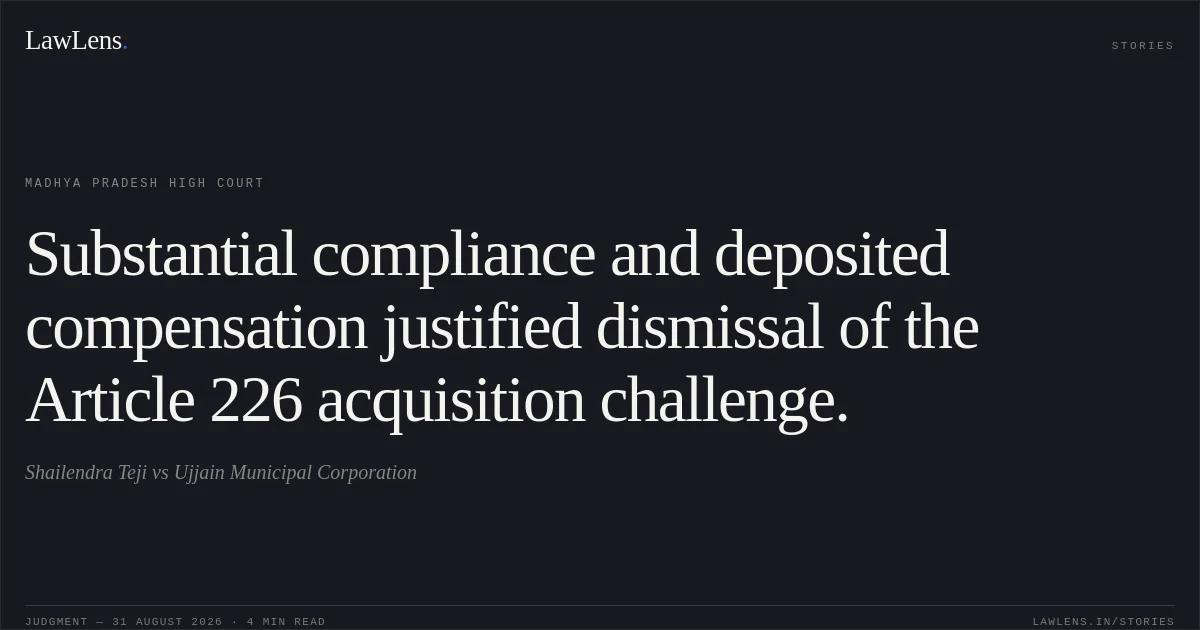
Source reference: paras. 11, 15, pp. 11–12, 18–19Although the petitioners relied on Article 300-A and authorities emphasising strict compliance with acquisition safeguards, the Court concluded that the respondents had substantially complied with the applicable procedure and that the alleged defects were only minor lapses.
Source reference: paras. 13–15, pp. 13–19The Court gave significant weight to the project’s public importance, its connection with Simhastha 2028, and the fact that more than 1,300 of approximately 1,500 affected landowners had accepted the award and compensation.
Source reference: paras. 6, 12, 16, pp. 6–8, 12–13, 19–20It therefore declined to interfere under Article 226, holding that individual objections concerning compensation could be pursued through the statutory mechanism without stalling the public infrastructure project.
Source reference: paras. 11–16, pp. 11–20Holding
The High Court dismissed all connected writ petitions, holding that no sufficient perversity, illegality or arbitrariness was established in the impugned proceedings.
The petitioners were permitted to avail themselves of the compensation already deposited and to challenge the assessment or award through the remedy under Section 64 of the 2013 Act, if aggrieved.
Source reference: paras. 15–16, pp. 18–20The interim status-quo or stay orders were vacated, and the respondents were permitted to proceed with the acquisition and Hari Fatak Railway Over Bridge project in accordance with law.
Source reference: paras. 16–18, pp. 19–21Acts & Sections Cited
10 provisions across 1 statute referred to in this judgment. Each provision opens on LawLens.
Right to Fair Compensation and Transparency in Land Acquisition, Rehabilitation and Resettlement Act, 2013
Original Court PDF
Shailendra TejivsUjjain Municipal Corporation
Click to open original judgment
Original judgment, available to read, download and summarize on LawLens.in