Facts
The Petitioner was enrolled in the Border Security Force (BSF) as a Constable in 1980, promoted to Lance Naik in 1989, and took voluntary retirement in 2003
Source reference: p. 2, para. 3After more than 20 years of retirement, he submitted representations in 2024 seeking the first financial upgradation under the Assured Career Progression (ACP) Scheme, 1999
Source reference: p. 2, para. 4The Respondents rejected his claim on 27.01.2025, stating that his Annual Confidential Reports (ACRs) for the period 1995–1999 fell below the prescribed benchmark
Source reference: p. 2, para. 5The Petitioner filed the present writ petition seeking a mandamus to decide a subsequent representation dated 18.11.2025 and grant the benefits under the ACP Scheme
Source reference: p. 1, para. 1; p. 2, para. 6Issues
1. Whether the denial of financial upgradation under the ACP Scheme constitutes a "continuing wrong" that exempts the Petitioner from the doctrine of delay and laches.
Source reference: p. 3, para. 7/92. Whether the Petitioner is entitled to a direction for reconsideration of his claim after a lapse of 21 years following his retirement.
Source reference: p. 3, para. 8Law Applied
The court primarily applied the doctrine of delay and laches, which dictates that discretionary relief under Article 226 of the Constitution cannot be invoked for stale claims to ensure administrative finality and public policy
Source reference: p. 5, para. 15The court distinguished the principle of "continuing wrong" established in Union of India Ors. v. Tarsem Singh (2008), noting that while disability pension creates a recurring cause of action, claims based on service conditions and eligibility assessments crystallize at a specific point in time
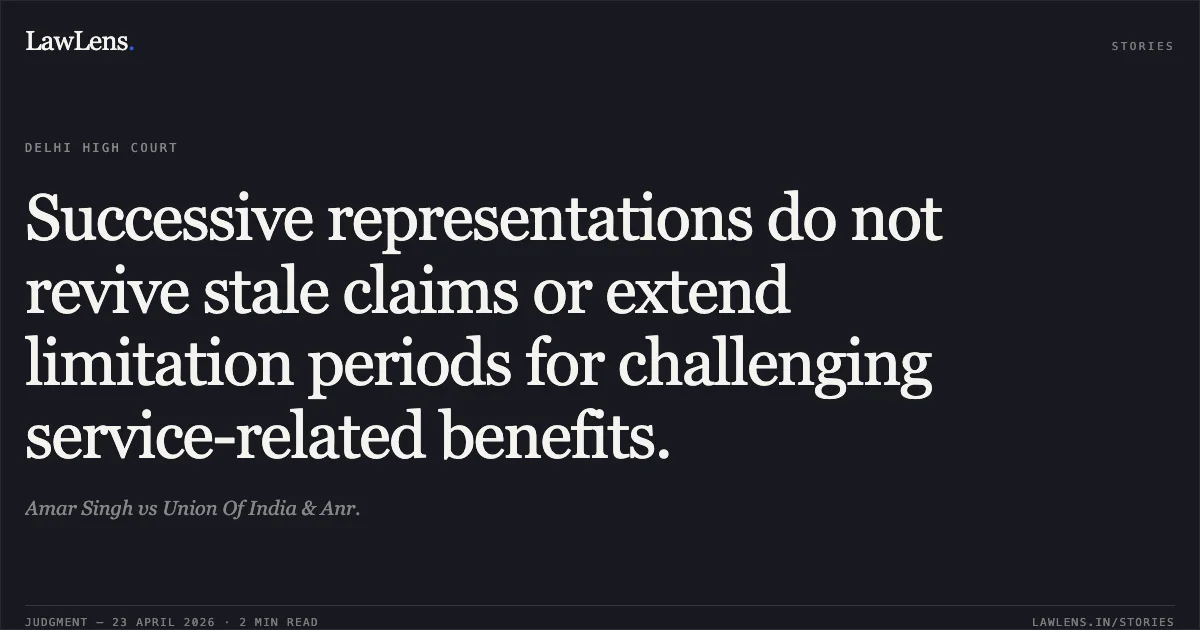
Source reference: p. 3, para. 10; p. 4, para. 11The court applied the principle that repeated representations do not revive a barred claim or create a fresh cause of action
Source reference: p. 5, para. 14Reasoning
The Court reasoned that the Petitioner’s reliance on Tarsem Singh was misconceived because financial upgradation under the ACP Scheme is contingent upon specific assessments of service records (ACRs) at a relevant time, unlike pension entitlements which accrue monthly
Source reference: p. 4, para. 11The Court found that the Petitioner remained silent for 21 years after retirement without any plausible explanation for the inaction
Source reference: p. 4, para. 12; p. 5, para. 16The Court observed that the Respondents had already considered and rejected his claim with reasoned grounds in early 2025
Source reference: p. 4, para. 13The Court emphasized that entertaining such "colossal" delays would subvert administrative certainty and that the Petitioner’s attempt to use a fresh representation [dated 18.11.2025] was merely a device to circumvent limitation
Source reference: p. 5, para. 14-16Holding
The Court answered both issues in the negative, holding that the claim was ex-facie stale and barred by inordinate delay and laches
The Court declined to exercise its discretionary jurisdiction under Article 226 and dismissed the writ petition without adjudicating on the merits of the ACR gradings
Source reference: p. 5, para. 17; p. 6, para. 18-19Original Court PDF
Amar SinghvsUnion Of India & Anr.
Click to open original judgment
Original judgment, available to read, download and summarize on LawLens.in