Facts
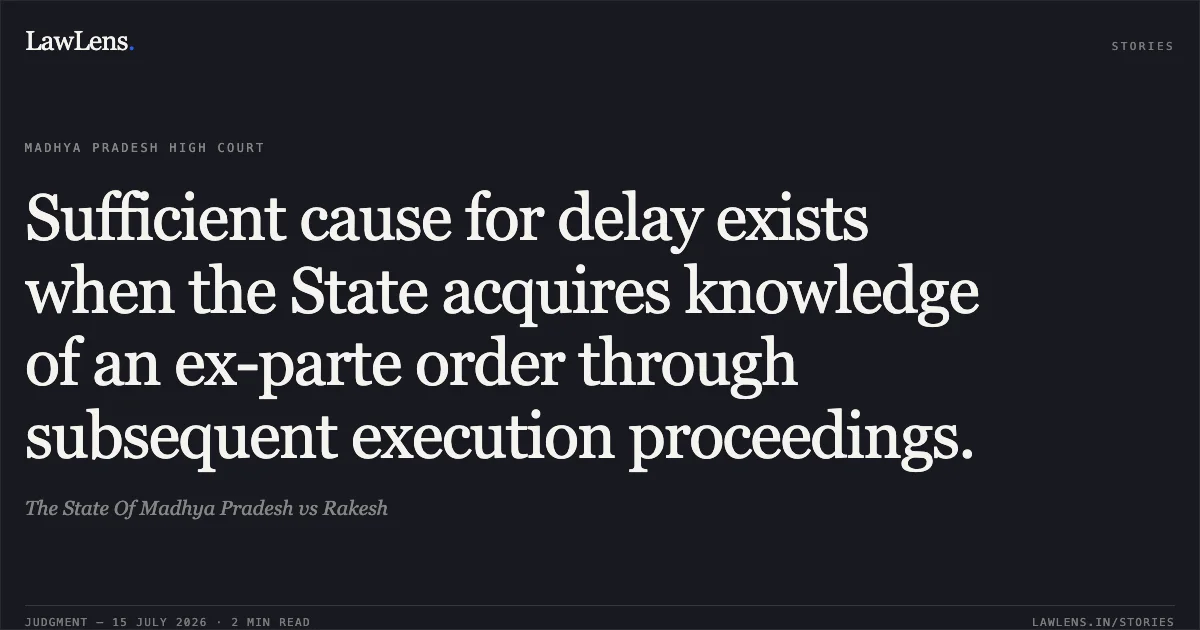
The State of Madhya Pradesh (Appellants) challenged an order dated 16.06.2025 passed by a learned Single Judge in M.P. No. 5275/2022, which had dismissed the State's petition solely on the ground of delay.
Source reference: para. 1The underlying dispute involves government land in Village Gotet, where an enquiry revealed that private respondents had fraudulently recorded their names as Bhumiswamis using fabricated documents.
Source reference: para. 2The Upper Collector, Tikamgarh, ordered the land be restored to the State on 02.06.2016.
Source reference: para. 2The Board of Revenue set aside this order on 07.12.2016 without notice to the State.
Source reference: para. 3The State claimed they only gained knowledge of the 2016 order in 2021/2022 during subsequent contempt proceedings/writ petitions filed by the respondents.
Source reference: para. 10Issues
1. Whether the learned Single Judge was justified in dismissing the miscellaneous petition on the ground of delay without considering the date of knowledge of the impugned order
Source reference: para. 152. Whether the State provided "sufficient cause" under Section 5 of the Limitation Act to condone the delay in filing the writ appeal and the underlying petition
Source reference: para. 13-14Law Applied
The Court applied Section 5 of the Limitation Act, 1963, emphasizing that the term "sufficient cause" must receive a liberal, pragmatic, and justice-oriented interpretation to advance substantial justice rather than a hyper-technical approach.
Source reference: para. 13The Court relied on the precedent Shiv Raj Singh v. Union of India & Others (2023 LiveLaw (SC) 865), which establishes that a liberal approach should be adopted for State delays, considering the procedural and administrative requirements of governmental decision-making.
Source reference: p.2Reasoning
The Court held that the period of limitation must be computed from the date the State acquired knowledge of the order, not the date of the order itself, as the State was never served notice by the Board of Revenue.
Source reference: para. 10The Court found the State's explanation—that knowledge was only gained during respondent-initiated implementation proceedings in 2021—to be bona fide and supported by the record.
Source reference: para. 11, 16Crucially, the Court noted that the 2016 order was passed by a Member of the Board of Revenue who was subsequently compulsorily retired for passing illegal orders, and whose decisions were under categorical State scrutiny via circular.
Source reference: para. 12, 17The Court reasoned that since the matter involved allegations of land fraud and unauthorized mutation of government property, a dismissal on technical grounds would defeat the interest of justice.
Source reference: para. 17Holding
The Court allowed the Writ Appeal and condoned the delay of 208 days.
The Court set aside the Single Judge’s order dated 16.06.2025 and restored M.P. No. 5275/2022 for fresh adjudication on merits.
Source reference: para. 19The Court directed the parties to maintain status quo regarding the property until the final disposal of the miscellaneous petition.
Source reference: para. 20Acts & Sections Cited
1 provisions across 1 statute referred to in this judgment. Each provision opens on LawLens.
Limitation Act, 19631
Original Court PDF
The State Of Madhya PradeshvsRakesh
Click to open original judgment
Original judgment, available to read, download and summarize on LawLens.in