Facts
The plaintiffs (respondents) claimed ownership and Bhumidhari rights over Khasra No. 430 in Village Adhoiwala, Dehradun
Source reference: para. 2In 1996, the Mussoorie Dehradun Development Authority (MDDA/Appellant) occupied 0.4000 hectares of this land without formal acquisition or compensation and constructed residential flats
Source reference: para. 2, 35A joint survey by the Tehsildar in 2003 confirmed the illegal occupation
Source reference: para. 2MDDA’s own legal counsel (DGC Revenue) admitted the plaintiffs' ownership and recommended compensation, which MDDA failed to pay
Source reference: para. 3, 35MDDA contended the land was recorded as Abadi and that possession had been transferred to various allottees between 2003–2004
Source reference: para. 5, 45The Trial Court decreed the suit in 2007, declaring the plaintiffs as owners and ordering MDDA to hand over possession and pay mesne profits
Source reference: para. 21The First Appellate Court affirmed this decision in 2021
Source reference: para. 40Issues
1. Whether possession of the property could be ordered to be delivered to the respondents when the building was already delivered to various individuals who were not made parties to the litigation (Non-joinder of necessary parties)
Source reference: para. 412. Whether the suit of the respondents/plaintiffs was barred under Article 58 of the Limitation Act, 1963, since the relief sought was to declare themselves as the owner of the property
Source reference: para. 41Law Applied
Order I Rule 9 of the CPC, which stipulates that no suit shall be defeated by reason of non-joinder of parties if an effective decree can still be passed
Source reference: para. 54The doctrine of lis pendens and the principle from H. Anjanappa v. A. Prabhakar and Alka Shrirang Chavan v. Hemchandra Rajaram Bhonsale, holding that transferees pendente lite or allottees are bound by the result of the litigation even if not impleaded
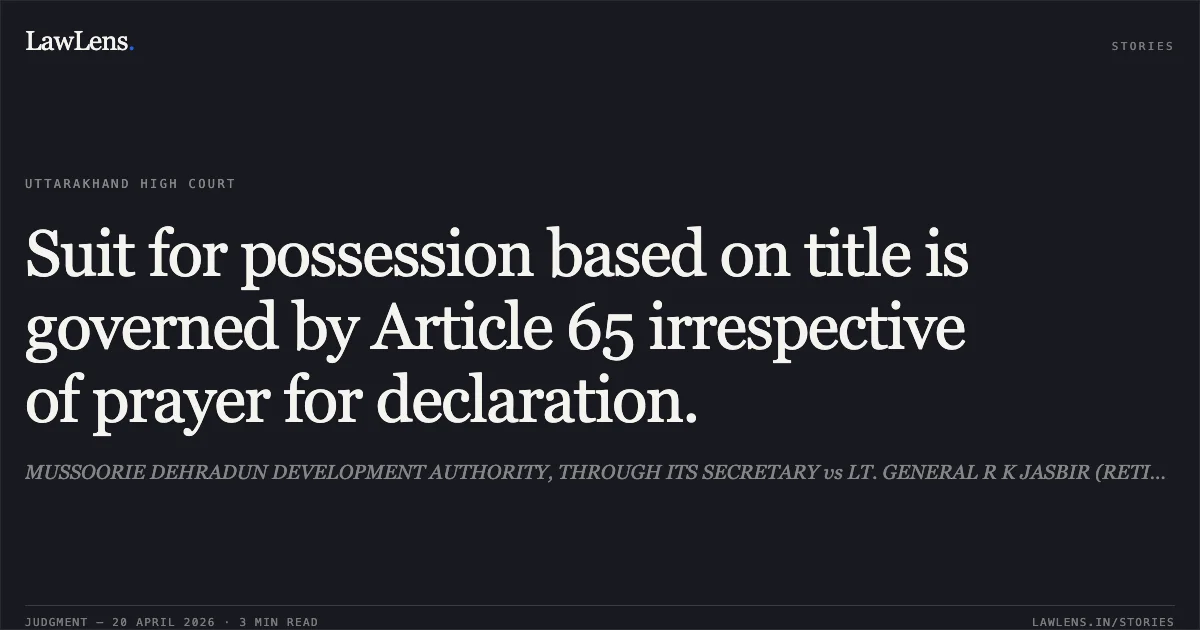
Source reference: para. 61, 62Article 65 of the Limitation Act, 1963 (12-year period for possession based on title) rather than Article 58 (3-year period for declaration)
Source reference: para. 84The precedents in State of Maharashtra v. Pravin Jethalal Kamdar and Sopanrao v. Syed Mehmood, which establish that if a suit seeks both declaration and possession, the longer limitation period for possession governs the suit
Source reference: para. 84, 85Reasoning
Regarding Issue 1, the court noted that MDDA's application to add the plea of non-joinder was rejected by the First Appellate Court, and since MDDA did not challenge that order, it attained finality
Source reference: para. 73, 74MDDA's witness admitted that MDDA was the recorded possessor in revenue records
Source reference: para. 74The court reasoned that since the allottees derived their interest from MDDA during the dispute, they were bound by the decree against the principal party
Source reference: para. 77, 80Regarding Issue 2, the court rejected MDDA's contention that the 3-year limitation under Article 58 applied. The court analyzed the nature of the suit and determined that recovery of possession was the primary relief based on the plaintiffs' title
Source reference: para. 85Because the MDDA's occupation was unauthorized and the plaintiffs proved their title via the Khatauni (revenue records), the 12-year limitation period under Article 65 was applicable, making the suit timely
Source reference: para. 86, 87Holding
The High Court dismissed the Second Appeal and affirmed the judgments of the lower courts
The non-impleadment of allottees was not fatal as they are bound by the decree against MDDA
Source reference: para. 80The suit was within the limitation period of 12 years as prescribed by Article 65 of the Limitation Act
Source reference: para. 87MDDA was directed to hand over peaceful possession to the plaintiffs and comply with the order for mesne profits
Source reference: para. 21, 91Acts & Sections Cited
5 provisions across 2 statutes referred to in this judgment. Each provision opens on LawLens.
Code of Civil Procedure, 19083
Limitation Act, 19632
Original Court PDF
MUSSOORIE DEHRADUN DEVELOPMENT AUTHORITY, THROUGH ITS SECRETARYvsLT. GENERAL R K JASBIR (RETIRED)
Click to open original judgment
Original judgment, available to read, download and summarize on LawLens.in