Facts
The Plaintiff filed suits for infringement of two patents: "Improved laser marking and engraving machine" and "Process of manufacturing engraved design articles on metals or non-metals"
Source reference: para. 1The Intellectual Property Appellate Board (IPAB) revoked these patents on 12th June 2012 ("First Order")
Source reference: para. 3(i)The Plaintiff challenged this before the Madras High Court, which stayed the First Order
Source reference: para. 3(ii)Subsequently, the IPAB passed two more orders on 14th March 2013 and 7th March 2014 ("subsequent orders") allowing other revocation applications based on the First Order
Source reference: para. 3(iii)On 3rd September 2015, the Bombay High Court set aside the First Order and remanded the matter to the IPAB
Source reference: para. 3(v)Despite the subsequent orders, the Patent Office continued to accept renewal fees and listed the patents as "in force" on the e-Register
Source reference: para. 3(vi)The Defendants filed Notices of Motion seeking summary dismissal under Order XIII-A of the CPC and rejection of the plaint under Order VII Rule 11, arguing the patents stood revoked by the unchallenged subsequent orders
Source reference: para. 2, 4Issues
1. Whether the subsequent orders of revocation were independent or consequential to the First Order which was set aside.
Source reference: para. 32(A)2. Whether the Defendants are entitled to a summary judgment under Order XIII-A of the CPC on the ground that the Plaintiff has no real prospect of success.
Source reference: para. 2, 32(F)3. Whether the Plaint is liable to be rejected under Order VII Rule 11 of the CPC for lack of cause of action or suppression of material facts.
Source reference: para. 2, 32(J)Law Applied
the court applied the "principle of consequential orders" established in Badrinath v. Government of Tamil Nadu, which holds that if a primary order is set aside, intermediate actions based solely on that order fall to the ground
Source reference: para. 21For summary judgment, the court applied Order XIII-A of the CPC, which requires the applicant to prove the opponent has "no real prospect of success" and there are no "compelling reasons" for a trial
Source reference: para. 28, 32(F)Regarding rejection of the plaint, the court followed Order VII Rule 11 of the CPC and precedents like Dahiben v. Arvindbhai Kalyanji Bhanusali, emphasizing that the court must only look at the averments within the Plaint to determine if a cause of action exists
Source reference: para. 17, 31It further applied Section 35 of the CPC (as amended by the Commercial Courts Act, 2015) regarding the awarding of costs
Source reference: para. 32(K)Reasoning
The Court found that the subsequent revocation orders were explicitly based on the First Order and lacked independent reasoning
Source reference: para. 32(A)-(B)Under the Badrinath doctrine, since the First Order was set aside by the High Court, the foundational basis for the subsequent orders was effaced
Source reference: para. 32(B)The Court observed that the Patent Controller continued to treat the patents as "in force" and accepted renewal fees, indicating the revocation was never effectively communicated or acted upon under Section 117D(2) of the Patents Act
Source reference: para. 32(C)-(D)Regarding Order XIII-A, the Court held that since the Patent Office itself maintained the patents as valid in various legal proceedings, the Plaintiff had a "real prospect" of success, and the issues (such as the legal effect of the stay orders) constituted triable questions
Source reference: para. 32(F), (I)On Order VII Rule 11, the Court ruled that the Defendants' plea relied on "looking beyond the Plaint" to external documents (the subsequent orders), which is impermissible at the rejection stage; furthermore, the allegation of suppression is a matter of evidence
Source reference: para. 30, 32(J)The Court concluded the motions were a "shot in the dark" to delay proceedings
Source reference: para. 32(E), (G)Holding
The Court dismissed all Notices of Motion, holding that the Plaintiff’s claim of valid and subsisting patents raises triable issues
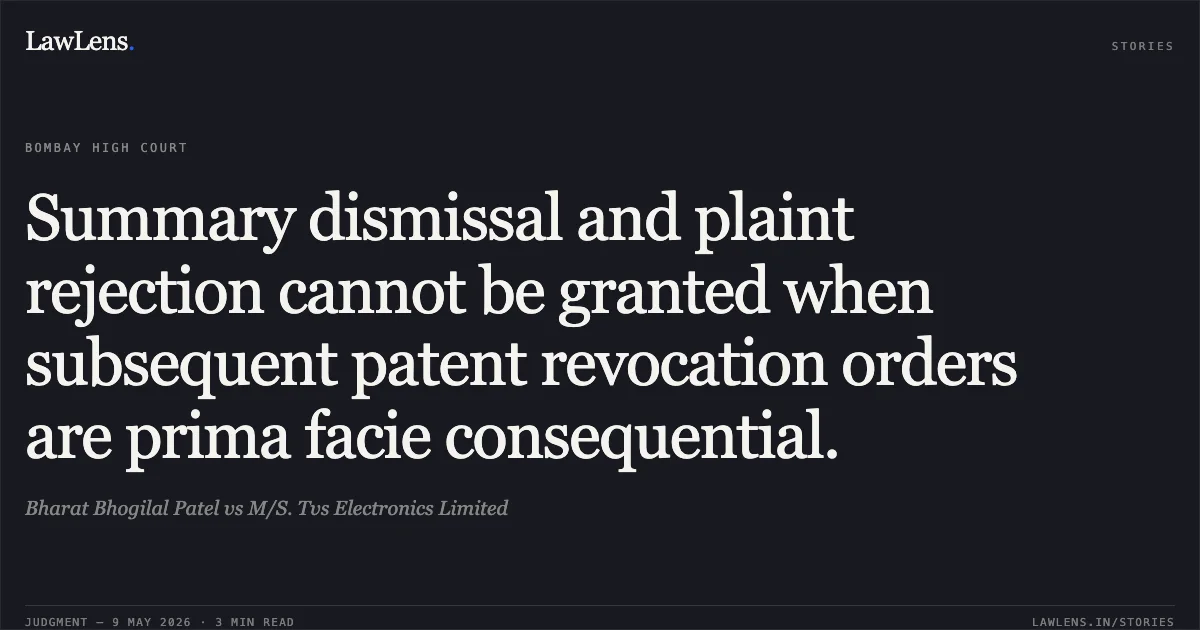
The Court directly held that a case for summary dismissal under Order XIII-A or rejection under Order VII Rule 11 was not made out as the subsequent revocation orders appeared consequential and were never enforced by the authorities
Source reference: para. 32(B), (D), (J)The Defendants were ordered to pay costs of Rs. 1,00,000/- for misusing the provisions of the Commercial Courts Act to obstruct the trial
Source reference: para. 33(i)The suits were directed to proceed to trial
Source reference: para. 33(iii)Acts & Sections Cited
4 provisions across 3 statutes referred to in this judgment. Each provision opens on LawLens.
Code of Civil Procedure, 19081
Patents Act, 19702
Commercial Courts Act, 20151
Original Court PDF
Bharat Bhogilal PatelvsM/S. Tvs Electronics Limited
Click to open original judgment
Original judgment, available to read, download and summarize on LawLens.in