Facts
The Appellant, a nationalized bank, was instructed by a Central Excise and Service Tax audit team to pay service tax amounting to ₹20,23,916/- on the share of profit from foreign exchange transactions
Source reference: p.2, para 2.1The Appellant paid the amount on 22.12.2006 but subsequently realized such profits were not taxable
Source reference: p.2, para 2.1A refund claim was filed and rejected by the Department on the grounds of limitation
Source reference: p.2, para 2.1Consequently, the Appellant suo motu adjusted the amount in a subsequent return, leading the Adjudicating Authority to issue an 'order in original' confirming a demand of ₹19,87,688/-, plus interest and a penalty of ₹1,00,000/-
Source reference: p.2-3, para 2.1The Commissioner (Appeals) and the CESTAT dismissed the Appellant’s challenges, with the Tribunal holding that suo motu credit was impermissible under Rule 6(3) of the Service Tax Rules (STR), 1994, and that the rejection of the initial refund claim had attained finality as it was not appealed
Source reference: p.3-4, para 3, 4.2Issues
1. Whether the share of profit earned by a bank branch in foreign exchange transactions is a taxable service under the Finance Act, 1994
Source reference: p.4, para 42. Whether the Department can retain service tax paid in error or impose penalties when an assessee suo motu adjusts such payments after a refund claim is rejected on technical grounds
Source reference: p.4-5, para 5, 6Law Applied
Section 35G of the Central Excise Act, 1944, read with Section 83 of the Finance Act, 1994, which provides the framework for appeals to the High Court
Source reference: p.1Rule 6(3) of the Service Tax Rules, 1994, which the Tribunal had used to deny suo motu credit for taxability disputes
Source reference: p.3-4, para 4.2Equitable principle against the "unjust enrichment" of the government, asserting that the State cannot retain taxes collected without the authority of law, notwithstanding procedural lapses such as limitation periods under Section 11B of the Central Excise Act or the failure to appeal a refund rejection
Source reference: p.5, para 6Reasoning
The Court observed that the Appellant made the initial payment solely based on the erroneous instructions of the Department's audit team
Source reference: p.4, para 5It noted that subsequent legal positions established that profit shares from foreign exchange are not taxable
Source reference: p.4, para 4The Court reasoned that since the tax was not legally due, the Department had an inherent obligation to refund the amount at the first instance
Source reference: p.4, para 5The Court rejected the Tribunal's focus on the finality of the refund rejection, holding that the Department cannot seek the "seal of approval" for unjust enrichment based on technicalities like limitation or failure to appeal
Source reference: p.5, para 6The assessee's suo motu adjustment was characterized as a "technical error or mistake" devoid of mala fide intention, which did not warrant the imposition of penalties
Source reference: p.5, para 6Holding
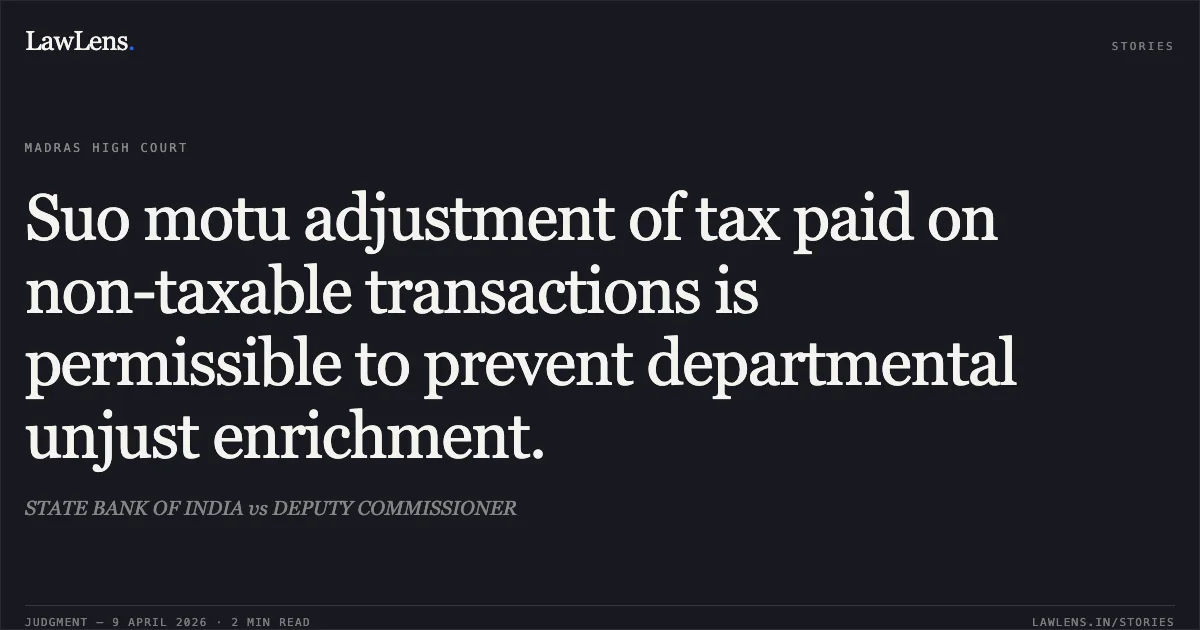
The Court held that the Department cannot retain tax paid in error on the grounds of limitation or technical procedural failures, as doing so would constitute unjust enrichment
The High Court allowed the appeal and set aside the Final Order No. 43138 of 2017 passed by the CESTAT and the underlying 'order in original'. No costs were awarded
Source reference: p.5, para 7Acts & Sections Cited
2 provisions across 1 statute referred to in this judgment. Each provision opens on LawLens.
Central Excise Act, 19442
Original Court PDF
STATE BANK OF INDIAvsDEPUTY COMMISSIONER
Click to open original judgment
Original judgment, available to read, download and summarize on LawLens.in