Facts
The petitioner joined the police service as a Sub-Inspector on 1 June 1983, was promoted as Inspector on 17 February 2006, and subsequently as Deputy Superintendent of Police on 9 January 2015.
Source reference: para. 2While posted at Police Station Bhagva, District Chhatarpur, he and an Assistant Sub-Inspector were subjected to a joint departmental enquiry pursuant to a charge-sheet dated 29 April 2006.
Source reference: paras. 3, 23The Enquiry Officer found three charges unproved and one charge partially proved against the petitioner, while all charges against the Assistant Sub-Inspector were found unsubstantiated.
Source reference: para. 4The Superintendent of Police imposed the penalty of stoppage of one increment with cumulative effect by order dated 30 September 2007; the petitioner’s departmental appeal was dismissed by the Deputy Inspector General on 25 March 2008.
Source reference: paras. 4–5The petitioner challenged these orders under Article 226 of the Constitution, contending, inter alia, that the Superintendent of Police lacked jurisdiction to conduct the joint enquiry and impose the penalty.
Source reference: paras. 17–20Issues
Whether the Superintendent of Police was competent to initiate and conduct a joint departmental enquiry against the petitioner, notwithstanding Rule 18(1) of the M.P. Civil Services (Classification, Control and Appeal) Rules, 1966.
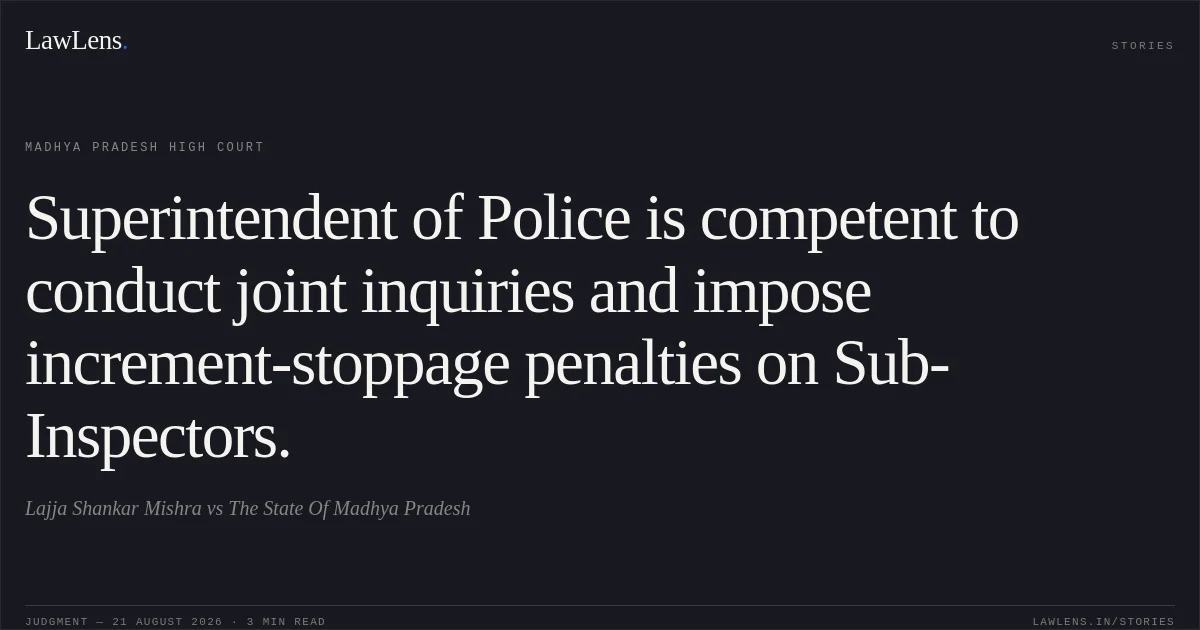
Source reference: paras. 23–26Whether the Superintendent of Police was competent to impose the penalty of stoppage of one increment with cumulative effect upon a Sub-Inspector, whose appointing authority under the Schedule to the 1966 Rules was the Deputy Inspector General of Police.
Source reference: paras. 24, 28Whether the petitioner’s representation before the Inspector General ought to have been treated as a revision under Regulation 270 of the Madhya Pradesh Police Regulations, instead of being rejected as an impermissible second appeal.
Source reference: paras. 29–31Whether the challenged disciplinary and appellate orders warranted interference under Article 226 of the Constitution.
Source reference: paras. 8, 13, 31–32Law Applied
The Schedule to the 1966 Rules expressly excludes Class III non-ministerial posts in the Police Department from the application of those Rules, providing that such posts are governed by the Madhya Pradesh Police Regulations.
Source reference: para. 25Under Regulation 221, the Superintendent of Police is empowered to initiate departmental proceedings and impose the punishments specified in Regulations 214 to 217; Regulation 214(ii) authorises withholding of increment.
Source reference: paras. 21, 26, 28Regulation 228 empowers the Superintendent of Police to record formal proceedings and does not distinguish between individual and joint enquiries.
Source reference: para. 27The Court relied on Raju Singh Ahirwar v. State of M.P., (2017) 4 MPLJ 656, which held that Regulation 228 authorises the Superintendent of Police to initiate proceedings, including a joint enquiry, against police personnel.
Source reference: para. 27Regulation 270 permits suo motu revision by a superior authority and revision on application by the person aggrieved against a final appellate order.
Source reference: para. 30Reasoning
The Court first determined the governing service regime by relying on the Schedule’s Note, which places Sub-Inspectors and Assistant Sub-Inspectors—Class III non-ministerial police employees—under the Police Regulations rather than the 1966 Rules.
Source reference: para. 25Consequently, the petitioner could not invoke Rule 18(1) to invalidate the joint enquiry.
Source reference: paras. 23–26Applying Regulations 221, 214(ii), and 228, the Court held that the Superintendent of Police possessed both the authority to initiate the proceedings and the power to impose the punishment of withholding an increment; the fact that the Deputy Inspector General was the appointing authority did not negate the specific disciplinary powers conferred by the Police Regulations.
Source reference: paras. 26–28Although Regulation 270 permitted revision, the Court declined to remand the matter for revisional consideration because the petitioner had already invoked the subsequent channel of challenge by filing a mercy petition, which was dismissed by the competent authority.
Source reference: para. 31The earlier orders had consequently merged into the mercy-petition order, and remand would disrupt the administrative hierarchy.
Source reference: para. 31The Court found no jurisdictional defect, procedural illegality, or other ground justifying writ interference.
Source reference: para. 32Holding
The Court answered all material issues against the petitioner.
It held that the Superintendent of Police was competent to conduct the joint departmental enquiry and to impose the penalty of stoppage of one increment with cumulative effect under the Madhya Pradesh Police Regulations.
Source reference: paras. 25–28The representation before the Inspector General did not warrant remand for fresh consideration as a revision, since the petitioner had already pursued and exhausted the further remedy of a mercy petition and the orders had merged in the subsequent decision.
Source reference: para. 31Both writ petitions were accordingly dismissed, with no interference under Article 226 of the Constitution.
Source reference: para. 32Original Court PDF
Lajja Shankar MishravsThe State Of Madhya Pradesh
Click to open original judgment
Original judgment, available to read, download and summarize on LawLens.in