Facts
The respondent was appointed Assistant Registrar (Legal) at Delhi Technological University (DTU). On 19.05.2016, he tendered his resignation to take effect after the notice period and subsequently requested waiver of the notice period and acceptance with effect from 31.05.2016. The Vice-Chancellor holding additional charge accepted the resignation, relieved him, and issued his no-dues, last-pay and experience certificates.
Source reference: para. 2–4The respondent sought withdrawal of his resignation approximately four months later, contending that the Vice-Chancellor lacked competence to accept it. In the meantime, the Board of Management (BOM), the competent authority, ratified the acceptance, and DTU rejected the withdrawal request.
Source reference: para. 5The Delhi High Court directed reinstatement, though it denied back wages because the respondent had obtained gainful employment with the National Institute of Technology, Calicut (NITC).
Source reference: para. 6–7In the connected NITC proceedings, the respondent resigned after joining as Deputy Registrar and requested permission to withdraw his resignation before being relieved. The competent authority accepted the resignation on 22.11.2018, communicated the acceptance on 04.12.2018, and permitted relieving upon completion of the notice period. After his selection for deputation, the respondent sought withdrawal of the resignation, which was rejected by a reasoned order.
Source reference: para. 8–10The Kerala High Court Division Bench upheld the rejection and set aside the direction for reinstatement.
Source reference: para. 8–10Issues
1. Whether the acceptance of the respondent’s resignation by an officer lacking statutory competence was validated by the subsequent ratification of the Board of Management, the competent authority under Section 23(2)(ix) of the Delhi Technological University Act, 2009?
Source reference: para. 15(i)2. Whether the Kerala High Court Division Bench was justified in upholding the acceptance of the respondent’s resignation by NITC and the rejection of his request to withdraw it?
Source reference: para. 15(ii)Law Applied
Section 23(2)(ix) of the Delhi Technological University Act, 2009, vested the Board of Management with the power to appoint persons to administrative posts; that power necessarily included the power to accept their resignation.
Source reference: para. 16Under the doctrine of ratification, a competent authority may retrospectively validate an act initially performed without authority; ratification operates as equivalent to prior authority and relates back to the date of the original act, provided the act was one which the competent authority could lawfully have performed.
Source reference: para. 18–19The Court relied on Sri Parmeshwari Prasad Gupta v. Union of India, High Court of Judicature for Rajasthan v. P.P. Singh, Maharashtra State Mining Corpn. v. Sunil, National Institute of Technology v. Pannalal Choudhury, and Municipal Commissioner, Jamnagar Municipal Corporation v. R.M. Doshi on ratification.
Source reference: para. 19Independently, a resignation may become irrevocable where the employee and employer have treated it as final and altered their positions accordingly; the employee may then be precluded by approbation and reprobation from challenging the transaction.
Source reference: para. 20–21Under the proviso to Statute 30 of the NIT First Statutes, 2009, a resignation takes effect when accepted by the appointing authority, and not merely upon communication or expiry of the notice period.
Source reference: para. 27Paragraph 3 of the Office Memorandum dated 11.02.1988 permits withdrawal of an accepted resignation before relieving only subject to the competent authority’s discretion to refuse withdrawal for recorded and communicated reasons.
Source reference: para. 28Reasoning
The Court held that the BOM was the competent authority to accept the DTU respondent’s resignation, and that the acting Vice-Chancellor lacked such authority.
Source reference: para. 16Nevertheless, the BOM’s subsequent express ratification cured the defect retrospectively, as acceptance of the resignation was an act the BOM could lawfully have performed in the first instance.
Source reference: para. 17–19, 25In addition, the respondent himself had requested early acceptance, accepted relieving and service-related certificates, and later used the experience certificate to secure employment with NITC. His conduct demonstrated that the resignation had been treated as final, independently attracting the principle against approbation and reprobation.
Source reference: para. 22–24Consequently, his later request to withdraw the resignation, made after he had ceased to be in DTU service, could not revive an already completed transaction.
Source reference: para. 25As regards NITC, the resignation was accepted by the competent authority on 22.11.2018 and therefore became legally effective on that date. The notice period governed only the date of actual relieving and did not postpone the effectiveness of acceptance; communication of acceptance was not a statutory precondition.
Source reference: para. 27The refusal to permit withdrawal was supported by recorded reasons, including the respondent’s statement that he was no longer interested in working at NITC and the timing of his withdrawal request after selection for deputation. The Court found the decision rational and free from mala fides, perversity or legal violation, and therefore declined to substitute its view under Article 226.
Source reference: para. 28–30Holding
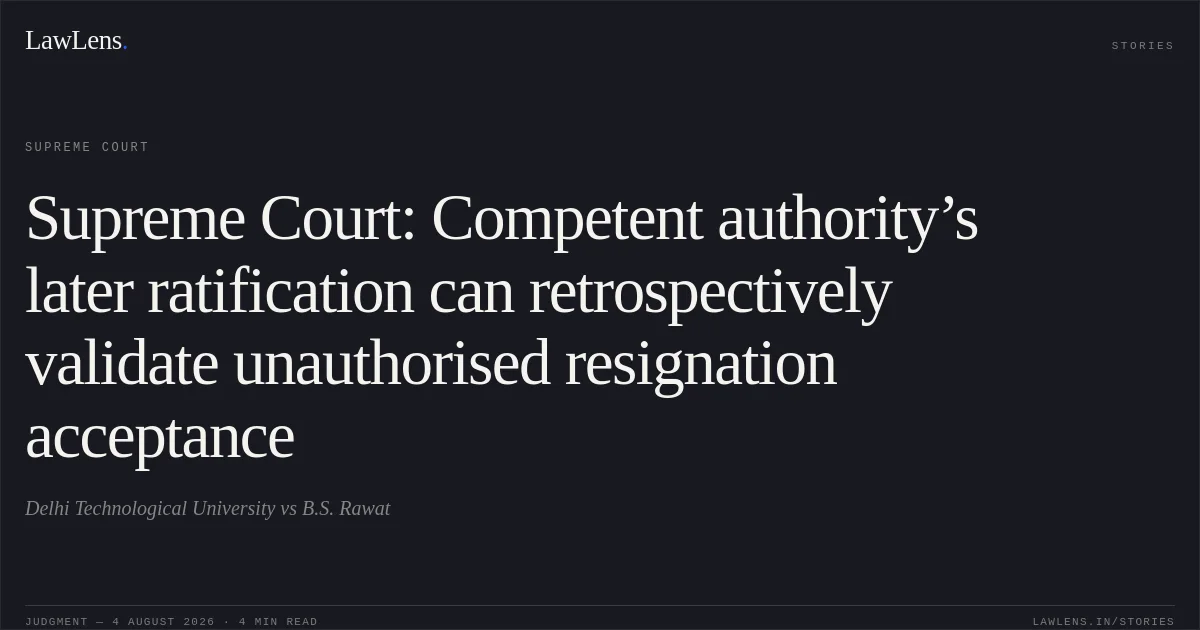
The Supreme Court held that the BOM’s ratification validated the DTU Vice-Chancellor’s otherwise unauthorised acceptance of resignation retrospectively. In any event, the respondent’s conduct had consummated the resignation and barred him from subsequently challenging it.
The direction for his reinstatement by the Delhi High Court was therefore set aside, and the writ petition was dismissed.
Source reference: para. 31(i)The respondent’s appeal seeking back wages from DTU was dismissed.
Source reference: para. 31(ii)The SLP challenging the NITC decision was also dismissed, the Court upholding the acceptance of resignation and the reasoned refusal to permit its withdrawal.
Source reference: para. 31(iii)There was no order as to costs.
Source reference: para. 32Original Court PDF
Delhi Technological UniversityvsB.S. Rawat
Click to open original judgment
Original judgment, available to read, download and summarize on LawLens.in