Facts
The appellant and respondent entered into an MoU in 2002 for construction and development works in Agra. The respondent received a mobilisation advance of ₹3.5 crores against bank guarantees.
Source reference: pp. 3–5, paras 3–6During arbitral proceedings, the Delhi High Court, by order dated 15.12.2005, recorded the respondent’s undertaking to keep the bank guarantees alive until the arbitration, and thereafter until disposal of any Section 34 proceedings; the appellant could invoke them if an executable award required recovery from the respondent.
Source reference: pp. 3–5, paras 3–6The respondent subsequently failed to keep the guarantees alive, and the appellant invoked and encashed them in September 2017.
Source reference: p. 5, para 7The arbitral award dated 05.12.2017 rejected the respondent’s claims, including its claim concerning discharge of the guarantees and bank charges; the appellant had filed no counterclaim.
Source reference: pp. 5–7, paras 9–10While the respondent’s Section 34 challenge was pending, it filed a fresh Section 9 application seeking return or deposit of the encashed amount. The Single Judge directed the appellant to deposit ₹3.5 crores with the High Court Registry, and the Division Bench upheld that direction.
Source reference: pp. 8–12, para 13Issues
Whether a post-award Section 9 application is maintainable at the instance of an award debtor whose claims have been dismissed and who has no enforceable award in its favour.
Source reference: pp. 15–18, paras 17–19Whether, pending adjudication of the respondent’s Section 34 challenge, the courts below were justified in directing the appellant to deposit ₹3.5 crores equivalent to the encashed bank guarantees.
Source reference: p. 15, para 17Whether the direction was a permissible interim measure under Section 9, or impermissibly amounted to a final adjudication of the parties’ rights.
Source reference: pp. 12–14, para 15; pp. 18–21, paras 20–24Law Applied
Section 9 of the Arbitration and Conciliation Act, 1996 confers wide power on the court to grant interim measures securing the amount in dispute or protecting the subject matter of arbitration, including such measures as may appear “just and convenient,” before or after the award but before enforcement under Section 36.
Source reference: pp. 18–20, paras 20–23Under Essar House Pvt. Ltd. v. Arcellor Mittal Nippon Steel India Ltd., (2022) 20 SCC 178, relief under Section 9 is governed by the existence of a prima facie case, balance of convenience, irreparable injury, and reasonable expedition; the power must be exercised judiciously to promote the efficacy of arbitration.
Source reference: pp. 18–20, paras 20–23Adhunik Steels Ltd. v. Orissa Manganese & Minerals (P) Ltd., (2007) 7 SCC 125, establishes that ordinary principles governing interim injunctions, including prima facie case, balance of convenience and irreparable injury, apply to Section 9 relief.
Source reference: pp. 20–21, para 24Relying on Home Care Retail Marts Pvt. Ltd. v. Haresh N. Sanghavi, 2026 SCC OnLine SC 670, the Court held that an unsuccessful award debtor may, in rare and compelling cases, invoke Section 9 to prevent irreparable prejudice and preserve the efficacy of a pending Section 34 challenge, although the threshold for relief is higher.
Source reference: pp. 15–18, paras 18–19Section 9 courts are guided by, but are not rigidly bound by, Order XXXVIII Rule 5 of the Code of Civil Procedure.
Source reference: pp. 19–20, para 23Reasoning
The Court held that the respondent’s Section 9 application was maintainable notwithstanding the dismissal of its arbitral claims, because the eventual outcome of the Section 34 proceedings could alter the parties’ rights and interim protection could be necessary to prevent irreversible prejudice.
Source reference: pp. 15–18, paras 18–19On the merits, the 2005 order permitted invocation of the bank guarantees only if, after adjudication, the appellant was found entitled to recover an amount from the respondent.
Source reference: pp. 22–24, para 26(i)–(vi)The appellant had filed no counterclaim, and the arbitrator had not determined that the mobilisation advance was unutilised or that the appellant was entitled to retain the encashed amount.
Source reference: pp. 22–24, para 26(i)–(vi)The arbitrator also appeared not to have appreciated that the guarantees had already been encashed and did not effectively decide the issue concerning their discharge.
Source reference: pp. 9–11, paras 12.1–12.3Consequently, the High Court had a strong prima facie basis to conclude that continued retention of ₹3.5 crores could result in unjust enrichment and conflict with the purpose of the 2005 order.
Source reference: pp. 11–12, paras 14–17; pp. 24–25, para 26(vii)–(ix)Depositing the amount in court, rather than directing immediate payment to the respondent, appropriately balanced the parties’ interests: the money would earn interest for the benefit of the ultimately successful party while preserving the subject matter pending the Section 34 proceedings.
Source reference: pp. 11–12, paras 14–17; pp. 24–25, para 26(vii)–(ix)The earlier order dated 01.11.2017, which had found no fault in the appellant’s conduct when the guarantees ceased to remain alive, did not bar the subsequent post-award Section 9 proceedings, which concerned the appellant’s entitlement to retain the encashed amount in light of the award.
Source reference: p. 24, para 26(v)Holding
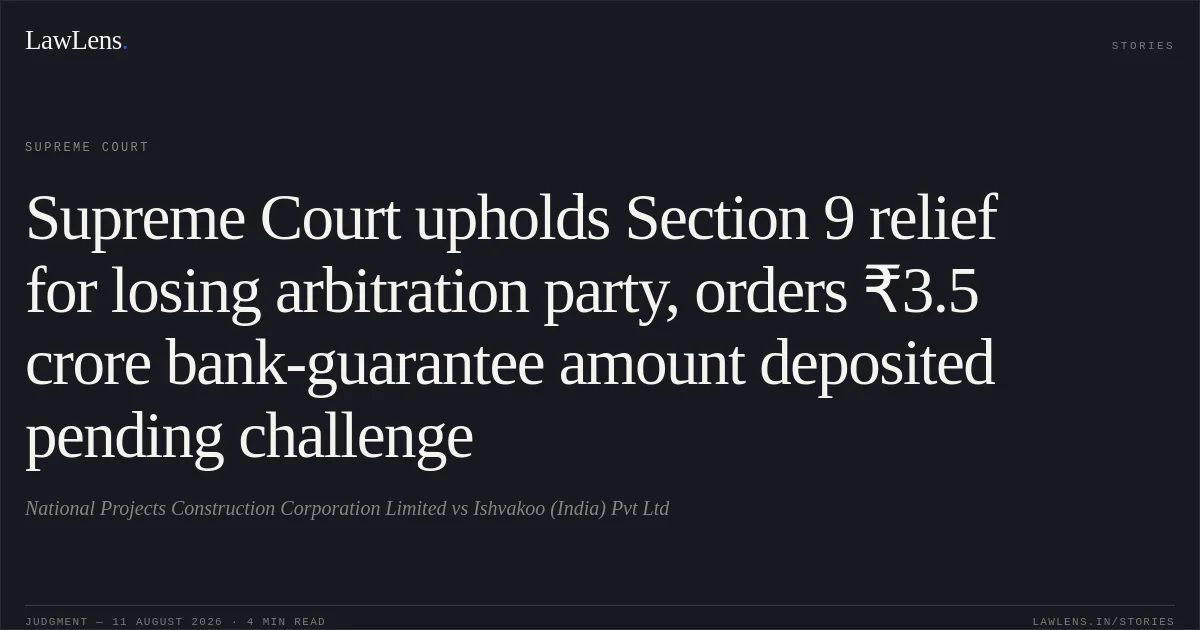
The Supreme Court dismissed the appeal and upheld the direction requiring the appellant to deposit ₹3.5 crores with the Registry of the Delhi High Court within four weeks.
Upon deposit, the amount was directed to be placed in a fixed deposit with a nationalised bank on an auto-renewal basis until disposal of the Section 34 application.
Source reference: p. 25, para 27The Court held that the respondent had established a rare and compelling case satisfying the requirements of prima facie case, balance of convenience, irreparable prejudice and reasonable expedition under Section 9.
Source reference: pp. 22–25, para 26It clarified that the observations made in the Section 9 proceedings were prima facie and would not influence determination of the Section 34 challenge.
Source reference: p. 25, para 27No order as to costs was made.
Source reference: p. 25, para 27Acts & Sections Cited
4 provisions across 2 statutes referred to in this judgment. Each provision opens on LawLens.
Arbitration and Conciliation Act, 19963
Code of Civil Procedure, 19081
Original Court PDF
National Projects Construction Corporation LimitedvsIshvakoo (India) Pvt Ltd
Click to open original judgment
Original judgment, available to read, download and summarize on LawLens.in