Facts
Sawairam Gurjar alleged that Dharmendra Sankhla, a lineman, and a Sub-Engineer demanded money to facilitate a permanent electricity connection.
Source reference: para. 1–2After a trap was arranged, Gurjar handed Sankhla ₹11,000 in phenolphthalein-treated notes; the notes were recovered from Sankhla, and phenolphthalein traces were found on his hands.
Source reference: para. 1–2The Special Judge acquitted Sankhla of offences under Sections 7 and 13(1)(d), read with Section 13(2), of the Prevention of Corruption Act, 1988.
Source reference: para. 1–2The State sought leave to appeal under Section 378(3) CrPC, and Gurjar filed a statutory appeal under Section 372 CrPC.
Source reference: para. 1–2Issues
Whether Sankhla was a “public servant” under Section 2(c) of the Prevention of Corruption Act, 1988, and whether the prosecution could proceed without prior sanction under Section 19 if he was a public servant.
Source reference: para. 19–20Whether the evidence established a demand for, and knowing acceptance of, illegal gratification, rather than payment connected with official charges for the electricity connection.
Source reference: para. 26–31Whether the acquittal disclosed an error warranting appellate interference or the grant of leave to appeal.
Source reference: para. 8–9, 31–32Law Applied
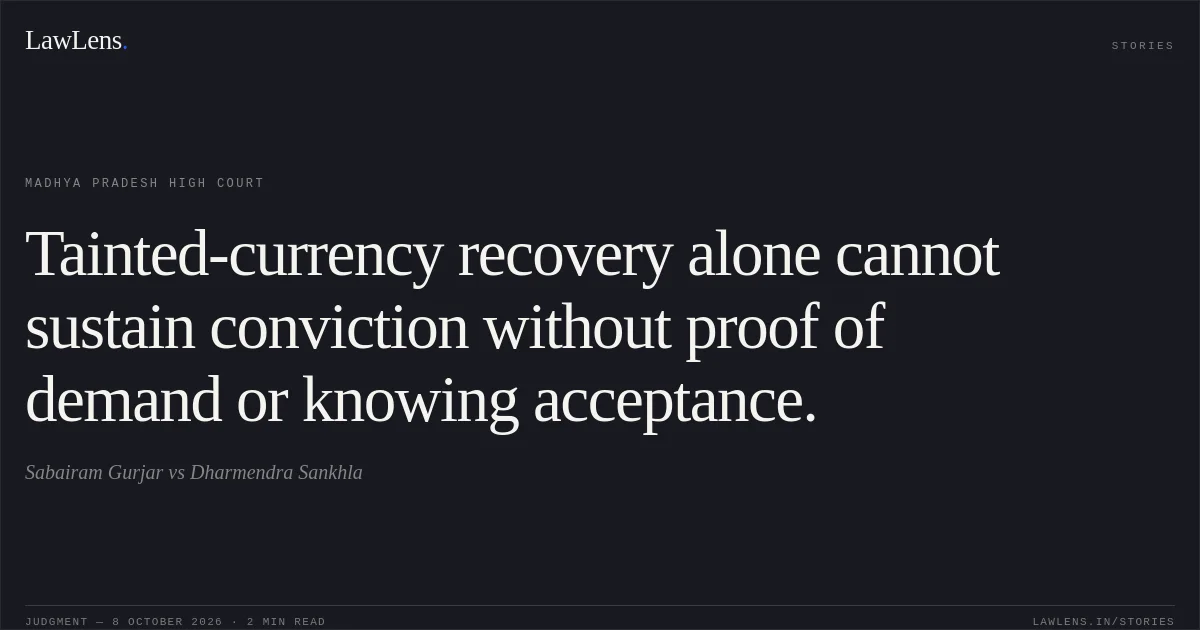
Sections 7 and 13(1)(d), read with Section 13(2), of the Prevention of Corruption Act, 1988 require proof of the relevant foundational facts of demand and acceptance or obtainment of illegal gratification; recovery alone is insufficient.
Source reference: para. 16Neeraj Dutta v. State (NCT of Delhi) holds that demand and acceptance may be proved by direct or circumstantial evidence, and that Section 20’s legal presumption applies to Section 7 only after the foundational facts are proved.
Source reference: para. 16Under Section 2(c)(viii), the prosecution must establish that the accused falls within the statutory definition of “public servant”; Section 19 bars cognizance of the specified offences against a public servant without previous sanction.
Source reference: para. 19–20On appeal against acquittal, the appellate court may review and reappreciate the evidence, but must account for the reinforced presumption of innocence; where two reasonable views are possible, the acquittal should not be disturbed (Sujay Mangesh Poyarekar and Chandrappa).
Source reference: para. 8–9Reasoning
The evidence showed that Sankhla was employed and paid by a private service provider, held no office in the Electricity Department, and had no authority to grant or facilitate the connection; the Court therefore found that his status as a public servant under Section 2(c)(viii) was not established.
Source reference: para. 19–20It added that, even if he were treated as a public servant, the record contained no prior sanction under Section 19.
Source reference: para. 19–20On the alleged bribe, the Court considered the complainant’s testimony alongside the transcripts and found that the conversations concerned the connection process and the amount to be deposited as official charges.
Source reference: para. 21–31The complainant also acknowledged that Sankhla had not asked for money for himself.
Source reference: para. 21–31Although the tainted notes were recovered from Sankhla, the evidence did not reliably establish that he demanded or knowingly accepted illegal gratification; recovery alone could not establish the offences.
Source reference: para. 21–31The trial court’s view was reasonably available on the evidence and did not warrant appellate interference.
Source reference: para. 31–32Holding
The High Court affirmed the acquittal dated 12 October 2019.
It dismissed Gurjar’s statutory appeal under Section 372 CrPC and dismissed the State’s application under Section 378(3) CrPC, declining leave to appeal.
Source reference: para. 32–33Acts & Sections Cited
7 provisions across 2 statutes referred to in this judgment. Each provision opens on LawLens.
Code of Criminal Procedure, 19732
Prevention of Corruption Act, 19885
Original Court PDF
Sabairam GurjarvsDharmendra Sankhla
Click to open original judgment
Original judgment, available to read, download and summarize on LawLens.in