Facts
The petitioner, a Junior Engineer in the Rural Works Department, Work Division, Araria, was accused along with a Sub-Divisional Officer of demanding illegal gratification from a contractor for release of his final bill relating to construction of a bridge under the Pradhan Mantri Gram Sadak Yojana. The allegation was that the petitioner demanded ₹40,000 and the co-accused demanded ₹62,000 as their respective shares.
Source reference: p.2, para. 3Following the contractor’s complaint, the Vigilance Department conducted verification and laid a trap on 2 August 2022. The petitioner was allegedly apprehended with tainted currency, and his hand-wash test in sodium carbonate solution was positive.
Source reference: p.2, para. 3The Special Judge, Vigilance, Bhagalpur took cognizance on 14 November 2024 in Special Case (Vig) No. 19 of 2022 for offences under Sections 7(a), 7(b), 7(c) and 12 of the Prevention of Corruption Act, 1988, as amended in 2018.
Source reference: p.1, para. 2The petitioner sought quashing of the cognizance order under Section 528 of the Bharatiya Nagarik Suraksha Sanhita, contending that the independent witnesses did not support the allegation of demand, the voice recording did not contain an express demand for ₹40,000, and the contractor’s final bill had already been paid online.
Source reference: p.2, paras. 4–5Issues
Whether the High Court, while exercising quashing jurisdiction under Section 528 of the BNSS, could assess the reliability and sufficiency of the prosecution evidence— including the witness statements, voice recording, prior payment of the bill and trap proceedings—at the threshold stage?
Source reference: p.3–5, paras. 6–9Whether the alleged inconsistencies regarding the precise amount demanded, the absence of complete independent corroboration, and the prior online release of the final bill warranted quashing of the cognizance order in a corruption trap case?
Source reference: p.4–5, paras. 7–9Whether the materials relating to the trap, recovery of tainted currency and positive hand-wash test disclosed sufficient prima facie material to require the petitioner to face trial for offences under Sections 7(a), 7(b), 7(c) and 12 of the Prevention of Corruption Act, 1988?
Source reference: p.4–5, paras. 7–10Law Applied
The Court applied Sections 7(a), 7(b), 7(c) and 12 of the Prevention of Corruption Act, 1988, as amended in 2018, concerning bribery-related offences and abetment.
Source reference: p.1, para. 2It exercised its inherent quashing jurisdiction under Section 528 of the BNSS, under which the High Court does not conduct a mini-trial or assess the sufficiency, reliability or probability of evidence when prima facie material exists.
Source reference: p.5, para. 7Relying on Central Bureau of Investigation v. Aryan Singh, 2023 SCC OnLine SC 379, the Court held that quashing jurisdiction is not appellate jurisdiction and the Court must not evaluate the evidence as if deciding the merits of the case.
Source reference: p.3, para. 6It further relied on State of Chhattisgarh v. Aman Kumar Singh, (2023) 6 SCC 559, which requires a particularly cautious, hands-off approach in corruption cases and prohibits threshold scrutiny of the genuineness, reliability or probability of allegations.
Source reference: p.3–4, para. 6The Court also referred to Sandip Kumar Roy v. State of West Bengal, CRR 3841 of 2017, as illustrating that recovery of tainted money, a positive hand-wash test and supporting trap evidence may constitute sufficient material to send a corruption case to trial.
Source reference: p.4–5, para. 7Reasoning
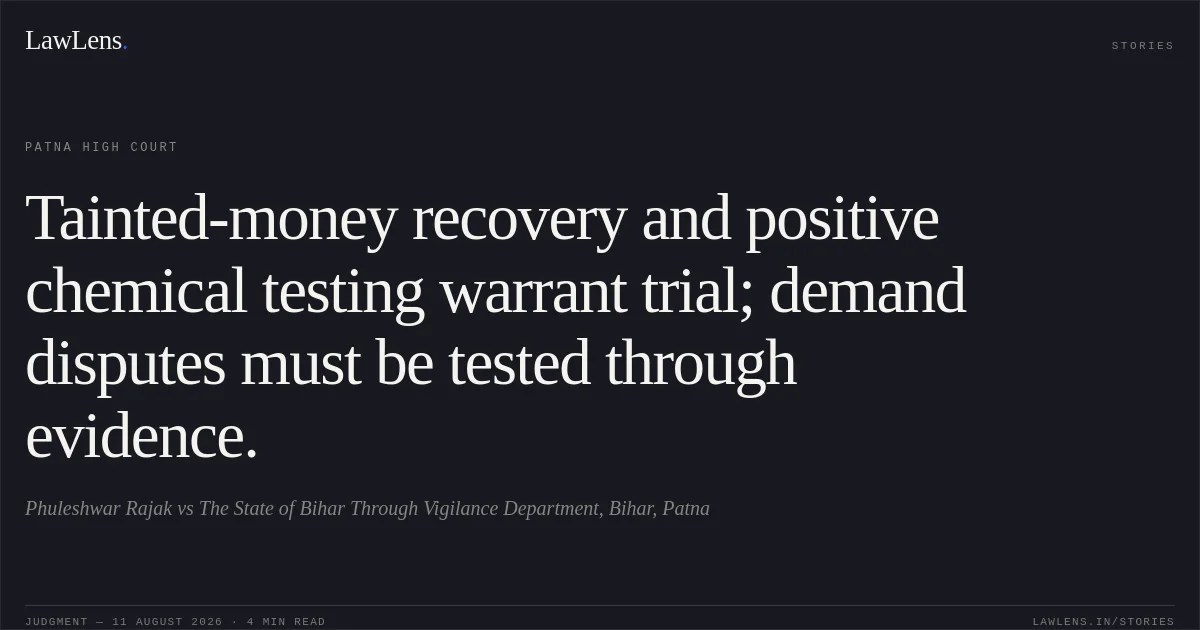
The Court found that the prosecution materials disclosed a trap, recovery of tainted currency from the petitioner and a positive chemical test, creating strong prima facie suspicion sufficient to justify continuation of the prosecution.
Source reference: p.4, para. 7The petitioner’s arguments concerning the absence of an express demand for exactly ₹40,000 in the recording, the alleged hostility or non-support of independent witnesses, and the possibility that the recovery was stage-managed required appreciation of evidence and cross-examination, which could not be undertaken in quashing proceedings.
Source reference: p.4–5, para. 7Similarly, the fact that the contractor’s final bill had allegedly been released online before the FIR did not conclusively negate the prosecution case, since the State alleged that the demand and related meetings preceded and accompanied the payment process.
Source reference: p.5, para. 8As none of the recognised grounds for quashing—absence of prima facie material, patent absurdity or a manifest legal bar—was established, the Court declined to interfere with the cognizance order.
Source reference: p.5, paras. 9–10Holding
The High Court held that the alleged defects in proof of demand, the contents of the voice recording, the conduct of independent witnesses and the prior online payment of the bill were matters for trial and could not justify quashing at the threshold.
The application challenging the order dated 14 November 2024 was therefore rejected, and the cognizance order in Special Case (Vig) No. 19 of 2022 was left undisturbed.
Source reference: p.6, para. 10The petitioner was granted liberty to raise all available contentions before the trial court, including at the stage of framing of charge, without the trial court being influenced by the High Court’s observations.
Source reference: p.6, para. 10Any interlocutory application was disposed of.
Source reference: p.6, paras. 11–12Acts & Sections Cited
3 provisions across 2 statutes referred to in this judgment. Each provision opens on LawLens.
Prevention of Corruption Act, 19882
Bharatiya Nagarik Suraksha Sanhita, 20231
Original Court PDF
Phuleshwar RajakvsThe State of Bihar Through Vigilance Department, Bihar, Patna
Click to open original judgment
Original judgment, available to read, download and summarize on LawLens.in