Facts
The respondents were F.L.III licensees operating bars and hotels in Tamil Nadu.
Source reference: paras. 1–4Due to the COVID-19 lockdown and governmental restrictions, their bars remained closed for a specified period in 2020.
Source reference: paras. 1–4They filed writ petitions seeking refund or adjustment of the licence fee and privilege fee for the period during which they were unable to transact business.
Source reference: paras. 1–4The learned Single Judge allowed the writ petitions by interpreting the proviso to Rule 24-A of the Tamil Nadu Liquor (Licence and Permit) Rules, 1981 as permitting proportionate refund without surrender of the licences.
Source reference: paras. 1–4The State and the Commissioner of Prohibition and Excise challenged those orders in the present writ appeals, contending that surrender of the licence was a mandatory precondition for any refund under Rule 24-A.
Source reference: paras. 5–6Issues
Whether the proviso to Rule 24-A of the Tamil Nadu Liquor (Licence and Permit) Rules, 1981 operates as an independent substantive provision enabling proportionate refund of licence and privilege fees without surrender of the licence?
Source reference: paras. 12–14, 19–25Whether the respondents were nevertheless entitled, on equitable grounds, to refund or adjustment of licence and privilege fees for the period during which their bars were compulsorily closed owing to COVID-19 restrictions?
Source reference: paras. 26–32Whether the period of entitlement should be limited to the period during which the bars were actually prohibited from operating, subject to proof of non-transaction of business?
Source reference: paras. 27–32Law Applied
The Court applied Rule 24-A of the Tamil Nadu Liquor (Licence and Permit) Rules, 1981, which permits refund of licence fee where the licensee has not transacted business, upon application accompanied by surrender of the licence and satisfaction of the licensing authority regarding non-transaction of business.
Source reference: para. 11The proviso, inserted by G.O.Ms.No.1107, Home, Prohibition & Excise (VIII) Department, dated 5 October 1989, provides for refund of proportionate licence and privilege fees where the licensee has not transacted business for any part of the year.
Source reference: para. 11Applying the settled principle that a proviso ordinarily qualifies or creates an exception to the main enactment and cannot be read independently so as to nullify it, the Court relied on S. Sundaram Pillai v. V.R. Pattabiraman, (1985) 1 SCC 591, and Dwarka Prasad v. Dwarka Das Saraf, (1976) 1 SCC 128.
Source reference: paras. 15–18The Court also relied on Har Shankar v. Deputy Excise and Taxation Commissioner, (1975) 1 SCC 737, Khoday Distilleries Ltd. v. State of Karnataka, (1995) 1 SCC 574, and State of Punjab v. Devans Modern Breweries Ltd./Isaac Peter principles, recognising that the State possesses the exclusive privilege in the trade of intoxicating liquor and that licence and privilege fees constitute consideration for that privilege, including the right to possess and transact in liquor.
Source reference: para. 23Reasoning
The Court held that Rule 24-A and its proviso had to be read harmoniously.
Source reference: paras. 19–24The main rule expressly required the refund application to be accompanied by surrender of the licence; therefore, the proviso could only regulate the quantum of refund—full or proportionate—and could not dispense with the substantive requirement of surrender.
Source reference: paras. 19–24Treating the proviso as an independent source of entitlement would render the main rule substantially nugatory and could enable licensees to claim compensation for temporary business interruptions while retaining and later utilising their licences.
Source reference: para. 25Accordingly, the Single Judge’s interpretation was held legally unsustainable.
Source reference: para. 25However, the Court distinguished the statutory entitlement under Rule 24-A from equitable relief arising out of the exceptional COVID-19 lockdown.
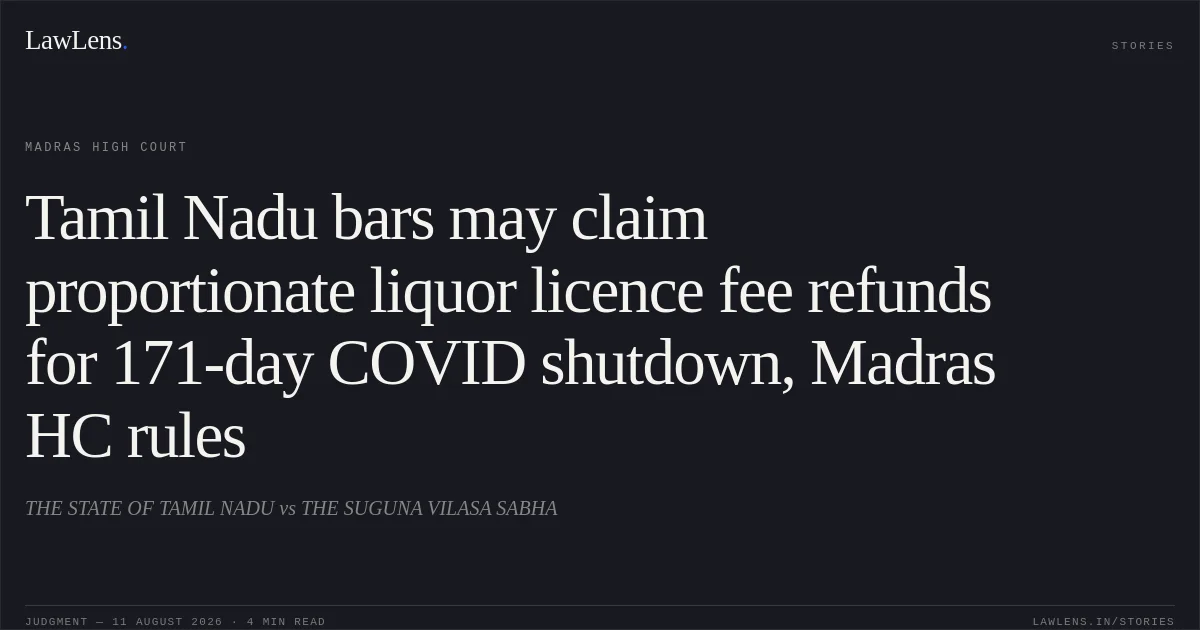
Source reference: paras. 30–32The governmental notifications showed that bars were shut from 17 March 2020 until their reopening was permitted in August/September 2020, resulting in a closure period of 171 days, whereas certain hospitality services continued subject to restrictions.
Source reference: paras. 27–30Since the respondents’ inability to transact business during that period resulted from governmental compulsion and not from their default, the Court considered limited refund or adjustment equitable, notwithstanding the absence of licence surrender.
Source reference: paras. 30–32Holding
The writ appeals were allowed, and the Single Judge’s orders dated 25 July 2023 were set aside.
The Court held that the proviso to Rule 24-A is not an independent provision and does not permit proportionate refund without surrender of the licence as a matter of statutory right.
Source reference: paras. 21–25Nevertheless, on equitable grounds, the respondents were granted liberty to claim refund or adjustment of licence and privilege fees for 171 days only, corresponding to the period during which the bars were compulsorily closed because of COVID-19 restrictions, subject to proof that no business was transacted during that period.
Source reference: paras. 30–33The respondents were directed to submit claim petitions to the Commissioner of Prohibition and Excise within two weeks, and the Commissioner was directed to decide the claims on merits and in accordance with law, preferably within twelve weeks of receiving the claims and supporting evidence.
Source reference: para. 33No order as to costs was made, and the connected miscellaneous petitions were closed.
Source reference: para. 33Acts & Sections Cited
8 provisions across 2 statutes referred to in this judgment. Linked provisions open on LawLens.
Tamil Nadu Prohibition Act, 19377
Tamil Nadu Buildings (Lease and Rent Control) Act, 19601
Original Court PDF
THE STATE OF TAMIL NADUvsTHE SUGUNA VILASA SABHA
Click to open original judgment
Original judgment, available to read, download and summarize on LawLens.in