Facts
The assessee appealed under Section 260A of the Income Tax Act, 1961, against a common ITAT order dated 31 July 2009 concerning assessment year 2006–07.
Source reference: p. 2–3The High Court had admitted four substantial questions of law concerning the head of assessment for mutual-fund interest and commission income, carry-forward of short-term capital loss, allowability of interest expenditure under Section 14A, and whether the Tribunal could decide an issue not before it.
Source reference: p. 2–3During the appeals, insolvency proceedings against the assessee culminated in a Supreme Court judgment allowing withdrawal of the CIRP under Section 12A of the Insolvency and Bankruptcy Code, 2016.
Source reference: p. 3–6The Supreme Court subsequently considered objections by the Income Tax Department and made orders addressing protection of the Department’s interests while leaving its claim to be established in the proceedings before it.
Source reference: p. 3–6Issues
1. Whether interest and commission income from subscriptions to mutual funds was assessable as “income from other sources” rather than “profits and gains from business or profession”.
Source reference: p. 32. Whether the assessee was entitled to carry forward its short-term capital loss.
Source reference: p. 33. Whether interest expenditure claimed as cost of improvement was disallowable under Section 14A.
Source reference: p. 34. Whether the Tribunal could decide the allowability of interest expenditure when that issue was not before it for adjudication.
Source reference: p. 3Law Applied
Section 260A of the Income Tax Act provides for appeals to the High Court on substantial questions of law; the Court did not decide the substantive tax questions raised under that provision.
Source reference: p. 2–3, p. 6The proceedings before the Supreme Court arose under Section 12A of the Insolvency and Bankruptcy Code, read with Regulation 30 of the 2016 Regulations.
Source reference: p. 4–5In addressing the Department’s objections, the Supreme Court stated that a settlement arrangement receiving judicial sanction could not be frustrated by subsequent claims of statutory authorities, referring to Ghanashyam Mishra & Sons (P) Ltd. v. Edelweiss Asset Reconstruction Co. Ltd., (2021) 9 SCC 657, and Embassy Property Developments (P) Ltd. v. State of Karnataka, (2020) 13 SCC 308.
Source reference: p. 4–5It also held that the Department’s claim had not been extinguished, compromised, or adjudicated, and that attachment of assets and deposit of sale proceeds in an interest-bearing fixed deposit protected the Department’s interests.
Source reference: p. 6Reasoning
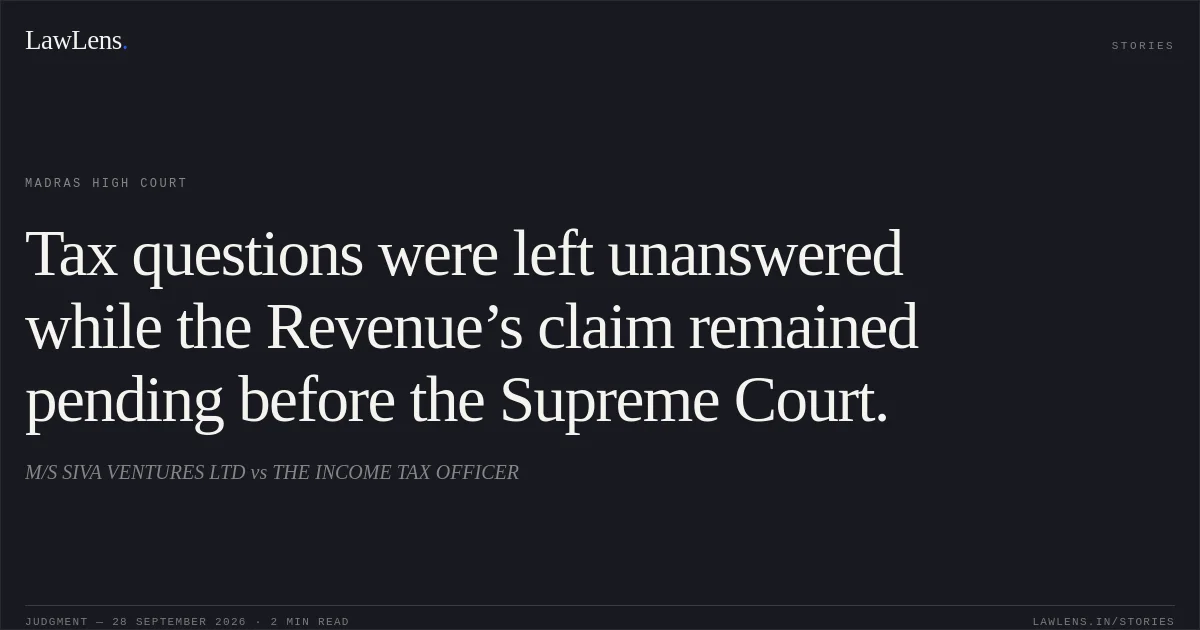
The High Court noted that the Supreme Court was overseeing the settlement and sale process and that the Department’s claim remained for determination in those proceedings.
Source reference: p. 5–6Because the Supreme Court’s orders had protected the Department’s interests and the claim had not been adjudicated or extinguished, the High Court considered itself not called upon to determine the admitted tax questions in these appeals.
Source reference: p. 5–6It therefore left the substantive tax issues unanswered rather than deciding them on their merits.
Source reference: p. 6Holding
The Court returned all four substantial questions of law unanswered and disposed of the tax appeals in light of the proceedings before the Supreme Court.
It granted the parties liberty to seek revival of the appeals if necessary and made no order as to costs.
Source reference: p. 7Acts & Sections Cited
3 provisions across 1 statute referred to in this judgment. Each provision opens on LawLens.
Insolvency and Bankruptcy Code, 2016.3
Original Court PDF
M/S SIVA VENTURES LTDvsTHE INCOME TAX OFFICER
Click to open original judgment
Original judgment, available to read, download and summarize on LawLens.in