Facts
The petitioner, an Assistant Teacher (L.B.) posted at Government Primary School, Karra, Block Masturi, challenged the transfer order dated 4 June 2025.
Source reference: para. 1–2Under the teacher-rationalisation policy, he was transferred from Government Primary School, Karra, Limtara, Masturi, to Government Primary School, Chisda, Masturi.
Source reference: para. 1–2He contended that the transfer was unsupported by proper justification, contrary to the applicable rationalisation and transfer norms, and caused him hardship.
Source reference: para. 1–2The State opposed the petition, relying on the Division Bench judgment in Shashi Shrivastava v. State of Chhattisgarh & Others, WA No. 674 of 2025, decided on 18 September 2025, and submitted that teacher-rationalisation instructions were only guidelines and that transfer was an incident of service.
Source reference: para. 3–4Issues
Whether the petitioner’s transfer order dated 4 June 2025 was liable to be quashed for allegedly violating the norms under the teacher-rationalisation and transfer policy
Source reference: para. 1–2Whether the Court should interfere with the transfer order on the ground of hardship or alleged non-compliance with rationalisation guidelines, absent mala fides, lack of competence, or violation of statutory rules
Source reference: para. 3–5Law Applied
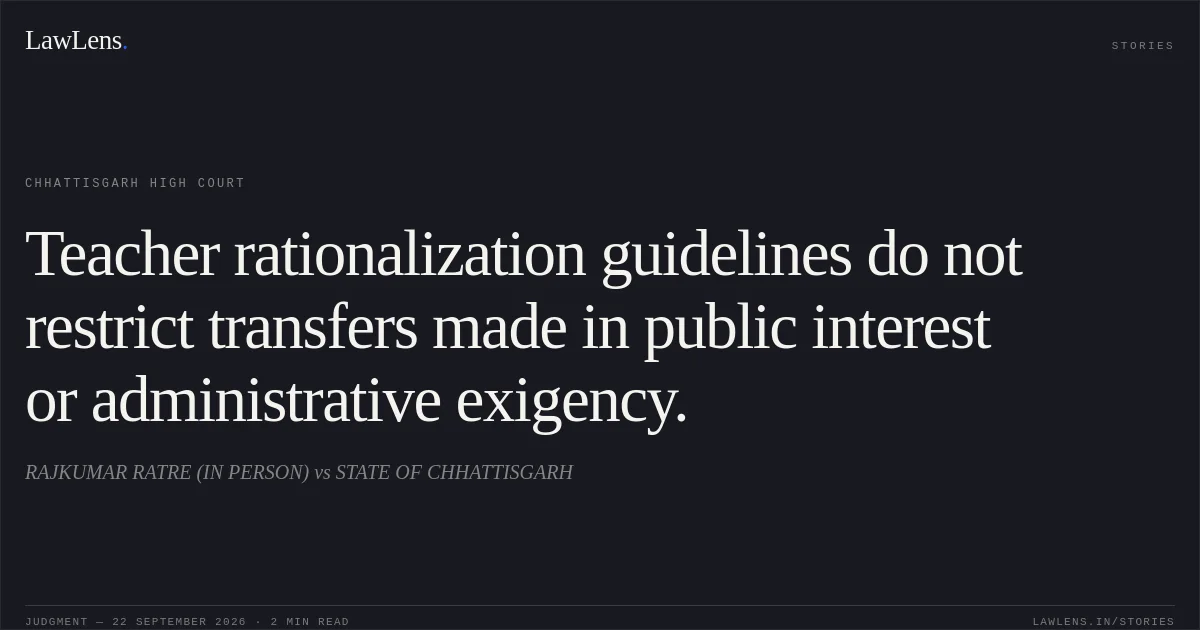
The Court applied the principle that transfer or posting is an incident of service and ordinarily lies within the employer’s administrative discretion.
Source reference: para. 3Teacher-rationalisation instructions are merely guidelines and cannot override the employer’s statutory power to post an employee in public interest or administrative exigency.
Source reference: para. 3Judicial interference with a transfer order is warranted only where there is established mala fide, lack of authority or competence in the officer issuing the order, or infringement of statutory rules and regulations.
Source reference: para. 3The Court further followed the binding approach adopted in the same writ appeal concerning rationalisation-related transfers.
Source reference: para. 5Reasoning
The Court found that the facts and legal issue in the present petition were identical to those considered by the Division Bench in Shashi Shrivastava.
Source reference: para. 5Applying the principle that rationalisation guidelines do not restrict the employer’s general power of transfer, the Court declined to interfere merely because the petitioner alleged hardship or non-compliance with policy norms.
Source reference: para. 3–5The petitioner did not establish mala fides, lack of competence of the authority passing the order, or violation of any statutory rule or regulation.
Source reference: para. 3–5Consequently, the Court considered itself bound to adopt the same view as in WA No. 674 of 2025.
Source reference: para. 3–5Holding
The Court held that the petitioner was not entitled to judicial interference with the impugned transfer order.
Finding the present case identical to WA No. 674 of 2025, the Court dismissed the writ petition in terms of the order dated 18 September 2025 passed in that appeal.
Source reference: para. 5–6No separate relief was granted to the petitioner.
Source reference: para. 5–6Original Court PDF
RAJKUMAR RATRE (IN PERSON)vsSTATE OF CHHATTISGARH
Click to open original judgment
Original judgment, available to read, download and summarize on LawLens.in