Facts
The Petitioner, a 78-year-old resident of Village Garhwat, filed a writ petition seeking a writ of mandamus against the State authorities.
Source reference: p. 1-2He alleged that Respondent No. 10 (a Patwari) had raised illegal constructions and encroachments over a public road, causing a nuisance.
Source reference: p. 2, para 2The Petitioner claimed that while the Gram Panchayat Garhwat had passed a resolution regarding this illegal construction, no enforcement action had been taken by the revenue officials.
Source reference: p. 3, para 3The State clarified that the matter was currently pending adjudication before the Tehsildar.
Source reference: p. 3, para 4Issues
1. Whether the High Court should intervene under Article 226 to direct the removal of encroachments when a statutory proceeding is already pending before the revenue authority.
Source reference: p. 4, para 52. Whether the procedure for removal of obstructions on State-vested land as prescribed under the Panchayat Raj Adhiniyam was being followed.
Source reference: p. 3, para 4Law Applied
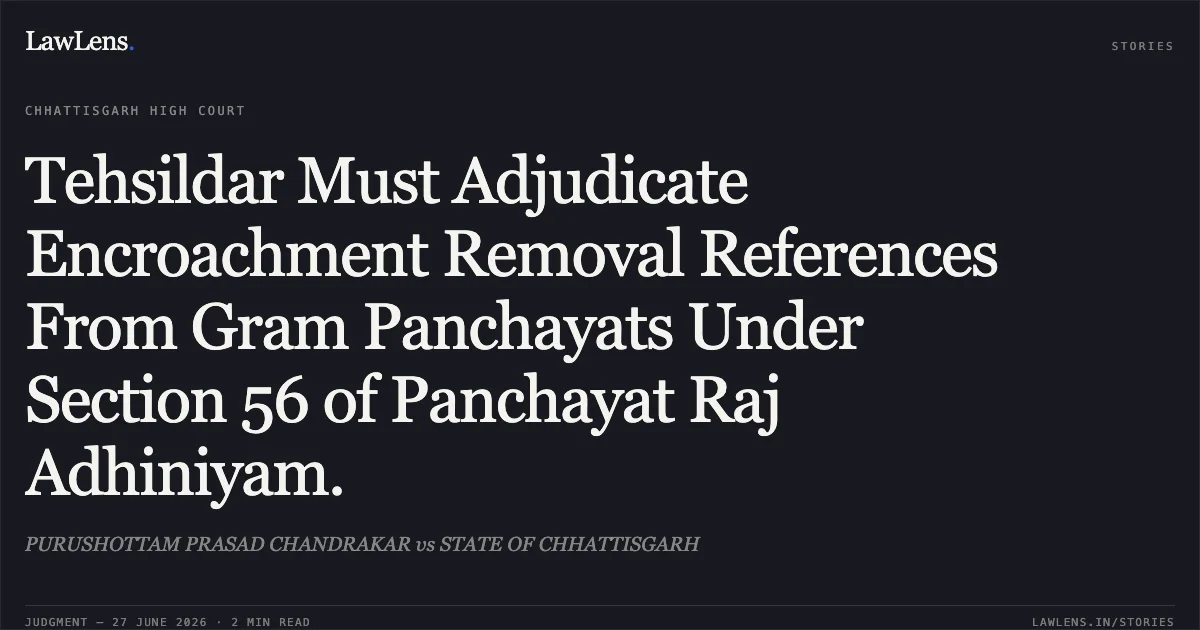
The court primarily applied the proviso to Section 56(2) of the Chhattisgarh Panchayat Raj Adhiniyam.
Source reference: p. 3, para 4This provision stipulates that if a Gram Panchayat resolves to remove hindrances or encroachments on land vested in the State Government, it may refer the matter to the Tehsildar; the Tehsildar is then mandated to proceed with the removal of such encroachments under the provisions of the Chhattisgarh Land Revenue Code, 1959.
Source reference: p. 3-4, para 4Reasoning
The Court examined the Petitioner’s grievance regarding the lack of action against Respondent No. 10 despite a Panchayat resolution.
Source reference: p. 3, para 3It took note of the State’s submission that the Matter was already seized by the Tehsildar under the statutory framework provided by the Adhiniyam.
Source reference: p. 3, para 4The Court reasoned that since a specific legal remedy was already in motion—where the Gram Panchayat refers the matter to the Tehsildar for enforcement under the Land Revenue Code—judicious interference required the Petitioner to pursue that specific remedy to its conclusion.
Source reference: p. 4, para 5The Court found that a direction for expeditious disposal by the lower authority was more appropriate than a direct order for demolition at the writ stage.
Source reference: p. 4, para 5Holding
The appropriate course of action was for the Petitioner to pursue the pending remedy before the Tehsildar.
The Court disposed of the petition without granting the direct reliefs for removal or removal of officers, and directed the concerned Tehsildar to pass an appropriate order in accordance with the law in an expeditious manner.
Source reference: p. 4, para 5, 6Acts & Sections Cited
1 provisions across 1 statute referred to in this judgment. Linked provisions open on LawLens.
Panchayat Raj Adhiniyam1
Original Court PDF
PURUSHOTTAM PRASAD CHANDRAKARvsSTATE OF CHHATTISGARH
Click to open original judgment
Original judgment, available to read, download and summarize on LawLens.in