Facts
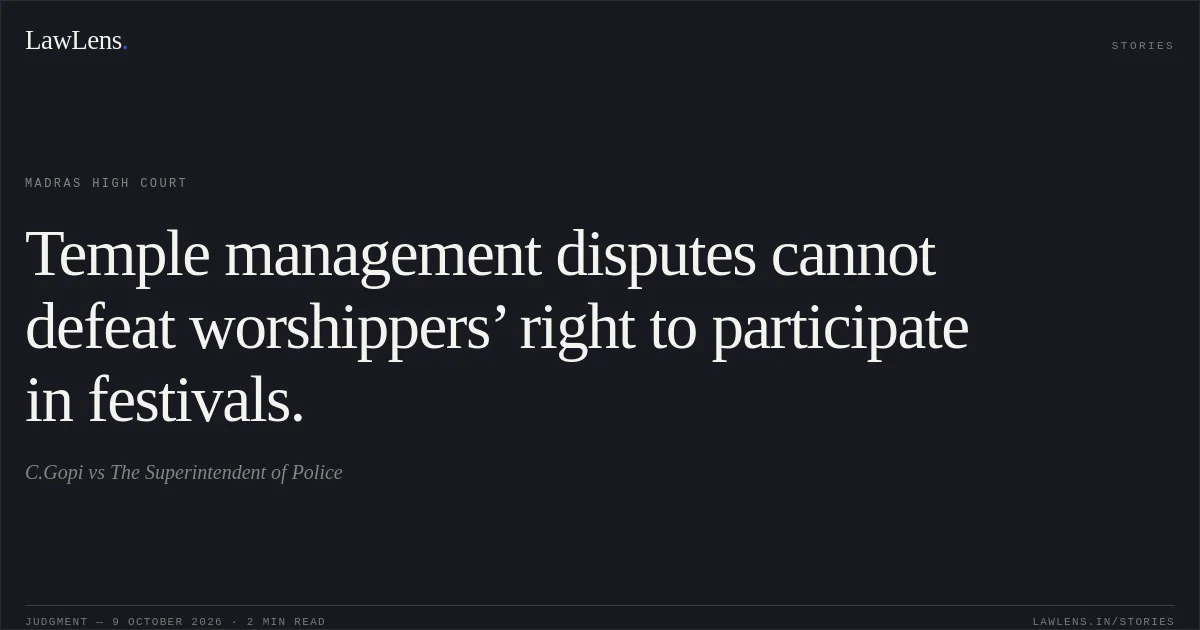
The petitioners claimed to be members of the committee managing an ancient temple dedicated to Arulmigu Sri Mariyamman and Arulmigu Sri Maha Muniyappan at Sellipalayam.
Source reference: paras. 2–5, pp. 2–4A dispute between them and the fifth respondent over temple management and collection of donations had led the Tahsildar to direct in 2022 that the festival not be held until the dispute was resolved.
Source reference: paras. 2–5, pp. 2–4After mediation again failed, the Tahsildar issued an order dated 11 August 2026 preventing the proposed festival for 2026.
Source reference: paras. 2–5, pp. 2–4The petitioners sought to challenge that order and obtain police protection for the festival planned from 23 October to 14 November 2026.
Source reference: paras. 2–5, pp. 2–4The fifth respondent disputed the petitioners’ management claim and argued that the dispute should be decided by a civil court; the State supported the Tahsildar’s decision on public-order grounds.
Source reference: paras. 7–8, p. 5Issues
Whether the proposed temple festival should be prevented because of the inter se dispute over temple management.
Source reference: paras. 3–5, pp. 3–4; para. 10, p. 5Whether the authorities should facilitate the festival and ensure its peaceful conduct, notwithstanding that dispute.
Source reference: paras. 4–5, pp. 3–4; para. 11, pp. 5–6Law Applied
The judgment identifies no specific statutory provision or precedent as the basis for its decision.
Source reference: no citationIt applies the principle that a dispute over temple management should not, in the circumstances of this case, deprive the worshipping public of participation in the temple festival.
Source reference: paras. 10–11, pp. 5–6It also places responsibility on the public authorities to manage the festival and maintain law and order so that the public may participate peacefully.
Source reference: paras. 10–11, pp. 5–6Reasoning
The Court noted that the temple’s existence and antiquity were undisputed and that the management dispute had halted the traditional festival for nearly half a decade, depriving worshippers of the opportunity to participate.
Source reference: para. 10, p. 5Because the Tahsildar’s mediation efforts had failed, the Court considered that continuing to defer the festival would allow the parties’ management dispute to override the worshippers’ interests.
Source reference: paras. 10–11, pp. 5–6It therefore directed the Tahsildar to take charge of the festival, with assistance from the jurisdictional HR&CE Inspector if needed, and directed the police to maintain order.
Source reference: paras. 10–11, pp. 5–6Holding
The Court disposed of the writ petition and directed that the temple car festival be conducted from 23 October to 14 November 2026.
The Tahsildar was made responsible for its conduct; all villagers, irrespective of caste, community, or gender, were entitled to participate; and the police were directed to maintain law and order and act against anyone disturbing the festival.
Source reference: para. 11, pp. 5–6The connected miscellaneous petition was closed.
Source reference: para. 12, p. 7Original Court PDF
C.GopivsThe Superintendent of Police
Click to open original judgment
Original judgment, available to read, download and summarize on LawLens.in