Facts
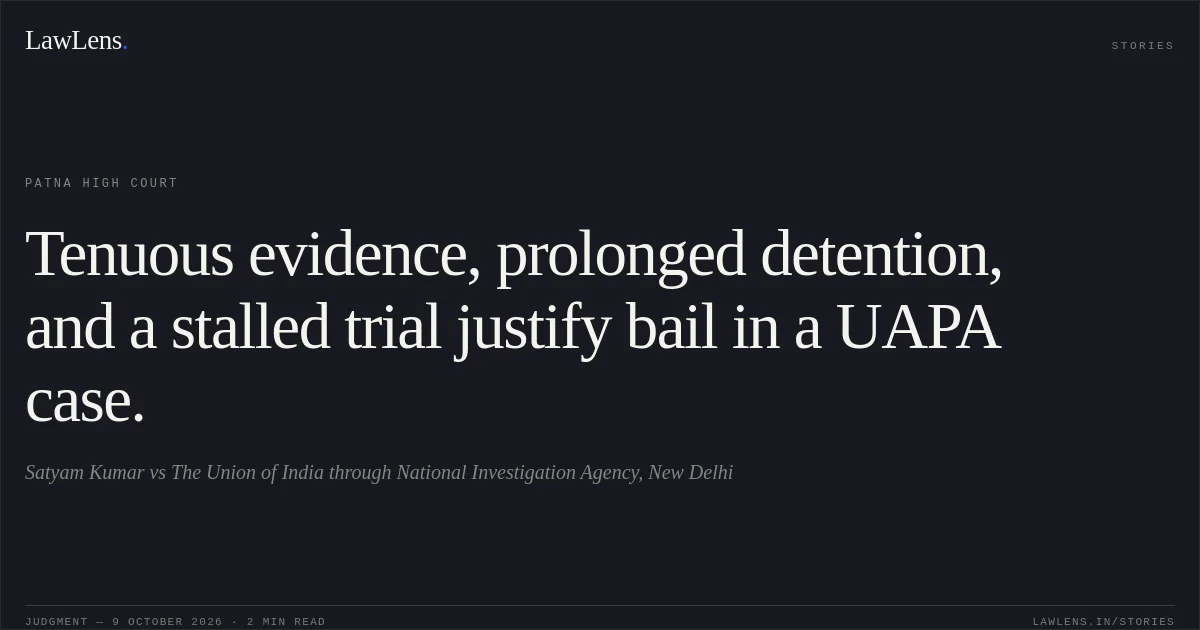
The appellant challenged the Special Judge, NIA, Patna’s order dated 11 May 2026 rejecting his bail application in a case arising from the alleged recovery of an AK-47 rifle and cartridges, registered under the Arms Act, the IPC and the UA(P) Act.
Source reference: pp. 1–2, 5The prosecution alleged that the appellant was apprehended with co-accused Vikash Kumar and that a rifle concealed by another accused was later recovered.
Source reference: pp. 6–9The NIA stated that the appellant had travelled to Dimapur with Vikash, his cousin, but acknowledged that it had found no financial transaction between the appellant and the co-accused and no digital connection in the analysed call-detail records.
Source reference: pp. 6–9On examining the case diary, the Court noted that the record did not show a seizure list documenting recovery of a lens from the appellant at the railway station, and that the only material specifically connecting him to the co-accused was the Dimapur visit.
Source reference: pp. 9–12The appellant had been in custody since 7 May 2024; at the time of decision, only two of 91 charge-sheet witnesses had been examined, and he had no criminal antecedents.
Source reference: pp. 5, 12Issues
1. Whether the record disclosed a sufficient connection between the appellant and the alleged offences to justify continued detention and refusal of bail.
Source reference: pp. 9–122. Whether the appellant’s period in custody and the limited progress of the trial supported release on bail.
Source reference: p. 12Law Applied
The case involved charges under Sections 25(1-AA), 26 and 35 of the Arms Act, Section 120B of the IPC, and Sections 13, 16 and 18 of the UA(P) Act.
Source reference: pp. 1, 5–7The judgment cites no precedent and does not expressly set out a statutory bail test. Its reasoning assesses the material connecting the appellant to the alleged offences, alongside the length of custody, progress of the trial and absence of criminal antecedents, in deciding whether continued detention was justified.
Source reference: p. 12Reasoning
The Court found the NIA’s case against the appellant materially weaker than its case against other accused: there was no financial or digital link, no seizure list showing recovery of the lens from him at the railway station, and no recorded confessional statement by him implicating himself.
Source reference: pp. 9–12The case diary indicated that the lens was seized later at another location, while the prosecution’s account of the sequence of disclosures and recovery was not borne out by the record.
Source reference: pp. 9–12The appellant’s single trip to Dimapur with his cousin was the only material identified as connecting him to the co-accused.
Source reference: pp. 9–12Weighing that limited material against more than two years and five months in custody, the examination of only two of 91 witnesses, and the absence of antecedents, the Court concluded that bail was warranted.
Source reference: pp. 9–12Holding
The Court allowed the appeal, set aside the order refusing bail, and directed the appellant’s release on a bond of ₹25,000 with two sureties of the like amount, to the satisfaction of the Special Judge, NIA, Patna.
The appellant must attend every trial date and may not leave India without the Court’s permission; any passport must be deposited with the trial court.
Source reference: pp. 12–13Acts & Sections Cited
6 provisions across 2 statutes referred to in this judgment. Each provision opens on LawLens.
Arms Act, 19593
Unlawful Activities (Prevention) Act, 19673
Original Court PDF
Satyam KumarvsThe Union of India through National Investigation Agency, New Delhi
Click to open original judgment
Original judgment, available to read, download and summarize on LawLens.in