Facts
The petitioner was appointed by the State Bank of India as a Junior Associate (CS & S) in the clerical cadre by appointment letter dated 23.07.2025 and joined at Hamirpur. His appointment was subject to a six-month probation period, satisfactory performance, and satisfactory verification of his character and antecedents.
Source reference: paras. 2, 11–13During the petitioner’s probation, two FIRs were registered against him under the Narcotic Drugs and Psychotropic Substances Act: FIR No. 329 of 2025 dated 05.12.2025 under Sections 21 and 29, and FIR No. 331 of 2025 dated 06.12.2025 under Section 21. He was arrested and subsequently released on bail on 20.01.2026 and 23.01.2026, respectively.
Source reference: paras. 3–4, 19–20The Bank terminated his services by order dated 22.01.2026, relying on the unsatisfactory character and antecedent verification report, the pending FIRs, his arrest and custody for 43 days, the alleged loss of trust and integrity, and an allegedly unsatisfactory report from the Branch Manager.
Source reference: para. 5The petitioner challenged the termination, contending that it was stigmatic and punitive because it was founded on the pending criminal cases and had been passed without notice, inquiry, or an opportunity of hearing.
Source reference: paras. 6–8Issues
Whether the termination of the petitioner during probation, based on the registration of FIRs and his arrest, was a termination simpliciter permissible under the appointment letter or a punitive and stigmatic termination founded on alleged misconduct?
Source reference: paras. 24–30Whether the Bank could terminate the petitioner without conducting a departmental inquiry or giving him an opportunity of hearing when the FIRs were registered after he had joined the Bank?
Source reference: paras. 21–30Whether the principles applicable to termination of probationers for suppression of pre-existing criminal antecedents applied to the petitioner’s case?
Source reference: paras. 21–23Law Applied
The Court applied the settled distinction between termination simpliciter of a probationer for unsuitability and punitive termination founded on misconduct.
Source reference: para. 16Under the principles stated in Sarita Chaudhary v. High Court of Madhya Pradesh, Parshotam Lal Dhingra v. Union of India, Samsher Singh v. State of Punjab, Anoop Jaiswal v. Union of India, and Dipti Prakash Banerjee v. Satyendra Nath Bose National Centre for Basic Sciences, a probationer may ordinarily be discharged without an inquiry if the termination is based on unsuitability or unsatisfactory performance; however, if the termination is founded on misconduct or contains stigma affecting future employment, a reasonable opportunity of hearing and the applicable inquiry safeguards are required.
Source reference: paras. 25–27The Court also considered Kendriya Vidyalaya Sangathan v. Ram Ratan Yadav and Kamal Nayan Mishra v. State of Madhya Pradesh, which permit termination of a probationer without inquiry where the employee suppressed or falsely disclosed criminal antecedents existing before appointment; the Court held that those decisions concerned pre-appointment conduct and concealment, not criminal cases arising after joining service.
Source reference: paras. 17–18, 21–23Reasoning
The Court found that the petitioner’s six-month probation and the Bank’s contractual power to assess his suitability did not, by themselves, authorise a punitive termination without procedural safeguards.
Source reference: paras. 11–14, 26Although the termination order referred to the Branch Manager’s unsatisfactory report, the Court held that the real foundation of the order was the registration of the two NDPS FIRs, the petitioner’s arrest, his period of custody, and the resulting alleged loss of trust and integrity—not an independent assessment that his work performance was unsatisfactory.
Source reference: paras. 5, 28–30Since both FIRs were registered after the petitioner had joined the Bank, there was no suppression of pre-existing criminal antecedents and the principles in Ram Ratan Yadav and Kamal Nayan Mishra were inapplicable.
Source reference: paras. 19–23The termination therefore operated on the basis of alleged misconduct and carried stigma capable of affecting the petitioner’s future career. In the absence of an inquiry or opportunity to respond, the order was held to be punitive and legally unsustainable.
Source reference: paras. 24–30Holding
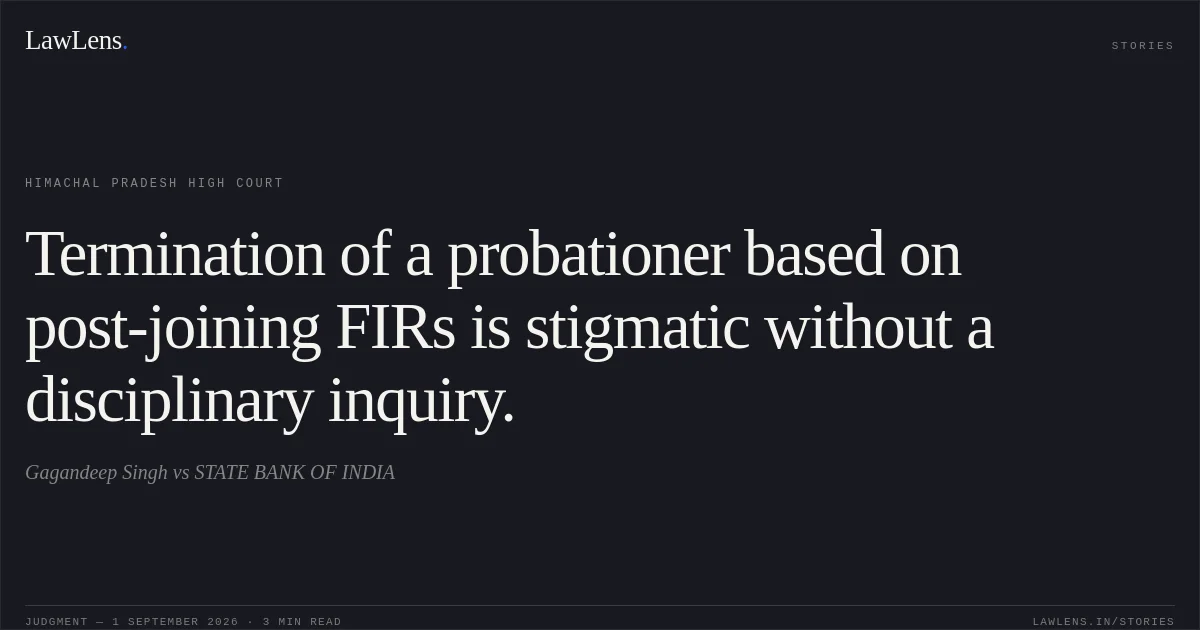
The Court held that the petitioner’s termination during probation was not a mere termination simpliciter for unsuitability; it was a stigmatic and punitive termination founded on the subsequent registration of criminal cases and his arrest.
The Bank could not rely on the doctrine applicable to suppression of pre-appointment criminal antecedents, because the FIRs arose after the petitioner joined service.
Source reference: paras. 21–30The writ petition was allowed, and the termination order dated 22.01.2026 and the consequential order dated 10.03.2026 were quashed and set aside, with consequential benefits. However, the Bank was permitted to proceed afresh against the petitioner in accordance with law.
Source reference: para. 31Acts & Sections Cited
2 provisions across 1 statute referred to in this judgment. Each provision opens on LawLens.
Narcotic Drugs and Psychotropic Substances Act, 19852
Original Court PDF
Gagandeep SinghvsSTATE BANK OF INDIA
Click to open original judgment
Original judgment, available to read, download and summarize on LawLens.in