Facts
The respondent was appointed as an Assistant Central Intelligence Officer Grade-II in the Intelligence Bureau on January 16, 2023.
Source reference: para. 1While on probation, his services were terminated on February 15, 2024, via an "innocuous" order invoking Rule 5(1) of the CCS (Temporary Services) Rules, 1965.
Source reference: para. 2, 4Upon perusing the petitioner’s internal files in a sealed cover, the CAT discovered that the termination was founded on specific allegations of misconduct, including illegally facilitating immigration clearance at IGI Airport, suspected corruption, and acquiring disproportionate assets.
Source reference: para. 4The CAT quashed the termination, leading the Union of India to file this writ petition.
Source reference: para. 5-7Issues
1. Whether the termination of a probationer, though couched in innocuous language, becomes punitive and requires a formal inquiry if it is founded upon specific allegations of misconduct.
Source reference: para. 9, 142. Whether the court can "lift the veil" to determine if the foundation of a termination order is suitability or misconduct.
Source reference: para. 5, 15Law Applied
Rule 5(1) of the CCS (Temporary Services) Rules, 1965.
Source reference: para. 2While a probationer's services can be terminated for general "unsuitability," a termination "founded" on misconduct is punitive and violates natural justice if no inquiry is held.
Source reference: para. 5, 9Principle in Chander Praksh Shahi v. State of UP, which distinguishes between the "motive" and the "foundation" of a termination.
Source reference: para. 10Principles from Parshotam Lal Dhingra v. Union of India and State of Bihar v. Gopi Kishore Prasad regarding the rights of temporary servants against punitive discharge without due process.
Source reference: para. 10Reasoning
The High Court observed that while the termination order appeared to be a termination simpliciter on its face, the internal departmental notings revealed a direct "foundation" of serious misconduct rather than a mere assessment of performance.
Source reference: para. 4, 14The court distinguished the present case from Pavnendra Narayan Verma v. Sanjay Gandhi PGI, noting that in Pavnendra, termination was based on "unsatisfactory" service (which is not stigmatic), whereas here, the allegations—corruption and illegal immigration facilitation—are "extremely serious".
Source reference: para. 12-14The Court reasoned that when such allegations form the basis of the decision, the "veil" must be lifted to ensure the employer is not bypassing constitutional protections/disciplinary procedures by using a summary termination rule.
Source reference: para. 14-15Holding
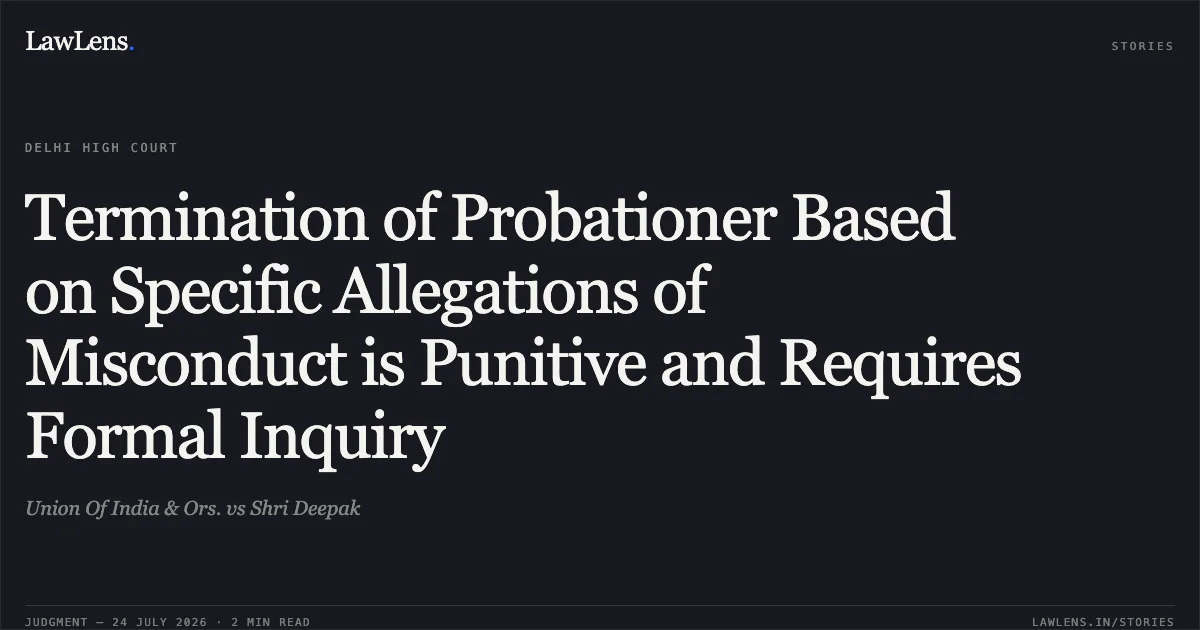
Because the allegations of misconduct constituted the "foundation" of the termination, the petitioner was legally required to provide a show-cause notice and conduct a proper departmental inquiry in accordance with the principles of natural justice.
The Court dismissed the writ petition, upholding the CAT's order to reinstate the respondent with consequential benefits, though the Court granted the petitioners liberty to initiate fresh disciplinary proceedings in accordance with the law.
Source reference: para. 16-17, 6, 18Original Court PDF
Union Of India & Ors.vsShri Deepak
Click to open original judgment
Original judgment, available to read, download and summarize on LawLens.in