Facts
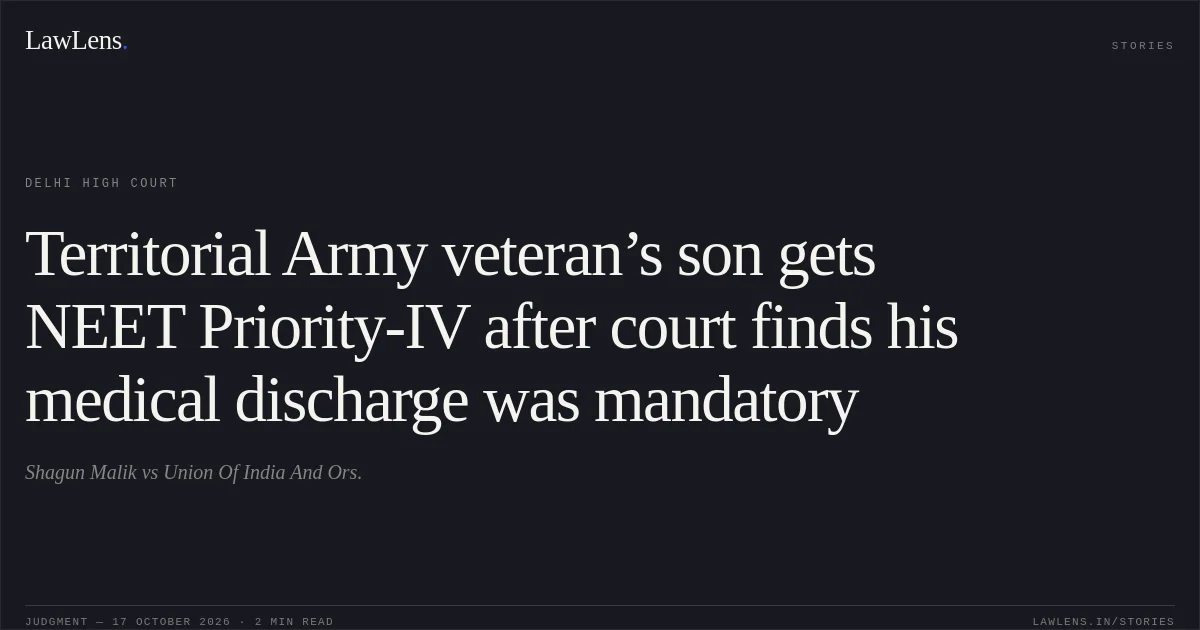
The petitioner, a NEET (UG) 2026 candidate, sought consideration under Priority-IV for MBBS/BDS Central Pool allotment as the son of a retired Territorial Army Naik. His father sustained an injury during military duty, was placed in Permanent Low Medical Category, and was assessed as having a 30% disability attributable to military service.
Source reference: para. 2–3The Zila Sainik Board issued an eligibility certificate under Priority-IV, but the respondents later classified the petitioner under Priority-VI, reasoning that his father had been released at his own request rather than boarded out.
Source reference: para. 4–5The petitioner challenged that decision under Article 226.
Source reference: para. 1Issues
1. Whether the petitioner’s father’s release from Territorial Army service, in light of his Low Medical Category status and length of embodied service, prevented the petitioner from qualifying under Priority-IV.
Source reference: para. 12–192. Whether the respondents’ reliance on the SOP dated 1 July 2020, rather than the Territorial Army scheme dated 17 January 2011, justified classifying the petitioner under Priority-VI.
Source reference: para. 10–11, 18–20Law Applied
The Court applied the Territorial Army scheme dated 17 January 2011, which governed personnel serving in the Territorial Army.
Source reference: para. 12It held that paragraph 7 required discharge of a soldier who became Low Medical Category after completing more than 15 years of embodied service, or upon completing 15 years of total embodied service after retention; paragraph 5 recorded that Territorial Army units had no sheltered appointments.
Source reference: para. 14–15The Court distinguished the respondents’ reliance on the SOP dated 1 July 2020 and the decision in Master Athrava Trupathi & Anr. v. Union of India & Ors., W.P.(C) 4338/2025, because that case did not concern Territorial Army personnel or the 2011 scheme.
Source reference: para. 18, 20Reasoning
The Court found that the father’s injury occurred while performing bona fide military duty, and that he had become Low Medical Category after completing more than 15 years of embodied Territorial Army service.
Source reference: para. 13, 16Under paragraph 7 of the applicable scheme, his discharge was required; accordingly, whether he had submitted an application for voluntary retirement was immaterial to the Priority-IV determination.
Source reference: para. 17The Court therefore concluded that the respondents’ reliance on the “own request” ground and the 2020 SOP did not support the Priority-VI classification.
Source reference: para. 18–19Holding
The Court allowed the petition and directed that the petitioner be treated as belonging to Priority-IV and accommodated against a seat, subject to availability.
The respondents were directed to communicate seat availability to the petitioner within 10 days of the order’s upload.
Source reference: para. 21The petition was disposed of accordingly.
Source reference: para. 22Original Court PDF
Shagun MalikvsUnion Of India And Ors.
Click to open original judgment
Original judgment, available to read, download and summarize on LawLens.in